Welcome to The Weekly Scroll!
The Weekly Scroll is a once-a-week roundup of the most interesting, strangest, and funniest stories from around the social internet.
This week, we’re talking about a nasty attack ad in Ohio, more cross-cultural battles on Twitter, and a surprising guest on Subway Takes.
Vivek October surprises himself
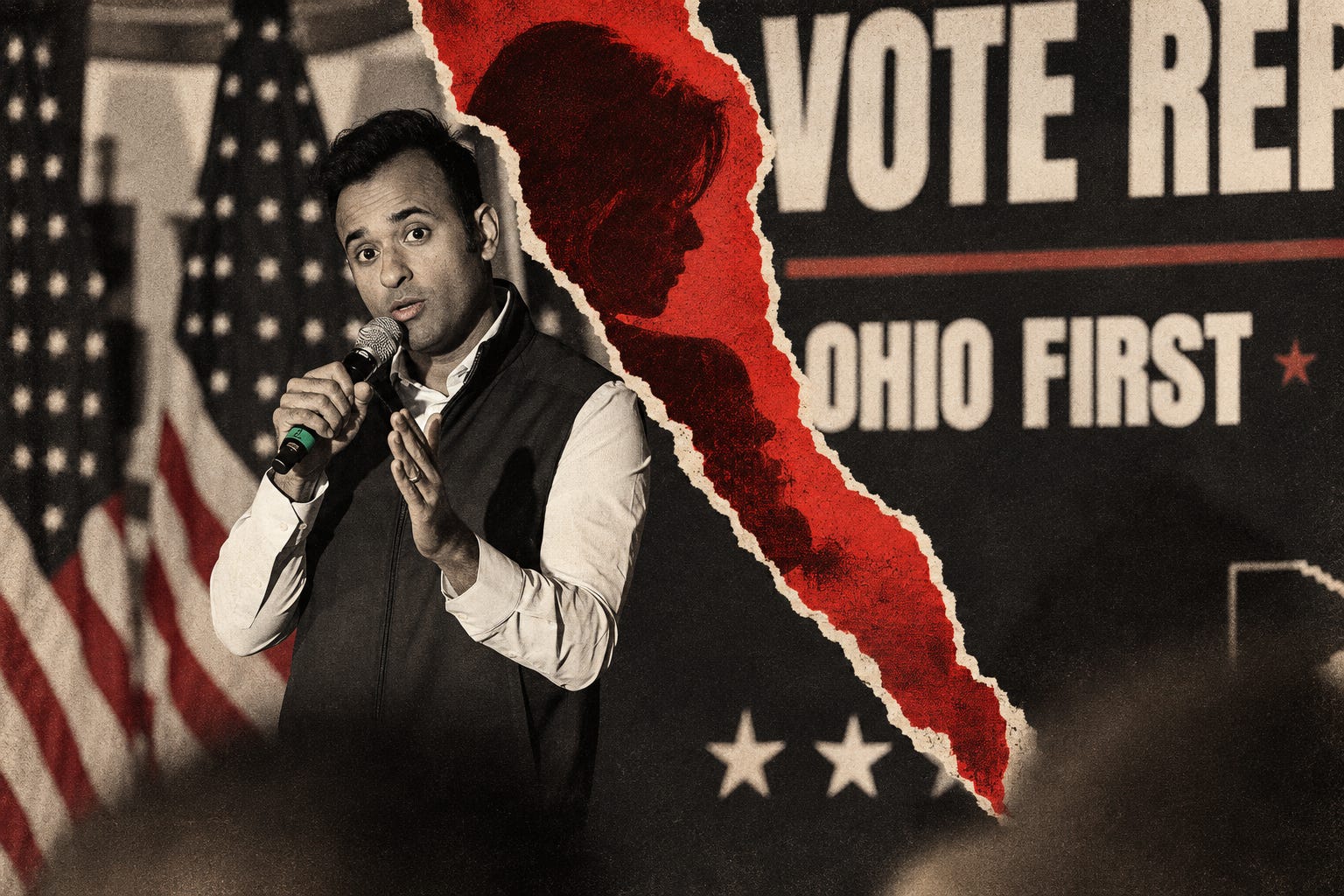
The bar for campaign attack ads has sunk unbelievably low, but Ohio gubernatorial nominee Vivek Ramaswamy, the Republican previously best known for being so insufferable that even Elon Musk wouldn’t hang out with him,1 has somehow failed to clear it.
Earlier this week, the Ramaswamy campaign released an ad in which the Democratic nominee, Amy Acton, is assailed by her own mother, Donna Arthur. Arthur says that her daughter is a liar and implies she has mental health issues.
What makes the ad so egregious is that Acton’s legitimate cause for estrangement from her mother is a matter of public record: She accused her stepfather of sexually abusing her when she was 12 years old, and he was subsequently arrested and indicted for rape in 1978. Arthur lost custody of Acton and her younger brother, and the stepfather fled prosecution and died without ever having faced trial. All this time, Arthur stood by him and remained married to him until he died.
That’s the subtext that’s not immediately apparent in the ad: Ramaswamy’s campaign brought in Acton’s mother to call her a liar, and what she’s implying is that Acton lied about being molested as a 12-year-old.
Standing with a woman who allegedly failed to protect her daughter from sexual abuse is ... an interesting campaign tactic. Condemnations came in from both sides of the aisle. While Democrats predictably pilloried the ad, so did many Republicans: Ohio Gov. Mike DeWine, who has endorsed Ramaswamy, called the ad “wrong” and “deeply, deeply troubling” and said the campaign should withdraw it. Former South Carolina Gov. and presidential candidate Nikki Haley called Ramaswamy “a bad guy,” while Ohio Republican Sen. Jon Husted said he would not have run the ad.
Now, look. I’m not a professional campaign strategist. But when you’ve lost the moral high ground to Nick Fuentes, it might be time to re-examine your tactics. (Fuentes, who has long opposed Ramaswamy’s campaign and called him an “anchor baby,” may, of course, have had less savory reasons to join the dogpile.)
Ramaswamy’s attempt to spring an “October surprise” seems to have backfired, making him look cruel to anyone with a shred of humanity. Luckily for him, there are plenty of people in politics without even that shred. Plenty of pro-MAGA voices are standing behind the ad, with Ben Shapiro engaging in some both-sides-ism and both President Donald Trump and Vice President JD Vance directly defending the video.
Beyond the obvious shock value that a campaign would do something like this, there are a few things I find interesting about this episode. The first is that the ad wasn’t initially run on TV but instead circulated online. It was first leaked to the Ramaswamy-critical Ohio politics blog The Rooster, and from there, right-wing accounts like Walter Curt, Donald Trump Jr., and many others amplified it as a “bombshell” that would devastate Acton’s campaign. Ramaswamy’s team didn’t actually take credit for the ad right away.
The Rooster told CNN that it obtained the video from a voter who had seen it as part of a poll and recorded it. We know that the Ramaswamy campaign went to the trouble of finding Acton’s mother and filming a slick, professionally produced video with her. But then it only put it into a few push polls two weeks before the election? And it had to be discovered by an anti-Ramaswamy blogger by accident? Really?
Unfortunately for Team Ramaswamy, social media makes it much harder to keep this kind of thing under wraps. If you show a video to any appreciable number of people, someone’s going to film it and stick it online. This could also explain why it took nearly 24 hours for Ramaswamy’s team to even acknowledge it was the one who produced the ad.
This entire episode is another instance of the disarray we’re currently seeing in the Republican Party. Whether it’s the Acton ad, the fake Talarico conspiracy theory, or podcasters discussing the “Indian Question,” these are not the actions of a movement that’s confident in its position going into the 2026 midterm elections.
This is what you see from a flailing, frightened party anticipating a wipeout, desperately throwing anything it can at the public to see if it will stick.
Found in translation
Last week, we talked about Chinese and Brazilian leftists fighting on Twitter about whether leftism should promote gay rights or protest police brutality.
This week, we saw yet another international spat, with Japanese users sparring with a variety of Western accounts over piracy.
You can get a broad overview of the conflict by browsing the trend at this link, but the sharpest disagreements were over situations where Japanese intellectual property (anime, video games, manga, etc.) simply wasn’t available for legitimate purchase overseas. Even in those situations, Japanese users strongly condemned piracy:

Admittedly, “piracy is bad” is not the world’s hottest take. Piracy is illegal! And “but I want it” isn’t the most inspiring defense of breaking the law.
On the other hand: “This thing you want isn’t available… why not just give up?” is a particularly uncompelling argument to an American. The American way is to question hierarchies, protest dumb rules, and throw out systems that are illogical and broken. We Americans aren’t just going to give up if we want something we can’t get legally. It’s not in our nature. I think there’s a vast cultural gap here that no amount of bickering is going to solve.
The entire discussion is even more interesting because Western consumption of much contemporary Japanese culture began with piracy. Anime’s popularity was built on a culture of bootleg VHS subs in the ‘90s. Similarly, manga gained a foothold in Western markets with the aid of unauthorized “scanlations” before it was ever legally available. The anime streaming site Crunchyroll began as a piracy site, growing massively popular before transitioning into a paid, legitimate service. (It was eventually purchased by Sony for $1.175 billion.)
The fact that this cross-cultural conversation is even happening is something new. I hate to hand it to the Muskified version of Twitter, but the auto-translation feature has enabled a fascinating new form of discourse: Chinese users fighting with Brazilians, Turks engaging in a meme war with Chinese people, Iranians posting AI-generated Lego videos of Trump.
And now, Japanese users are fighting pretty much everyone about piracy. It’s one of the single most interesting things happening on social media right now. I have no idea if any of this is good, but it’s sure as hell got my attention.
The best episode of Subway Takes yet
Conan O’Brien is one of the comedy greats, and his instant rapport with the woman at the end of the video shows why

Your tax dollars are paying for kids to mainline YouTube slop
NBC News has a fantastic new story on kids and social media built around a very simple idea: Look at kids’ YouTube history and see what videos they’re watching during school hours:
To understand how much YouTube some students are viewing, NBC News reached out to parents across the country who had raised concerns about the spread of technology in schools and asked them to download their children’s site histories. Eleven agreed, sharing lists of links from students ranging from second to 12th grade. In a first-of-its-kind analysis, reporters examined more than 17,000 videos through a mix of AI and manual review. More than 95% of the videos, which include ads, were not educational. [Emphasis added]
The majority of the kids involved in the project had watched hundreds (or thousands) of videos during school hours. Few of those videos had any educational value at all. There’s a lot you could say here, but mostly: I don’t understand why anyone is surprised by this!
At a time when many schools are banning smartphones altogether and seeing positive results, others are just handing kids a direct portal to the most brain-rotted parts of the internet and letting them loose.
Social media, particularly short-form vertical video, is one of the most addictive technologies we’ve ever created. If you put it in the hands of a child and say, “Now only use this for history research and algebra homework, wink wink,” what did you think was going to happen?
Links
“Nobody Wants To Talk About Why The Ringer Is Pivoting To Substack.” An interesting piece that doesn’t reach any firm conclusions, but might point at where our media landscape is headed. The Ringer is a mostly sports, mostly podcast media outfit that has recently appeared to shift back toward written content. But, strangely, rather than setting up its own paywall on its own site, it’s just doing a bunch of separate Substacks. And there’s no bundled option allowing you to read all Ringer writers — you have to pay or subscribe separately for each one. Very odd.
There’s been a rash of politically questionable content moderation decisions recently. TikTok banned the account of Alex Gibney’s new documentary about Musk before claiming it was an error. Meta suspended the No Kings Instagram account during the No Kings protests and was also accused by Brazilian President Luiz Inácio Lula da Silva of interfering with his ability to post. Each of these incidents could be nefarious, or each could have a more innocent explanation. Part of the larger problem, given the size and influence of these platforms, is that it’s almost impossible to tell the difference.
“Online forum controlled by Nevada GOP House candidate contains slurs and Nazi talk.” “It wasn’t a couple of crazies. The popular sentiment was, ‘Yes, slavery should be legal,’” said one former member.
Something I missed a few weeks back: the NHL’s disastrous “Hot for Hockey” campaign targeting horny BookTok users. What could possibly go wrong?
Gym launches “thumb workout” in anticipation of Grand Theft Auto VI
Posts
Recommended reading:
It is, admittedly, very funny that Ramaswamy is so annoying he got DOGE’d out of DOGE before DOGE had even begun.