There is a midterm election coming up soon, as you have probably heard, and I am hoping that Democrats will do very well in it.
One reason for this is that due to the way our political system is constructed, the Democrats I have the biggest doubts about are definitely going to win no matter what. Melat Kiros and Darializa Avila Chevalier are coming to Congress even if Democrats underperform the current polling by 11 points or whatever. But there are a whole bunch of people who I really like — Josh Turek, Mary Peltola, Adam Hamilton, Bobby Pulido, Johnny Garcia, Jamie Ager, just to name a few — who will win their seats if and only if Democrats win by margins about as big as what Nate Silver is forecasting. Indeed, the slightly stupid way the House speaker election works means that if Democrats have a huge majority, then Hakeem Jeffries will be installed with no problem, but if it’s a very narrow majority, then the hard left can block him and hold the caucus hostage to their nutty ideas. If Democrats flip the Senate, then the big story will be the senators who flipped Senate seats — Turek, Peltola, Hamilton, Roy Cooper, Sherrod Brown, and James Talarico — but if they don’t, then it’s the Abdul El-Sayed Show.
But the other reason is that I really would like to see the spell of Trump mania come to an end. I don’t hold to Obama-in-2012 delusions that “the fever will break.” But there are just tons of conservative ideological causes and policy positions that keep getting dragged down by Trump’s bluster, corruption, and incompetence. Yet the leaders of those causes have spent the past few years taking the bet that working with Trump to try to consolidate authoritarian power is their best chance forward. I think a good midterm drubbing is the best opportunity to talk them out of that and into the idea that they should try to advance a 2028 candidate who’ll stand for right-of-center policy ideas but not stand for slavish devotion to personality cult politics and endless assaults on the rule of law.
Anyway, on to your questions.
Trisha Jha: Is the idea that prices communicate useful information and we mess with them at our peril the most hated insight of Econ 101?
This goes back to something I’ve noted before, which is that it would be useful in many cases to have a clearer index of exactly what the conventional wisdom is. My sense, personally, is that the fact that we mostly don’t see a lot of price control policies being implemented is evidence that the basic point about the value of prices is pretty well-understood.
My personal vote for a widely underrated Econ 101 insight is the explanation of why a certain class of policy ideas doesn’t scale up.
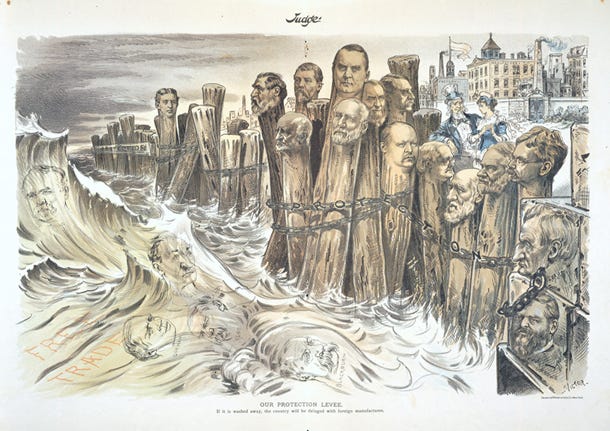
I write a Substack. If you created a cumbersome licensing system before other people were allowed to launch their own Substack, that would be narrowly good for me. Similarly, if it was illegal for Americans to read takes written by foreigners, that might also be good for me. Anything you can do with regulation, trade policy, immigration, or whatever else to block the supply of new takes helps the existing stock of takesmiths. This is pretty widely understood, and you see lots of examples of different groups of people clamoring for various sorts of protections and often getting them — or at least getting a serious hearing.
What Econ 101 tells you is that each of these moves imposes very small costs on a very large number of people, such that the aggregate costs exceed the benefits.
This means that while you can boost the fortunes of any given occupation by creating barriers to entry, doing so across a large fraction of occupations will end up making everyone worse off than if you hadn’t done it. You can help auto workers by imposing tariffs on foreign-made cars, but if you put tariffs on everything, then everyone is worse off. If you block new housing on Long Island, you can inflate home values and increase the wealth of incumbent homeowners, but if you block new housing in every desirable suburb of every city, the whole country will be much poorer on average.
What makes this insight powerful is that the people pushing for specific protections aren’t “wrong.”
When the Air Line Pilots Association pushes to maintain the unreasonable 1,500-hour rule for new pilots, they’re correct that this benefits their members. Keeping Waymo out of a city benefits Uber and Lyft. Blocking the importation of Canadian softwood lumber helps American loggers. But politicians who are sympathetic to these kinds of claims, normally because they are made by specific interest groups they like, are actually harming more people than they are helping.
A lot of progressive-minded people who in general put a great deal of stock in credentials and formal signifiers of expertise take a very dim view of the idea that economists have relevant expertise on economic policy questions or that mainstream consensus in the profession should generally be given more weight than the views of outliers. What tends to happen here is a kind of faux sophistication where people learn that according to Econ 101, all that Econ 101 stuff about market prices being optimal really only applies if you can assume a perfectly competitive market. Then you look around and it turns out that very few markets meet that standard. So you convince yourself that you can reject the Econ 101 points. The more prudent take is that since real-world markets are only approximately competitive, the Econ 101 models are only approximately true. But they are still offering a lot of insight relative to just guessing or making stuff up.
TW: It would be interesting to hear your detailed views in response to Martin Gurri’s book, “The Revolt of the Public and the Crisis of Authority in the New Millennium”? Much of the political instability in the U.S., and the see-sawing of voter preference between parties, is showing the same pattern in most of the major Western democracies, which means the forces driving this aren’t uniquely American. I thought Gurri’s analysis was prescient and illuminating. Do you agree?
Gurri is an interesting figure because he voted for Trump in 2024 but his whole analysis and register of speaking are closer to the dopey idealism of an academic leftist than the normal cruelty and cynicism of the MAGA right.
I put this answer under the Econ 101 one because I think it’s an illustration of the fact that in the real world you actually do need responsible elites to make technocratically sound policies. Otherwise, you get huge fuckups and people are angrier than ever. I don’t per se disagree with his structural analysis of how elite control over the discourse has weakened or that some aspects of this more democratized public square are normatively desirable. But if you look at problems like the weak American labor market from 2009-14 or the failures of European energy policy that were exposed when Russia invaded Ukraine, these are actually just failures of technocratic elites to do the technically correct thing. There are a lot of emotional aspects to the immigration policy debate in Germany, but the fact that the country never built the state capacity to remove people whose asylum claims are rejected is a really boring kind of failure. Voters understandably get angry at would-be technocrats who don’t govern effectively, but now in America we have Trump who is also not governing effectively, and people are angry about that.
Max Haas: You argue that the popularity of do-nothing governors is evidence against campaigning on bold change. While it’s true that voters don’t like “we’re gonna end police” levels of boldness in campaigns, I think you’re confusing what voters like their politicians to do (nothing) with what they *think* they want their politicians to do (something). Can you imagine, say, David Jolly actually saying in his ads “I will be doing nothing?” I don’t think you’d advise that.
So what are the things people like David Jolly and Ken Casner should run on? Or should they simply argue “I’ll make the legislature pump the brakes?”
It’s not that you want to say you’re not going to do anything. It’s that you want to take a relatively small number of relatively modest changes and make a big deal out of them. Gretchen Whitmer vowing to “fix the damn roads” or Trump characterizing some relatively mild changes to NAFTA as scrapping the whole thing strike me as two different kinds of examples of playing voters’ mixed feelings about this well.
Siddhartha Roychowdhury: You keep rejecting debates with FdB because you don’t like the format. Technically you had an interview with Mehedi, but why did you agree to that when you know that he’s a jackass and wouldn’t have a friendly conversation with you? You are argumentative in the written formats like X but you’re very polite in person and rarely become very confrontational in these scenarios. Do you regret doing that interview?
I’ve done a lot of podcasts with a lot of different hosts who I have a lot of different disagreements with, and honestly, I was taken aback by how hostile that interview was. I did not really think of my disagreements with Hasan as shouting across a huge political void. We both support the same candidate in the Michigan Senate race, for example, and while he was sharply critical of Kamala Harris’s approach to Gaza in 2024, he also argued that supporters of Palestine should vote for her and that Trump would be worse.
I am interested in trying to reach different audiences with my ideas, and I was not expecting to be treated as “the enemy” in that kind of way — very few podcasts operate on that format. I should have researched the show more thoroughly before agreeing to go on, and my advice to people in the future would be not to do it.
Sasha Gusev: Some popular 80% policies end up failing (assault weapons ban) and some unpopular 20% policies end up being durable (bush tax cuts). What are some 80% policies Democrats should avoid and 20% policies they should take a hail mary on?
Just to set the table, I think 80-20 is an exaggeration here. I see a Gallup poll showing support for an assault weapons ban at 52-47 and the general idea of stricter gun laws at 56 percent.
But I think the Republican approach to taxes is instructive here. Conservative policy elites believe, very sincerely, that low taxes on the rich are very good for long-term economic growth even though taxing the rich is popular. They see the natural tendency of majoritarian institutions to promote redistribution as a major bug in democracy and see participation in a political movement that musters majoritarian sentiment on other issues in order to block majoritarian sentiment on redistribution as really good and morally praiseworthy. And they are really very focused on this point in two different ways:
They pair tax cuts that they strongly believe in with other tax measures that they don’t think have a strong basis on the merits (think “no tax on tips”) in order to try to broaden the overall political appeal of their tax message.
They are quite flexible on cultural issues, deploying opposition to same-sex marriage to great effect in 2004 but entirely dropping it by 2016 in order to prioritize their tax ideas.
Notably, “prioritize” in this sense is pretty literal. Republicans never vote to raise taxes on the rich, and every Republican Party trifecta votes to reduce taxes on the rich. On other topics, the policy agenda swings around quite a lot based on Republicans’ read of the policy environment. Prioritize does not mean “talking a lot about the issue.” It means that there is a rank ordering of policy priorities and low taxes on rich people is always near the top of that stack.
Democrats seem to me to really struggle with this prioritization concept. The tendency is to take whatever happens to be spiking in the news on any given week and treat it as a transcendent moral cause but then drop it three weeks later. I think it’s honestly pretty immature. But, just as an example of an unpopular stance I am glad Democrats are pretty stubborn about, voters love the idea of “work requirements” on social safety net programs, but these requirements generate a lot of hassle on vulnerable people and have very little upside in terms of getting more people working. Precisely because this stand is not popular, I don’t think it’s helpful to run around shouting from the rooftops about it, but it’s good that Democrats fight in the legislative trenches to try to stop it.
Daniel: It seems to me that two of your takes are in tension: on the one hand, that young workers should be ready to grind out the extra hours, and on the other hand, that Americans need to get out of the house more. The tension I see is that, back in your (and my) day, grinding out the hours was also a social activity. (Fun anecdote: I remember Deborah Liu telling FB moms and assorted future parents “we shouldn’t strive for work-life balance, but work-life integration”, causing her audience to freak out a bit. Fidji Simo followed that up by talking about how she flies her entire family with her whenever she travels for work to achieve this integration, which didn’t help to say the least.) While work-life integration was a viable approach in the 2000s and 2010s, today it means isolating yourself in front of your laptop talking to Zoom or to OpenRouter for 12 hours a day. What advice do you give to young people trying to navigate the noxiously antisocial workplace of 2026?
I am kind of skeptical about remote work in general, but it’s worth being clear that the vast majority of jobs are not done remotely because most people work providing in-person services. Even in the white collar zone, it’s not like every single workplace is 100 percent remote now. Most people who I know seem to work in “hybrid” workplaces with an expectation of two or three days in the office and where, to the best of my knowledge, you are allowed to come in on the other two or three days. Slow Boring operates on a “flexible” principle where the expectation is that you’ll come in, but it’s always okay to not come in if something is happening.
My advice to young people, in particular, would be to try to find a job that has people in the office. It is true that commuting is a hassle, but the solution to this is to prioritize finding an easy commute when looking for a place to live. Accept a smaller apartment or a worse neighborhood. Middle-aged parents face much more acute tradeoffs around home size, price, and school quality and also benefit more from extra time at home. But if you’re 24, prioritize finding a commute you can live with and show up and meet people.
Pat T: What do you envision being the near-to-mid term future of EVs in the US? Biden admin went big in on EVs, and with the incentives scrapped by Trump, sales have fallen. It doesn’t seem like something that Dems are willing to invest political capital in again when it isn’t popular with the general public, and especially because of Elon’s heavy involvement in the industry/propensity to benefit. But charging infrastructure is legitimately getting better, and the cars are generally pleasant to drive.
Could EVs turn the corner and become increasingly normalized, or will they continue being an unusual choice to make for most Americans?
You almost never hear about an electric vehicle owner switching back to internal combustion. E.V.s have a lot of desirable performance characteristics, and while Democrats (I hope) will not return to centering E.V.s in their policymaking, I assume they will adopt stricter fleetwide tailpipe emission rules that incentivize automakers to sell more E.V.s or plug-in hybrids.
The fundamental issue for E.V. adoption in the United States, though, remains the fact that gasoline is very cheap here. If the gas tax had been indexed to inflation in 1993 rather than raised in nominal terms and allowed to decline ever since, gasoline would be a lot more expensive. You would have marginally fewer people buying the kind of large trucks for which the electric options currently available aren’t very good and more people eager to save money by going electric even if it’s a hassle on road trips. Then greater E.V. adoption would naturally lead to more provision of charging and the balance of considerations would tilt more and more to the electric cars. As long as gas is structurally cheap, the fact that you can pour liquid into a tank faster than you can charge a battery remains a pretty solid feature for gas.
Still, the balance tips one way or another. I think about the family across the alley that had a Tesla and installed one of those fast chargers in their parking area. They sold the house and moved out. The new people who moved in don’t have an electric car, but they didn’t un-install the fast charger (why would you), so whenever they buy their next car, the home charging infrastructure is already there for them, which is a little thumb on the scale of electrifying. You’ll see the incentive structure keep shifting in dribs and drabs toward electric. It seems like a good bet that batteries will improve faster than internal combustion engines, and as E.V. adoption rises, the political consensus in favor of defending cheap gas above all other considerations will start to wane.
Something I want environmentalists to consider about the bipartisan permitting-reform bill pending in Congress is that making electricity cheaper tilts the balance of considerations toward E.V.s and that even if the extra electricity is 100 percent generated by burning natural gas (which in practice it won’t be), burning methane in efficient combined-cycle turbines is much cleaner than burning gasoline in car engines.
Tom Hitchner: What would a consistent opposition to the idea of an “ethnostate” look like? Do you think opposition to ethnostates is a reasonable principle to uphold? You’ve defended Austria-Hungary as being arguably preferable to what followed; is that still relevant to world politics today? Or will “ethnostate” just be an ad hoc way of attacking Israel?
Like a lot of center-left diaspora Jews, I am of two minds about this. On the one hand, I think the general milieu of 19th-century European ethnic nationalism from which modern Zionism emerged was basically a bad idea that had a lot of bad consequences for a lot of people around the world. I am proud to be an American, and part of that pride is pride in our decidedly non-ethnic conception of citizenship.
That being said, if Israel decided to drop the Law of Return in favor of a new immigration concept centered on a points-based system emphasizing labor-market prospects, family ties to Israel, and Hebrew language ability, I don’t think that would transform international perceptions of Israel. Nor does anyone seem particularly upset by Japan having a special ethnic preference in immigration policy or the fact that both Egypt (the Arab Republic of Egypt) and Syria (the Syrian Arab Republic) have officially ethnic conceptions of national identity.
The difficulty for Jews like me is that Israel is frequently accused of things that it is, in fact, guilty of and that we don’t approve of but that lots of other countries are guilty of too and yet don’t seem to be treated nearly the same way. The “ethnostate” thing just seems like one on a long list of examples.