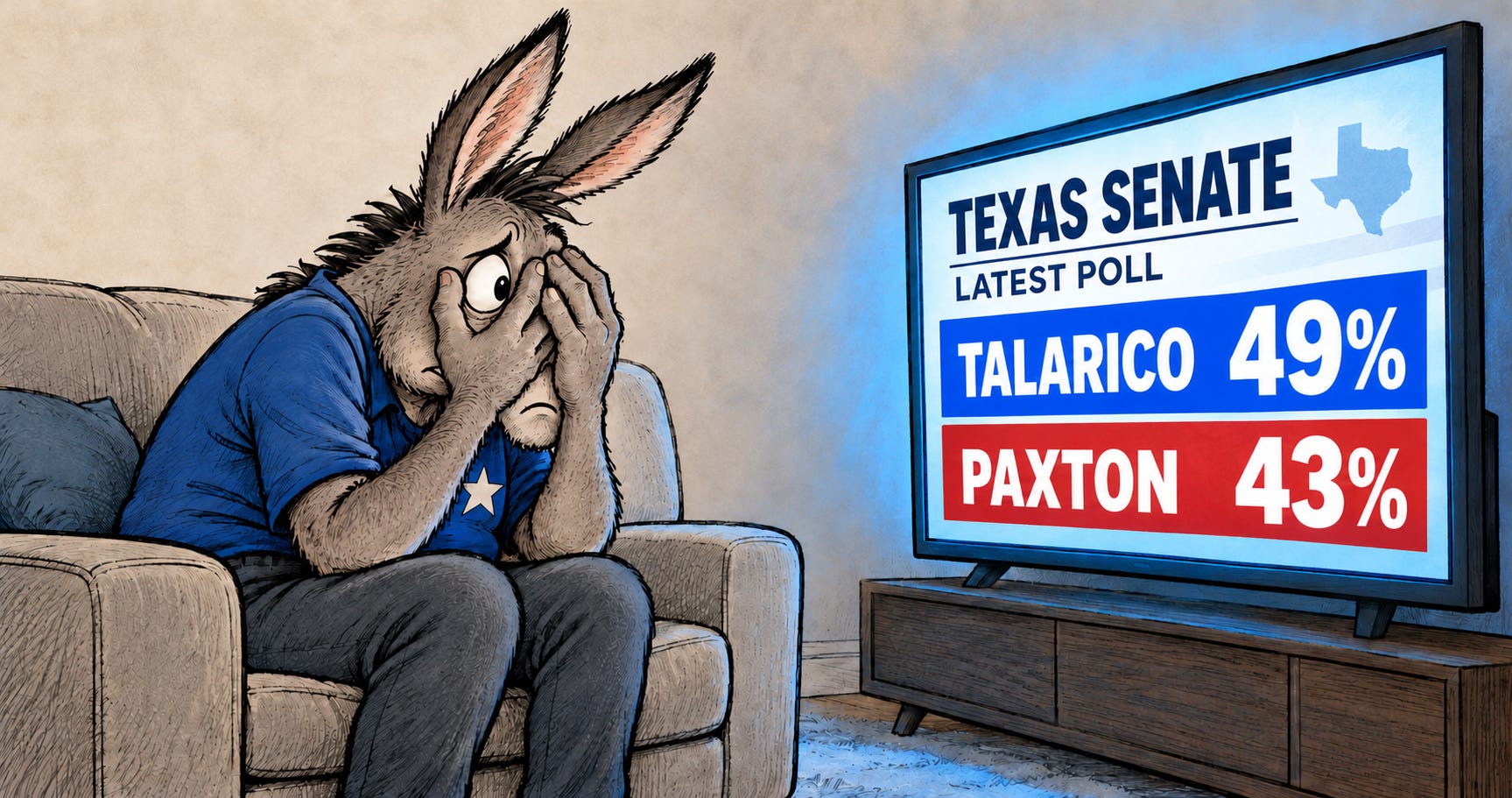
This is the weekly Still Counting post. It’s coming to you a day late because yesterday was one of those days. Not in a bad way, but in the way the last few days before the election typically are.
We’re in a mode now where we’re sort of a tapas restaurant and are going to deliver posts to you as they become available from the overburdened kitchen. We’ll try to space things out, but it’s possible that dishes will pile up and there will be some dry spells, or that you’ll get more than one newsletter or more than one FLIPR update in a day.
The one constraint that’s absolutely locked into place is our Election Day coverage:
In line with FiveThirtyEight/Silver Bulletin tradition, shortly after midnight on Tuesday, we’ll run the final FLIPR update of the season and post our final overview of the race.1
Then we’ll lie in bed “sleeping” as we refresh Twitter constantly.
We’ll spend the afternoon nervously pacing around while trying to ignore anecdotal reports about turnout in Waukesha County.
Then starting at roughly 5:30 pm, we’ll be co-hosting an Election Night video stream and liveblog with The Argument, Galen Druke’s GD Politics and Matt Yglesias’s Slow Boring, plus plenty of special guests. Like it says on the invites to cool parties (not that I’d know anything about those) we’ll go from 5:30 until “late,” although we’ll preserve some energy if the outcome is ambiguous and it looks like vote-counting has slowed to a crawl.

We tested the liveblogging tech last night, and it went relatively smoothly. We’re super excited about this feature, and grateful to Substack for developing it. We hope to employ it for things other than Tuesday too, like big political or sports nights.
The intent for Election Night is for the video stream to be free, while the liveblog, where we’ll get a bit more granular, will be for paying subscribers.2 We really hope that you’ll join us!
Meanwhile, here’s the YouTube of the Still Counting episode:
And here’s the audio. We’re very grateful for any reviews, comments, likes and subscribes you might spare.
The context
When FLIPR launched in August, I wrote that this wasn’t an election that filled me with a sense of “existential dread,” compared with… well, most of the recent ones. We knew both background conditions and midterm history were on Democrats’ side. If anything, those indicators have been unusually self-consistent this cycle. It was safe to assume Democrats were clear favorites to flip the House — you didn’t need FLIPR to tell you that, really, considering that Republicans started out with such a small majority — along with a number of governorships and state legislatures.
But in the Senate, we were caught between the proverbial rock and a hard place, since the battlegrounds required for a Democratic majority were being contested in very red terrain. Were Democrats really going to win Texas? Or Kansas? Or Alaska?
FLIPR initially forecasted the Senate odds at close to 50/50. As in 2024, that had seemed to make this election something of a low-stakes affair for the model. 28,000 lines of code, and all FLIPR was really saying is “well, who knows?”
Then, within a couple of weeks of Labor Day, there was some kind of phase change, with Democrats gaining 2 to 3 points on the generic ballot. There were several logical reasons for this: rising gas prices, further declines in Trump approval, growing evidence of a Democratic enthusiasm advantage, and perhaps increased public concern about AI, an issue where Trump is on the wrong side of the consensus.
So we’re no longer in the safe, nothing-ventured, nothing-gained “toss-up” zone. Democrats moved up to being roughly 3-to-1 favorites in FLIPR, and they’ve basically remained there for a few weeks now.
If you squint, there’s actually been the slightest recovery for Republicans on the generic ballot — but I’d argue that state and district polls have, if anything, been getting better for Democrats, like in a set of CNN polls yesterday morning that had them winning Kansas by 4 points and Texas by 6 (!). Even South Carolina might be in play, a flip I was (and to some degree remain) skeptical about.
Don’t believe polls from CNN or the NYT? Well, look at the New York Times polling database, where we get most of FLIPR’s data from, and search for any poll showing “Republican sponsor.” The GOP-commissioned polls3 imply a Senate map that is at best a toss-up for Republicans, but really leaning D, along with deep prospective gains for Democrats in the House and bad results for Republicans in swing-state governorships.
In a twist that I’m not sure I’ve seen before, Republican “vibes” about this election — especially if you adjust those partisan polls for the usual partisan bias4 — almost seem to imply a worse outcome for Republicans than Democratic ones.

But just look at where Republicans are spending money: it implies a deeply defensive, almost “prevent defense” posture. Or look at how Democrats are trying to expand the map in the House. There’s some kind of disconnect here between stated beliefs and revealed preferences.
I don’t have as much time to go into a deep-dive about the psychology here as I’d like. But I think Democrats are treating the possibility of flipping the Senate as "found money.” They’re optimistic-ish, but they don’t want to get their hopes up too much. It’s easy to understand why:
2016
Despite Joe Biden’s win that year, 20205
And to a slightly lesser extent, 2024
Still, it’s one thing to take a healthy attitude of “hope for the best, but be prepared for the worst,” and another to actually have to put odds on the outcome, as FLIPR and people trading at prediction markets do. Some of the gaps between models and markets that we’ve previously highlighted have narrowed significantly.
But it remains hard to wrap your head around this election because it feels so boom-or-bust:

This is an understandable sentiment, and the “boom” part is true. Conditional upon James Talarico winning in Texas — Texas! — Democrats will be huge favorites to flip the Senate. Specifically, around 90 percent of the time according to FLIPR Deluxe.
But if Democrats don’t win Texas?
What might be counterintuitive is that they’ll retain decent chances of winning the Senate. Democrats could flip the Senate solely by winning states that Barack Obama won at least once: North Carolina, Maine, Ohio and Iowa. (They’d also, nontrivially, have to hold all of their own seats.) There are also more exotic possibilities: Alaska, Kansas, Nebraska, South Carolina or maybe even Montana.
FLIPR polling averages show Mary Peltola and Adam Hamilton slightly ahead in Alaska and Kansas, respectively. Nebraska is basically a tie in the polls between Pete Ricketts and Dan Osborn, although the advanced features of FLIPR shift Nebraska to Lean R.
But here’s where I think some of the cognitive dissonance creeps in. It’s easy to say: “well, either there will be a polling bust” — indeed, such an occurrence is highly plausible! — or “polls are basically right, so Democrats will win and maybe run up the score.” Ergo, the Senate is 50/50, you might think.
That’s not the worst first approximation, but it leaves a lot out. Those outcomes aren’t necessarily equally likely, and this election isn’t necessarily that binary. Democrats might be able to withstand a modest polling error in the Senate. Or polls could underestimate them, like they did in 2025.
Or the outcome might just get a bit weird. I wouldn’t really be that surprised, for instance, if Talarico wins — but Susan Collins wins too.
Election observers might actually be overindexing to presidential years, when there are the same two candidates on the ballot at the top of the ticket, and race-by-race correlations are stronger than in midterms. Because they lead in the polls, however narrowly, in states totaling 54 Senate seats — 55 if you count Nebraska, where Osborn is 0.3 points “ahead” in our polling average6 — most of the weird outcomes result in D wins, in the same way that being a field goal ahead is nice if the second half of an NFL game turns into a comedy of errors.
At the same time, there isn’t any sort of “safe space” here. There’s no “Blue Wall” or anything like that. Except probably for North Carolina, none of the prospective D pickups are “safe” or “solid.” I have my opinions about which pickups are relatively more likely and relatively less likely, and FLIPR does too.
But this requires a willingness to “trust the process,” when Democrats very understandably feel like the polls are Lucy with the Football. And even FLIPR can only provide conditional, probabilistic affirmation. A roughly 3-in-4 chance means that you’ll lose 1 in 4 times: all it takes is the coin coming up tails twice in a row.
It’s more natural to compare 2026 to other midterms. But in certain ways, the best analogy is to a presidential year, 2008, the last time the political environment was polling so blue. Barack Obama flipped several states — Virginia, Colorado, North Carolina and oddly, Indiana — that at the time were considered canonically, almost existentially Republican. (Those states have taken different trajectories since then, obviously.) Or if you prefer, FLIPR’s forecast is a bit like picking the Knicks to win the NBA title or the Milwaukee Brewers to win the World Series after they’d won the first two games of the series. “I’ll believe it when I see it” is the attitude people take when it comes to things like this, and I don’t blame them exactly.
Are pollsters herding? And if so, toward what?
On Still Counting, we discussed a Marist poll that came out this week and had some very weird results in Maine. This now feels like slightly old news. But the poll showed Troy Jackson ahead by 9 points among registered voters and the Democratic gubernatorial nominee, Hannah Pingree, up by 11 among RVs. Among likely voters, however, Marist showed Jackson at a mere +2 — and Pingree tied against Republican Bobby Charles.
I’m not one to critique individual polls. Since we’re publishing a lot of newsletters, and since I tweet a lot, I think I’ve established some credibility on that front. But as I said on the show, I don’t think the Marist poll is defensible.
It’s not that Jackson +2 is infeasible. Indeed, it’s very close to FLIPR’s forecast in ME-SEN! What I don’t buy, though, is that Jackson would win by 9 points if every registered voter turns out, but is only slightly ahead given the actual likely-voter Maine electorate.
But ignore the Senate race for now, as important as it is. Marist’s gubernatorial poll in Maine makes absolutely zero sense.
For one thing, no other poll shows anything remotely in the vicinity of a tie in the governor’s race. Pingree leads by roughly 10 points in our polling average, which includes the Marist poll — but no other poll this cycle shows Pingree anything less than 8 points ahead:

The whole question in Maine is whether Collins has retained her supernatural powers to outperform polls and partisan baselines in a blue state in what looks like a very blue environment. I actually might take the under on FLIPR’s roughly 70/30 odds for Jackson.
There shouldn’t be much question, though, about Pingree being a heavy favorite in a fairly typical gubernatorial race. True, governor’s races are less correlated with the overall partisan environment than races for Congress, but Charles is a fairly obscure opponent whereas Pingree comes from a locally popular mini-dynasty.
The topline in Marist’s RV numbers was:
Pingree, 51 percent
Charles, 40 percent
Independent Rick Bennett, 7 percent
And 2 percent undecided.
Maine, unlike (say) South Carolina, is typically a high-turnout state, with somewhere in the neighborhood of 70 percent turnout among registered voters in recent midterms. But suppose that 70 percent of Charles RVs turn out, along with only 60 percent of Bennett’s supporters and undecided voters. This sort of spread is highly implausible, especially given that early voting looks decent-to-good for Democrats in Maine.
But humor me for a bit. Even with that correction applied, the topline would shift to Pingree 48, Charles 44. She’d still win.
I don’t see any way on earth that you have an 11-point shift from RV to LV in this relatively straightforward gubernatorial race, especially in what Marist itself sees as a D +8 national environment. On top of that, Marist has the undecided vote share in ME-GOV growing from 2 percent among registered voters to 6 percent among LVs. This makes even less sense. If you’re still undecided a week before the election, there’s a good chance that you won’t turn out at all. I’ve never seen a poll where the undecided ratio increased 3x when you filter for likely voters.
My leading hypothesis is that Marist, which does tend to publish relatively rosy numbers for Democrats, is terrified of its own shadow and/or terrified of being the next Ann Selzer, who was sued by President Trump. (The case was eventually dismissed.) The Senate race in Maine has a high profile; the gubernatorial race doesn’t. So it saw the Jackson +9 and it didn’t believe it, and then reverse-engineered its likely-voter model to produce a result that was more aligned with the consensus in Maine. And then its gubernatorial result was collateral damage.
My secondary hypothesis is that Marist’s spreadsheet or algorithm is broken and they ought to pay for some smart graduate students (or enough Claude or ChatGPT tokens) to fix it.
But if you’re issuing a survey that shows Pingree +11 and a tie in the same race in the same poll, you shouldn’t have published it.
Noah Wyhof-Rudnick has a great analysis of what pollsters are assuming about turnout shifts versus 2024. On average, the polls show a slightly more D-leaning turnout profile than two years ago, but only slightly.
You could argue that this is a conservative assumption given early voting data and other signs of Democratic enthusiasm. There’s also the potential issue, as Wyhof-Rudnick points out, of Trump voters mis-recalling or misstating their vote given how unpopular he has become, as some other pollsters have found. To simplify a bit, that could lead to these polls overestimating Republican turnout.
But, as Wyhof-Rudnick found, pollsters seem to be giving themselves varying degrees of permission to let their assumptions about turnout “float” relative to 2024, based on their priors about each race. They seem to be especially reluctant to underestimate Collins in Maine, given what happened in 2020.

This backs up my hypothesis, which is embedded into FLIPR, that pollsters are acutely aware of past polling errors and trying to correct for them — at the risk of either under-correcting or overcorrecting — and therefore the direction of polling error is hard to predict. Empirically, polling errors aren’t that correlated from cycle to cycle, but that might partly reflect how polling has become more of an art than a science. Human judgment plays a major role; as the Selzer Iowa poll in 2024 unfortunately showed, just “trusting your data” is no longer necessarily a reliable method.
Marist deserves credit for publishing both its RV and LV estimates, which most pollsters do not do. More often than not, the assumptions that pollsters make aren’t so transparent.
Still, I consider the Marist poll of Maine to be the “poll of the year.” Like Time Magazine's Person of the Year, this is sometimes an indicator of infamy, though. Pollsters seem to be undergoing a crisis of confidence and have a lot on the line (as do models like FLIPR). Polls are becoming something more like forecasts or models, rather than “pure” measures of public opinion. And models like FLIPR are becoming almost like prediction markets in basically taking a weighted average of those opinions. The Maine Senate race is a hard race to forecast. But I’m going to admit I’ll find it hilarious if Pingree wins by 10 points and Marist weighted its way out of what would otherwise have been an accurate result.
Silver Bulletin news and notes
We’ve patched FLIPR’s assumptions in the Montana Senate race, which is a weird one because there’s both an actual Democrat (Alani Bankhead) and a de facto Democrat (independent Seth Bodnar) on the ballot.
I’ve been doing lots of media, including being interviewed by Ezra Klein this week.
And please join us on Election Night!
If you’re a pollster who happens to be reading this, please publish your surveys before 11:59 p.m. on Monday.
Subscribers to any of the four publications will have access to the liveblog.
Along with polls that aren’t officially Republican but usually lean that way.
Typically about 3-4 points of vote margin.
This actually featured the largest polling error of the Trump election triad.
Although not in FLIPR Classic and FLIPR Deluxe, which blend the polls with fundamentals and expert ratings, respectively.