
We’ve been heavy on Senate content at Silver Bulletin this cycle. Partially, that’s because Senate races have more general appeal than individual House races.1 Most people who are following the election even semi-regularly have heard of candidates in high-profile statewide contests like James Talarico, even if just from their omnipresent ads. But you have to be more of a serious politics nerd to know the names of many House candidates outside your own district.
But also, the House is just far less competitive than the Senate this year. FLIPR’s Deluxe forecast gives Democrats a 95 percent chance of retaking the lower chamber. Certainly, 5 percent chances do happen (5 percent of the time, duh!) but Republicans’ 25 percent chance of holding on to the Senate is a much more meaningful source of uncertainty as we enter the final week of the campaign.
In fact, since our House tour in late August, the number of seats FLIPR rates as Solid D has increased by one, while the model has added 14 seats to the Likely D camp.2 Meanwhile, there are three fewer Solid R seats and nine fewer Likely R seats. That’s not a great sign for Republicans, obviously. The battleground expanding late in the race is a hallmark of a wave election.
However, ending up with a House majority is a relatively low bar. You can point to countless examples from the past two years that show how much trouble Mike Johnson has had governing with a minuscule House majority.
So how big might the blue wave be? And how much cushion do Democrats have if the night is on the disappointing side for the party?
Unlike the topline “which party controls the House” question, there’s still a lot of uncertainty on that front. If something like the most recent New York Times/Siena poll is dead on and Democrats win the popular vote by 11 points, House seats that would have looked like longshots for Democrats six months ago will almost certainly flip. On the other hand, if Democrats have just an okay year or are being overestimated in the polls, their majority could be slim indeed. That’s doubly true because even though it looks like many of Republicans’ hoped-for redistricting gains won’t come to fruition this cycle, the redraws did succeed in tilting the overall bias of the House map in their favor. And gerrymandering by both parties, along with voter self-sorting (cities blue; rural areas red) has reduced the number of competitive districts.

So let’s go through every remotely competitive House race — all 83 of them — to see where Democrats stand to gain the most ground. But first, to get a better idea of how many seats Democrats need to pick up, let’s look at where they’re playing defense.
Republican pickups
There are seven seats currently held by Democrats where Republicans are at least slightly favored to win, or are in a dead heat with Democrats. Some — such as LA-6 and TN-9 — are near-locks for the GOP, while others, namely FL-9 and TX-35, are highly competitive contests. What they all have in common is that they’re competitive primarily because they were shifted right during mid-decade redistricting. Still, Democrats have managed to battle the new TX-35, which would have voted for Trump by 10 points in 2024, to as close to a pure toss-up as you can get.
The other toss-up on this list — and the first race not affected by redistricting — is ME-2. As we wrote in our House tour, that’s a district Trump won by 9 points in 2024, and the main reason Democrats currently hold the House seat is because of Jared Golden’s consistent overperformance. With his retirement and the much more progressive Matt Dunlap running in his place, Democrats are only slightly favored to hold the seat, even though 2026 should be meaningfully bluer than 2024.
After Maine, there are three Lean D races — OH-9, FL-22, and FL-25 — that are also competitive because of recent redistricting. These redrawn districts would have voted for Trump by between 9 and 11 points in 2024, but FLIPR sees the Democratic candidates as slight favorites this year. The 10 Likely D races on this list are relatively safe bets for Democrats, unless the national environment winds up a fair amount redder than polls currently show.
Let’s do some quick math. Democrats currently hold 215 House seats, counting one vacancy in the very blue FL-20, which Democrats won in 2024 and we wouldn’t consider to be a flip. So if they held all of their own seats, they’d only need 3 GOP-held pickups to reach the coveted 218. But they’re almost certainly going to lose some seats.
Great night for Ds: Among their own seats, Dems lose only the 4 Likely R or Solid R races. Therefore, they need 7 pickups total.
Good night for Ds: They win the toss-ups, and all of the Lean D+ seats, but none of the Lean Rs. Down 6 of their own seats, they’d need 9 pickups in GOP-held seats.
Mildly disappointing night for Ds: They lose the toss-ups and 2 of the 3 lean Ds. Having lost 10 of their own seats, they’d need 13 pickups.
Very disappointing night for Ds: They lose all of the lean Ds and the first four Likely D races. Now they’re out 15 of their own seats and require 18 pickups. This could get tough.
But Democrats do have a lot of targets — as well as some seats they’re almost certain to win even if things otherwise aren’t going well for them.
Democratic pickups: Solid D
The tiny category of Republican-held seats that are near-locks for Democrats is made up almost entirely of mid-decade redistricting casualties, which Nate and I recently wrote about in depth. Democrats have at least a 99 percent chance of winning three of the five California districts redrawn to be bluer, and they’re all but guaranteed to pick up the new Utah district centered on Salt Lake City.
The exception to this rule is Nebraska’s Second District. That seat has been held by Republican Don Bacon since 2016, but Kamala Harris won the district by nearly five points in 2024. With Bacon retiring and 2026 shaping up to be a much bluer year, FLIPR projects Democrats to win by nearly 14 points.
Democratic pickups: Likely D
The first two seats on this list are the other California districts redrawn to flip parties. Really, they’re Likely D in name only and are just a few tenths of a percent from falling back into the Solid D camp.
The remaining Likely D Democratic pickup opportunities generally fall into one of two groups. First, we have seats that Donald Trump won narrowly in 2024 (such as NJ-7, VA-2, MI-7, and AZ-6) or that Harris won outright in the case of NY-17. By virtue of the environment alone, you’d expect these seats to fall into Democrats’ hands this cycle.
FLIPR expects these districts to end up around D +5 to D +6, and in most cases, the polls agree: Democrat Bob Brooks leads by 5.2 points in our PA-7 average, for example. On the other hand, Republican incumbent Mike Lawler is trailing his opponent in NY-17 by just 1.1 points in our average. But considering that this was actually a Harris district, the model thinks he has just a 17 percent chance of pulling off an upset. (Generally speaking, FLIPR defaults to the “fundamentals” more in the House because there are fewer reliable polls3 than in the Senate.)
The second category includes NC-11, PA-8, PA-10, IA-1, OH-7, and WI-3. These are seats that Trump won by between five and 11 points in 2024 that FLIPR nonetheless still expects Democrats to win by at least four points this year. A couple of these likely flips come down to candidate quality: the Republican candidate in OH-7, Max Miller, has been accused of spousal abuse and child abuse4, while IA-1 features Mariannette Miller-Meeks, a serial underperformer.5
In the others, the polls have been consistently strong for Democrats. Paige Cognetti leads by 3.8 points in our PA-8 average, while Rebecca Cooke is up by 1.7 in R +7 WI-3. The PA-10 polls are even narrower — the Democratic candidate leads by just 1.3 points in our average — but that district was only R +5 in 2024, so a Democratic win this year is entirely plausible based on shifts in the environment alone.
But note that between the Solid D and Likely D seats, 22 Republican-held races are listed here. In the “mildly disappointing” scenario described above, Democrats will only require 13 pickups. Mildly disappointing is almost certainly good enough for Democrats to win the House, in other words. (And they’d have a fighting chance in the Senate, though would be underdogs.)
Don’t take this too far, however. In the “very disappointing” scenario, Ds would need to acquire 18 Republican seats. You might like their odds given that they have 22 Solid D or Likely D pickups to choose from. But in such a scenario, Democrats will, by definition, be underperforming across the board. If Republicans won 5 of the 17 Likely D seats, they’d retain control of the House by one vote.
Democratic pickups: Lean D
Compared to the previous category, this list is relatively short. Michigan’s 10th District was only R +6.5 in 2024, and with the seat’s Republican incumbent running for governor, it’s a reasonable pickup opportunity for Democrats. However, their candidate was tied with the Republican in the latest poll of the race. IA-2 is a much redder district, but it’s also an open seat and the Democratic candidate holds a 2-point lead in our polling average.
Pennsylvania’s 1st District is a bit of an outlier in this list. Harris actually won the district narrowly in 2024, but Republican incumbent Brian Fitzpatrick has been pulling off massive overperformances since 2016. The polls in this race are a dead heat, but still, the model thinks Fitzpatrick has just a 33 percent chance of retaining his seat this year.
The other big surprise on this list is Texas’ 15th District, which voted for Trump by nearly 18 points in 2024. Even in a blue year you’d expect that seat to be an uphill battle, but Democrat Bobby Pulido leads by 8.2 points in our polling average. That probably reflects a combination of Pulido being an excellent candidate, and Hispanic voters in south Texas swinging back toward Democrats.
And remember, even with the potential losses we discussed up front, Democrats can retake the House simply by picking up the Solid D Republican-held seats along with a smattering of the Likely D races. Everything from here on out would just be expanding their majority.
Democratic pickups: Toss-up
Yes, there are just four races here: you can’t accuse FLIPR of hedging its bets. Our categories are determined algorithmically — a “toss-up” is any race where neither party has a 60 percent chance of winning.
All but one of these seats was very red in 2024, which isn’t surprising given that FLIPR expects Democrats to win the popular vote by about eight points nationally. The closest thing to an exception is Wisconsin’s 1st District, which was just R +4.5 two years ago. That’s less red than many of our Likely D districts, but Republican incumbent Bryan Steil is a consistent overperformer and currently leads in our polling average by about three points. The D +2.4 fundamentals are what bring this race to a toss-up.
The other three seats on this list were between R +12 and R +15 in 2024. It’s a testament to Democrats’ strength this cycle that they’ve managed to pull anywhere close to even in districts like KY-6 and MT-1. They actually lead in polls of both those races, but FLIPR discounts those with the fundamentals and still gives Republicans a slight edge in all three.
Texas’ 23rd District, which Democrats currently have a 47 percent chance of flipping, is another example of Republicans making their lives needlessly difficult in Texas. Their nomination of Brandon Herrera, a YouTuber who has made some controversial comments over the years, has put the race in play. Still, Herrera is either leading or tied in the couple polls we have of the race, both of which were sponsored by Democrats.
Democratic pickups: Lean R
At this point, we’re well past FLIPR’s average projection of Democrats netting 24 House seats and ending up with a total of 239 to Republicans’ 196. Trump won these Lean R seats by at least eight points — and in most cases by double digits — in 2024. Democrats picking up many of these districts would represent an overperformance versus FLIPR’s projection of the national environment.
The party’s best shots are in MN-1, CO-5, MO-2 and OH-15. FLIPR projects Republicans to win each district by 2 points or less. Ohio’s 15th District actually got slightly redder in the state’s recent redistricting, but still, Democrat Don Leonard is trailing by just 1.5 points in our polling average. The Democratic candidate, Frederick Wellman, actually leads by 1.2 points in our MO-2 average in suburban St. Louis.
The next two seats are both from the Sunshine State: Florida’s 7th and 13th districts. Neither seat was made any bluer during mid-decade redistricting — in fact, the 13th became slightly redder — but Republicans have just a 66 percent chance of winning each one.
After those two, Democrats’ chances in the remaining Lean R seats drop below 30 percent. But still, as we keep saying with our Senate forecast, 25 percent chances aren’t that unlikely. Polling error can cut in both directions, and it wouldn’t take much for these seats to become truly competitive.
Just for fun, though, say the “great night for Democrats” scenario comes up, which it might if that NYT/Siena poll is right. Democrats lose only 4 of their own seats, while picking up the 22 Likely or Solid D Republican-held seats, the 6 Lean Ds, the 4 toss-ups and the 12 Lean Rs. That would reflect a net gain of 40 seats, similar to 2018, but more impressive since Democrats are starting from a higher floor than in 2018 and the map is more gerrymandered now.
Much beyond that, and everyone would — and frankly should — be talking about why polls had missed so low on Democrats for a change. But Democrats do have some far-flung targets. If you look carefully at FLIPR’s seat distribution chart, you might notice it’s slightly asymmetric. (And this is the Deluxe version; that’s even clearer for Classic and Lite, which bake in fewer expectations.)
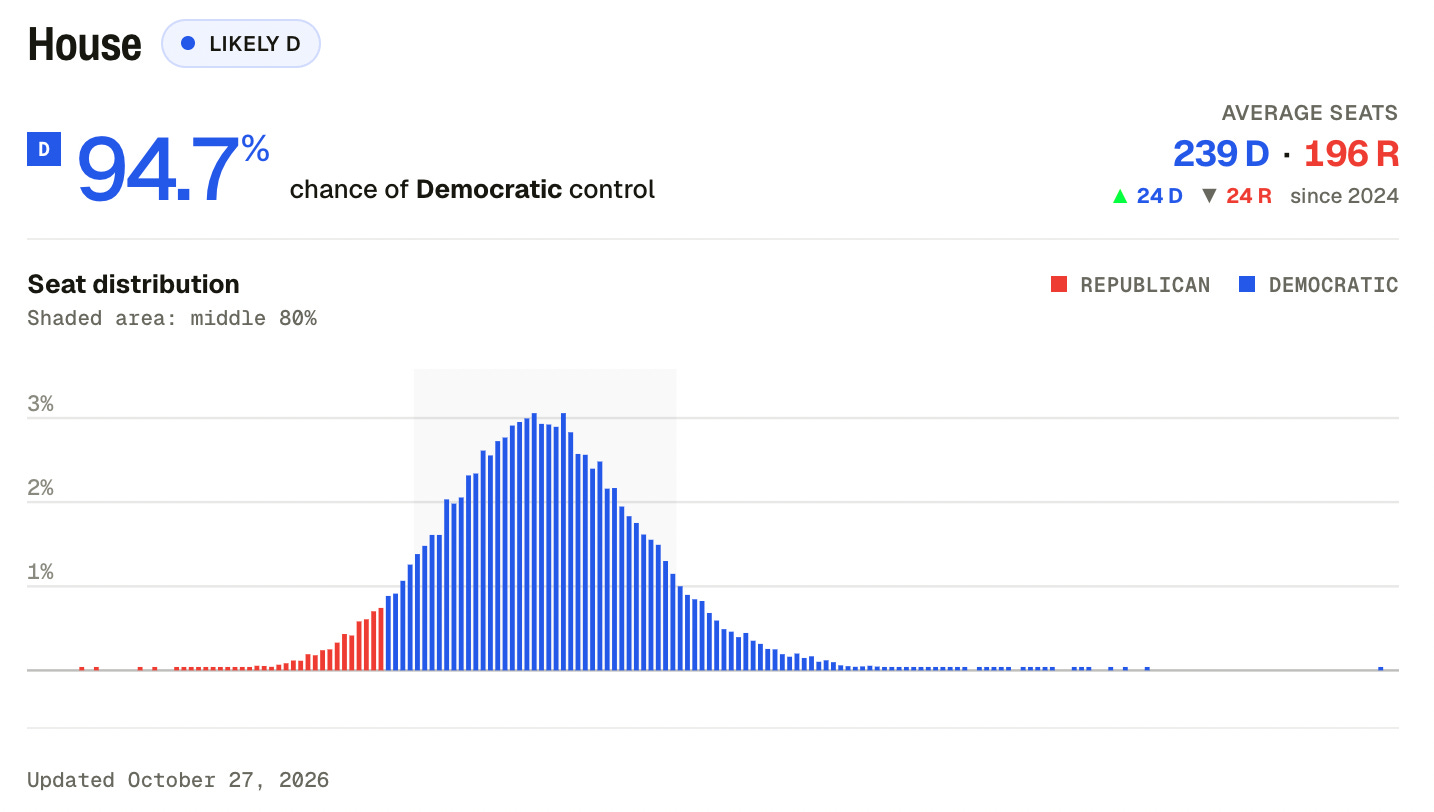
In other words, there’s a long tail of races Democrats could win if they’re having a really, really good night and catch unprepared Republican incumbents.
Democratic pickups: Likely R
This is a long list, so we won’t cover every seat in detail. The least far-fetched options are seats like NV-2, CO-4, and OH-10. Democrats are clear underdogs, but Republicans’ polling leads are small enough where an upset is still possible. Florida’s 16th District became slightly bluer in Florida’s redraw, so a flip there could realistically result in a dummymander.
Democrats do have a 16 percent chance of winning Alaska’s at-large House race, probably in the form of Bill Hill, an independent whom FLIPR assumes would caucus with the Democrats. Alaska is tricky to forecast because of ranked-choice voting, but Republican Nick Begich leads by about 10 points in our polling average and received about 45 percent of the vote in the state’s open primary.
A majority of the other seats in this category are districts in Southern states — think Virginia, Florida, North Carolina, and Texas — where Democrats have a nonzero shot at eking out a win. But if we’re seeing seats like NC-3 flip next week6, we’ll be in the middle of a blue tsunami and 2026 will be remembered as a legendary wave along the lines of 2010 or 1994.
For what it’s worth, FLIPR’s Senate landing page gets about twice as much traffic as our House page.
A Solid rating means one party has more than a 95 percent chance of winning the seat, while a Likely rating means one party has between a 75 and 95 percent chance of winning the seat.
Many of the polls are partisan or have small sample sizes, and FLIPR weights these less.
Miller has denied the allegations.
Her Split Ticket WAR in 2024 was D +11.3.
Another potential dummymander.