If you’re fully exploring the probabilistic landscape in an uncertain electoral environment, you’re inevitably going to end up with some posts that “didn’t age well.” For example, if Democrats have a good night next Tuesday and Peggy Flanagan easily wins in Minnesota, our newsletter from earlier this month that seriously contemplated Michele Tafoya’s chances might be one of those.
If Democrats have a disappointing night, conversely, this post about the South Carolina Senate race will be a candidate for the “didn’t age well” bucket.
But we haven’t examined South Carolina all that seriously. Nor have we given sufficient attention to a possibility that could give Democrats a winning hand in the Senate, even if they fall short in the Palmetto State: disproportionately high turnout among Black voters.

Minnesota and South Carolina, indeed, were two of the three states that The New York Times and Siena University polled in their latest round of surveys, published early this morning.
The third state, Florida, produced the least interesting result, with Republican Ashley Moody ahead by 6 points, pretty much spot-on to FLIPR’s polling average there. The Minnesota and South Carolina surveys were more surprising, although only one of them is really an outlier relative to other polls.
And that state is actually … Minnesota, where NYT/Siena had Flanagan ahead by 14 points, much greater than her 4.7-point lead in the FLIPR average entering the day.
The new poll may reflect Democrats coming home despite Flanagan’s weaknesses as a candidate.1 Indeed, our “simple fundamentals” calculation in Minnesota, based on the generic ballot among likely voters and its partisan lean score, pegs it at D +13.7. Even so, the poll may be on the optimistic side for Flanagan: “probably too hot for Democrats”, as the Times’s Nate Cohn wrote. (Unlike many other pollsters, the NYT/Siena polls do very little herding, and they’ve never been afraid to publish results that differ from the consensus.)
Still, Minnesota comes up as the tipping-point state 6 percent of the time in our simulations, as much as other states that get more attention. Pushing Minnesota from “slightly weird race that could give Republicans a few backdoor outs” to “state that Flanagan will win unless Democrats are having huge problems elsewhere and are screwed anyway” is potentially worth something.2
Your paid subscription gives you full access to our Election Night livestream with The Argument, GD Politics, and Slow Boring.

The NYT poll in South Carolina is not an outlier
The Times’s poll in South Carolina drew more attention. It showed the race tied 48-48. (Republican Darline Graham was ahead of Democrat Annie Andrews by less than a full point if you go to the decimal place.)
But this poll is not an outlier relative to the polling average in South Carolina, which had shown Graham up by 1.5 points entering the day. Now the average is at … Graham +1.5, still.
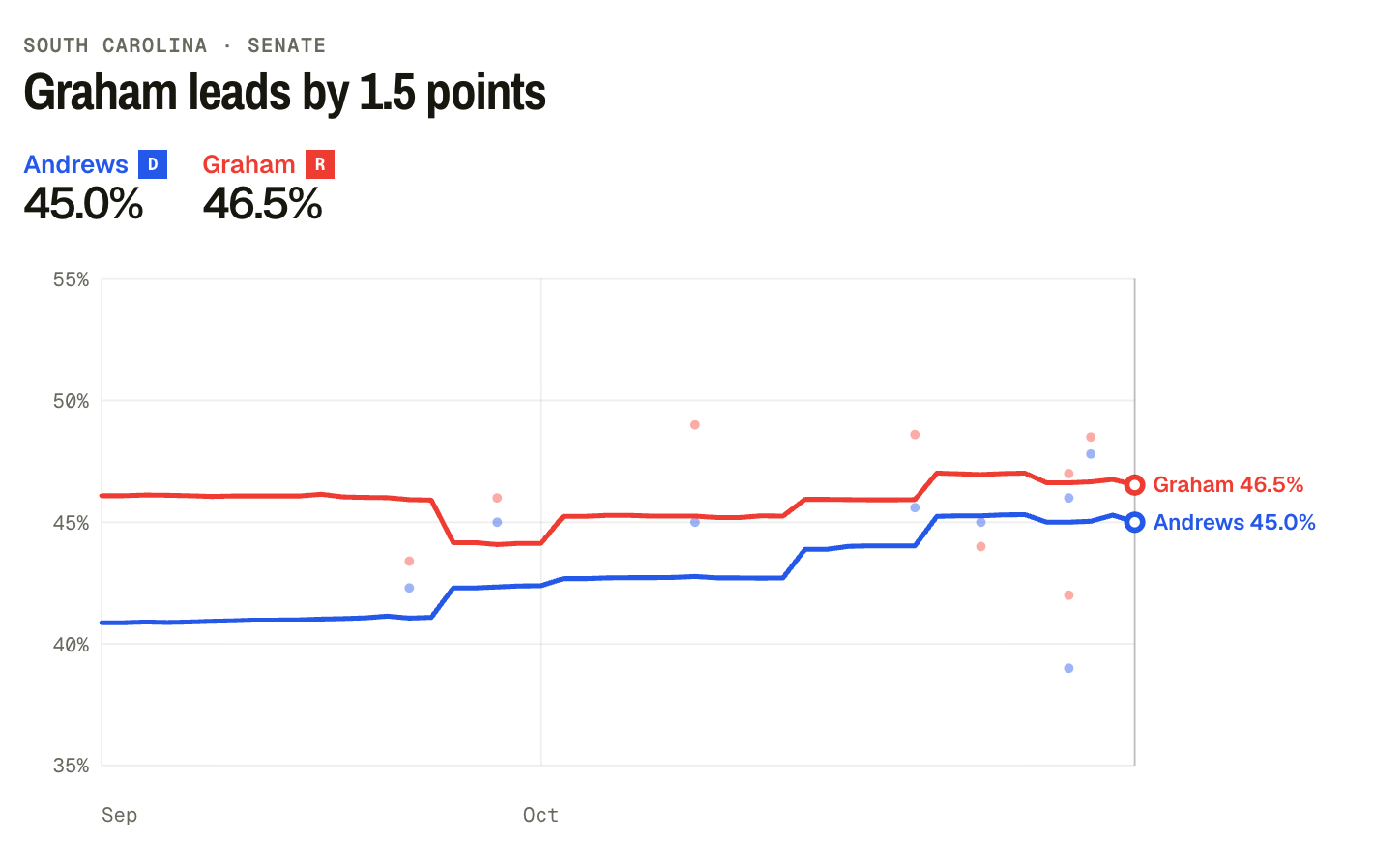
That’s partly because the NYT survey wasn’t the only new poll of South Carolina to enter our database overnight. A new Citadel Poll has Graham, who was appointed to succeed Lindsey Graham after he died in July, leading by 3 points. Although in an interesting twist we’ll return to later, the Citadel had Andrews ahead by 6 points among registered voters.3
In my roundup of Senate races this weekend that compared FLIPR’s forecasts against prediction markets, I didn’t take FLIPR’s side in South Carolina. At the time, we gave Andrews a 27 percent chance there, as compared to 20 percent for prediction markets. This is what I wrote about the state:
Here’s where I feel like we start to get into more speculative territory, even though the difference between FLIPR (27 percent for Annie Andrews) and prediction markets (20 percent) isn’t all that large. I suppose I have a reflexive concern about taking the bull case on Democrats in South Carolina given two factors. First, the much overhyped Jaime Harrison race, where he eventually lost to Lindsey Graham (RIP) by 10 points. And second, the state is relatively inelastic. It has a large Black population, a lot of conservative, evangelical whites, and not many swing voters.
Even according to FLIPR, there’s little chance — 4 percent — that South Carolina will be the tipping-point state. If polls are systematically overestimating Democrats in red states, Andrews’s chances are basically zip even if Darline Graham, Lindsey’s sister, is a weak candidate. If the polls are accurate about red-state performance, Democrats could pick up South Carolina if they’re having a fantastic night, but at that point they’ve probably already won Texas and so forth and have more than enough seats in hand.
Ironically, Andrews’s chances have now improved to 27 percent at Polymarket with the new polling, exactly where FLIPR had it previously. Although FLIPR’s odds for Andrews have also ticked up slightly, to 31 percent.
That might actually seem ungenerous to Andrews given how tight the polling is, but FLIPR Classic and FLIPR Deluxe blend polls with “fundamentals” and, in the case of Deluxe, expert ratings. One point I’ve emphasized in recent interviews is that polls and fundamentals actually aren’t all that out of whack in states like Ohio, Texas and Iowa. For instance, a roughly 11-point swing from 2024, in line with FLIPR’s current popular vote forecast, would bring a state like Ohio, which Trump carried by 11 points in 2024, basically to parity.
But that math doesn’t work in South Carolina, which Trump won by 18 points in 2024. Democrats will need basically everything to go right there: first, a serious outperformance for Andrews based on candidate quality and second, turnout patterns that look much different than South Carolina has experienced in the recent past.
Why did FLIPR’s odds for Andrews improve, however slightly, even if our polling average didn’t change? It’s because of that disparity between polls and fundamentals. In a race with no polling at all, FLIPR has no choice but to go entirely on fundamentals. The more polling there is, and the more reliable FLIPR considers polls to be, the more weight it puts on polls instead — although it never entirely zeroes out fundamentals.
Basically, in possession of more data, FLIPR is a bit more confident now that the polls really do show a close race in South Carolina. Those polls might be wrong, and FLIPR still hedges against them a fair bit, projecting Graham to win by about 3 points. But as Bill Scher points out, today’s poll forms a marked contrast to the final NYT/Siena poll in 2020, which rained on the Jaime Harrison parade by showing Graham up 6 points.
Still, as I said, Democrats really need a parlay in South Carolina. To win a Trump +18 state, they’ll need to max out on every factor: turnout and persuasion.
Darline Graham is not a great candidate
Although this post will mostly explore the turnout question, let’s first consider whether the candidates in the race make such an overperformance feasible.
The best recent Senate performance in South Carolina for Democrats came in 2020, when Harrison lost to Lindsey Graham by 10 points, a disappointment relative to polls that had shown a tight race there and attracted an inordinate amount of Democratic small-donor money. Harrison did outperform Joe Biden in the end, but only slightly. (Biden lost to Trump by 12 points.) In 2022, by contrast, Republican Tim Scott was re-elected by 26 points against Democrat Krystle Matthews.
Graham was never super popular, though, often carried along by South Carolina’s red partisan tide. And presumably his sister is less popular than he was?
There aren’t a lot of recent examples of what happened when family members were appointed to replace deceased Senators.4 Graham shows some signs of weakness, however. She did win her primary in August over U.S. Rep. Ralph Norman, but her 5-point margin was rather meager given that Trump had endorsed her. She’s also seemed awkward and sometimes out of her depth on the debate stage. Nor does Graham have a resume that would be typical of a U.S. Senator, having served on various relatively obscure state commissions and never having run for office. I feel safe in asserting she wouldn’t have been appointed to the seat if she wasn’t Lindsey Graham’s sister.
Andrews, a pediatrician, did run for office once before, losing by 14 points in 2022 to Republican incumbent Nancy Mace in South Carolina’s 1st Congressional District. According to Split Ticket WAR, that reflected roughly a 5-point overperformance relative to the district’s partisan baseline. Not bad, although that may be more about Mace than Andrews. Mace underperformed in her other two elections, too, according to Split Ticket.
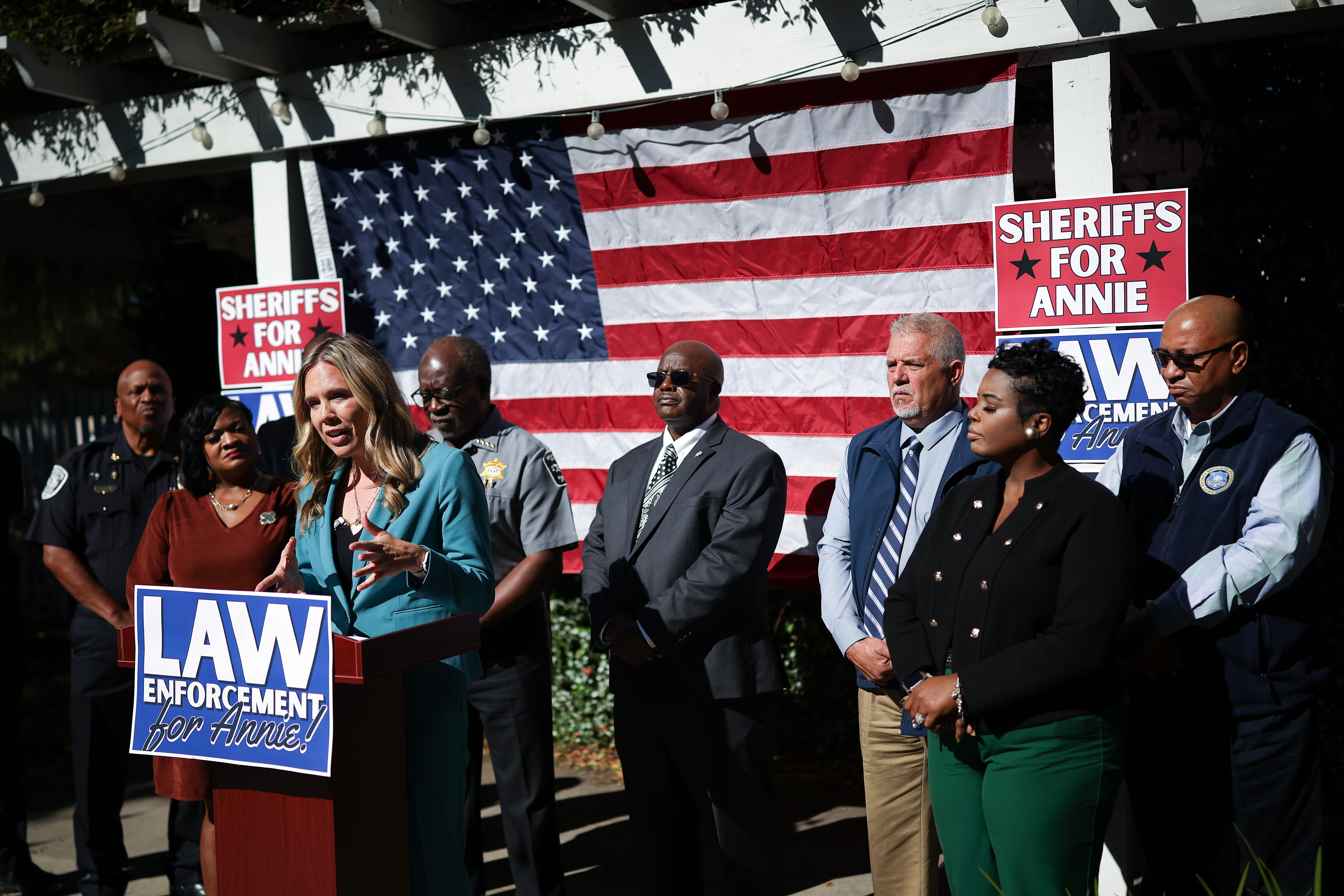
Andrews’s political positions are a fairly typical mix for a Democrat who straddles the moderate-to-progressive boundary, while her branding has been more nonpartisan. She frequently appears in medical scrubs in her campaign materials and styles herself as Dr. Andrews. And as you can see from my photo choice, she has emphasized her endorsements from local sheriffs.
So you can make a case that Andrews is a decent-to-good candidate. It might help that she’s kept a lower profile than Harrison, who later became DNC chair. But nothing here screams “electoral superstar”, at least not until and unless she prevails next week. This race is mostly about Graham’s weaknesses — and the possibility of a very strong turnout for Democrats.
The basics on Black turnout
Midterms have typically featured whiter electorates than presidential years. This was part of Barack Obama’s problem in his poor midterms in 2010 and 2014, for instance. Here’s some data from the Brennan Center that tells the story5:
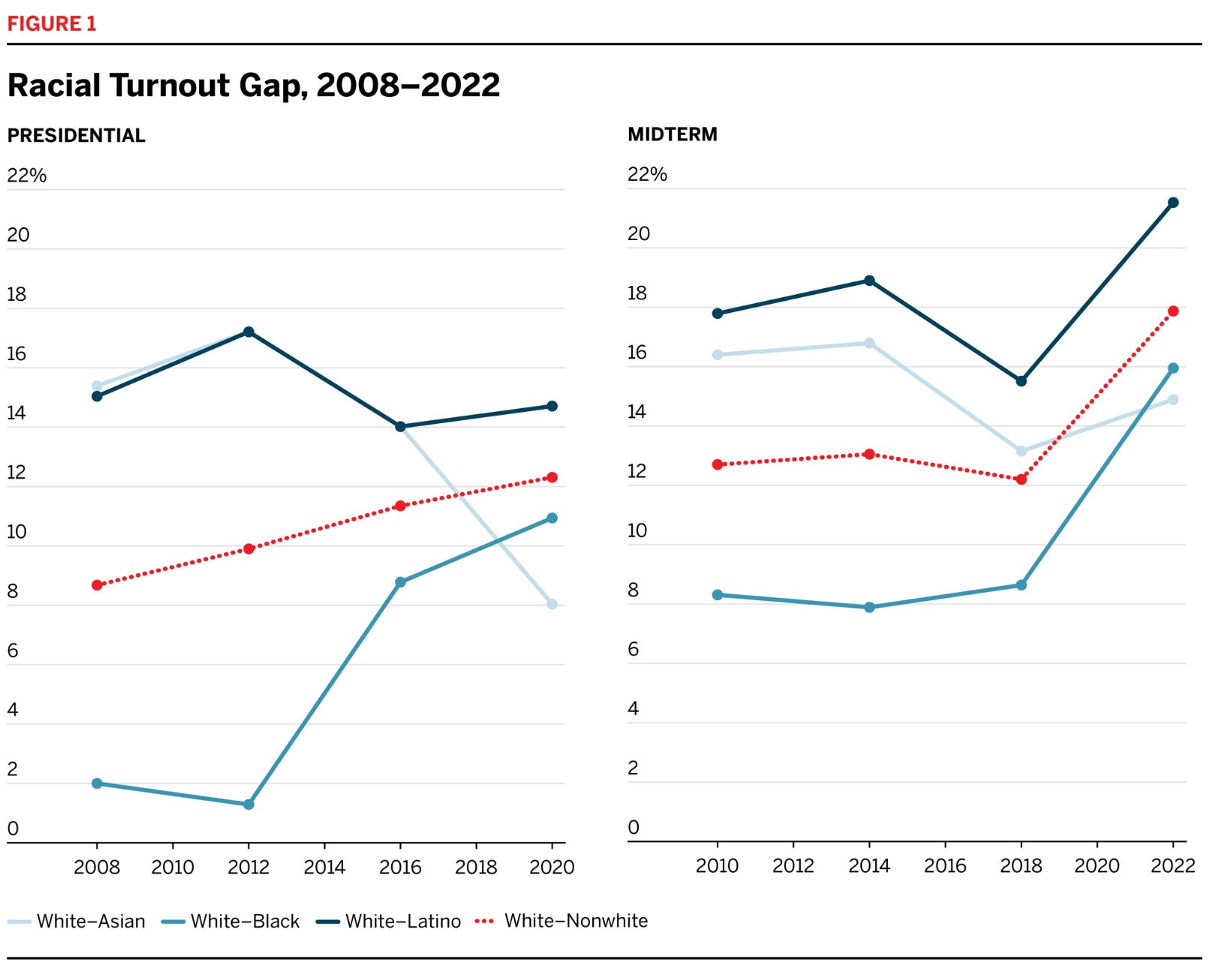
FLIPR’s partisan lean scores are based primarily on the results of the past two presidential elections.6 So if you’re following this logic carefully, you might argue that those scores overrate Democratic performance at the midterms in states with lots of Black voters.
There is another factor that runs in the other direction, however. According to Pew Research, Trump really has shown improvement among Black voters between his three elections on the presidential ballot, going from 6 percent of the Black vote in 2016 to 8 percent in 2020 and 15 percent in 2024.
That support may be extremely Trump-specific, however. In 2022, according to Pew, Republicans got just 5 percent of the Black vote across all U.S. House races.
If we’re keying our partisan lean estimates off of presidential years, we might implicitly be overestimating the amount of Black turnout in states like South Carolina. But we may also be overestimating the Republican share of the Black vote, because the relatively high amount of support that Trump got in 2024 might not translate to a candidate like Graham or Ken Paxton.
But … what if Democrats get the best of both worlds? First, Black support for Republicans reverts back to the ~5 percent that is typical for midterms. (Graham pulled only 4 percent of the Black vote in the Times/Siena poll across a respectable sample size.) But also, say the turnout gap between Black and white voters declines to something more like one of the Obama presidential elections, when it was virtually zero?
Black voters may be reacting to Callais
As I’ve said, you ought to be very careful with early voting data. With early voting data, it’s easy to fool yourself, and to find confirmation for whatever hypothesis you were hoping to “prove.”
Still, some people — not me — specialize in analyzing early voting data. And they mostly seem to be finding very strong turnout numbers among Black voters (and optimistic signs for Democrats generally). For instance, John Couvillon, a pollster and political analyst from Louisiana, has observed Black voters making up an unusually high share of early-voting turnout in Louisiana so far as compared to past midterms:

Couvillon isn’t expecting a Democratic win in the Senate race in Louisiana, but he has predicted the race is “going to be closer than is popularly thought”. (I don’t know if that implies a closer race than FLIPR’s current forecast of the Republican Julia Letlow winning by 11 points.)
Louisiana is an interesting case because it redistricted late in the cycle to remove a second majority-Black district, which will almost certainly cost Democrats a House seat there. Indeed, the Supreme Court decision that enabled this and weakened the Voting Rights Act was called Louisiana vs. Callais. Voters can feel extremely motivated if they feel like they’re being disenfranchised.
Perhaps fearing a backlash, South Carolina Republicans spared Jim Clyburn’s seat in South Carolina, defying Trump in the process. But Black early-voting turnout has also been strong in states like North Carolina and Georgia.
Indeed, the fact that we’re talking about South Carolina — and even a little bit about Louisiana — and not talking much about the Senate races in North Carolina and Georgia might tell you something. Yes, Roy Cooper and Jon Ossoff are strong candidates, but still, they’re running a couple of points ahead of our partisan baselines there. Strong Black turnout would help to turn those states from probable D wins into almost certain ones.
What differentially high Black turnout might look like
How much of a difference could this make? The Citadel poll might provide one hint. I’m generally skeptical of polls that show a large gap between registered and likely voters. But if there’s a state where this makes sense — where the actual electorate is much more friendly to Republicans than the registered voter electorate — it’s South Carolina. The state typically has among the larger white versus nonwhite turnout gaps, especially in midterms.
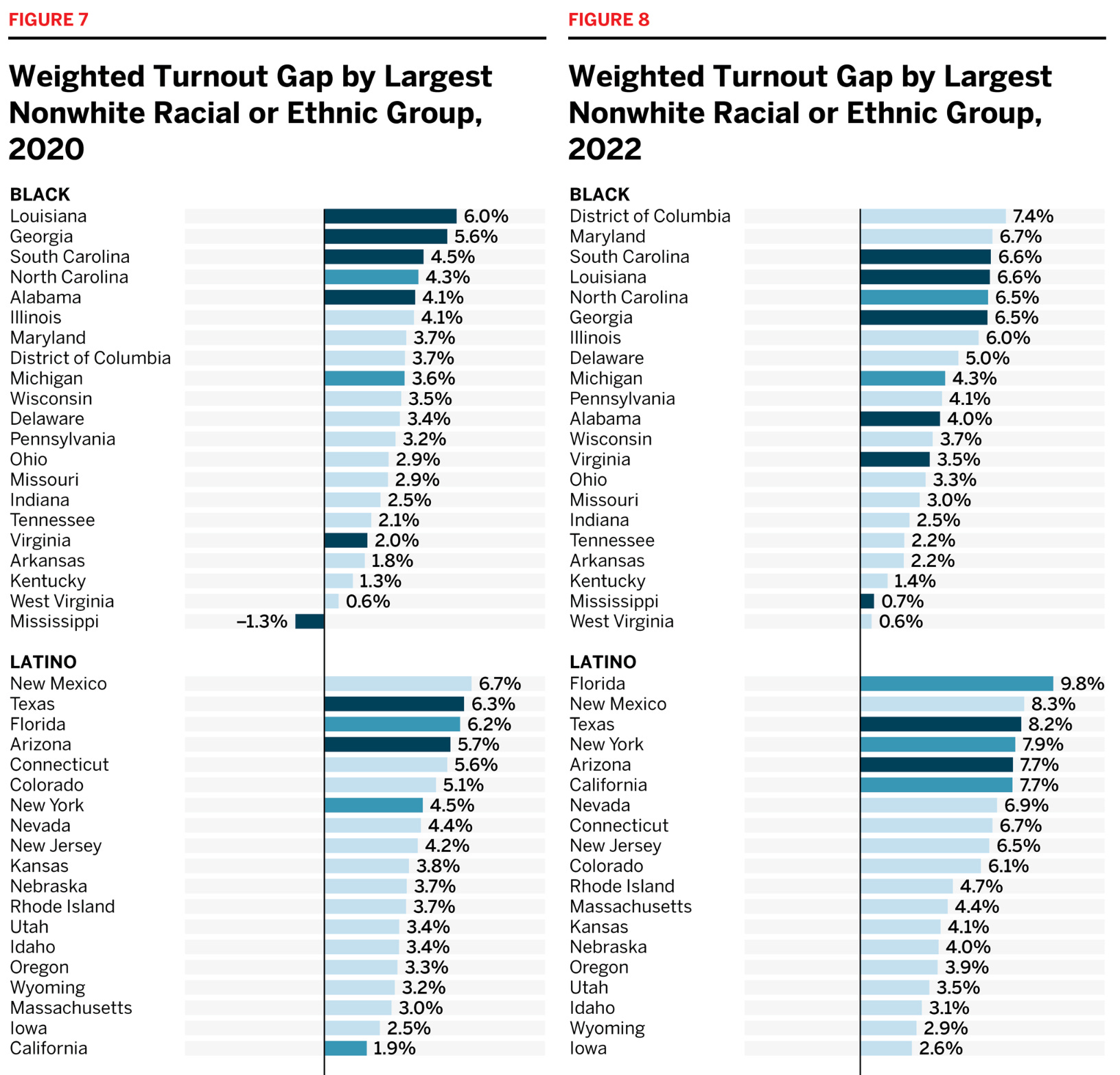
So let’s get a little crazy here. I’m going to run a thought experiment that almost certainly exaggerates the gains Democrats will make from Black turnout, but might provide some sense of direction in a best-case scenario for the party.
Suppose that, based on estimates from AP Votecast, Black voters turn out in the same numbers that they did in the 2024 presidential election in South Carolina, but whites and other groups turn out at their 2022 midterm numbers. What happens? The Black share of the electorate increases from 22 percent in 2022 and 23 percent in 2024 to 30.8 percent in this hypothetical hybrid electorate.
This probably isn’t going to happen. In fact, the NYT/Siena poll still has the Black turnout share at 20 percent this year — so basically 2022 levels or even a little lower. South Carolina’s Black population share is 25 to 27 percent, based on various government estimates, meanwhile.
Just to level-set, though, this would produce a net swing of around 10 to 11 points toward Democrats based on turnout alone, based on typical voting patterns in South Carolina (where the white vote is quite GOP).
Could Democrats get halfway there, so the Black voter share edges up to 25 or 27 percent, in the range of South Carolina’s general population, producing a net swing of around 5 points based on turnout alone? I’m not sure I’d want to rule that out. And interestingly, none if this is so far off from the difference between likely and registered voters in the Citadel poll.
Meanwhile, the NYT/Siena poll projects Andrews to win 7 percent of the Republican vote in South Carolina, but Graham to take just 2 percent of the Democratic vote. And they have Andrews winning independent and unaffiliated voters by 20 points.
You still have to do some work here to get Andrews to a majority. Maybe you start with the Harrison-Lindsey Graham race (R +10) as a starting point. Democrats pick up a few points from turnout. A few more from Darline Graham being a weaker candidate than her brother. And a few more from the overall political environment being considerably bluer than in 2020.7 Her upside is pretty capped.
And Graham does maintain a slight lead in our polling average. There are a bunch of states, like Kansas and Iowa, that everyone pegs as toss-ups but where the Democratic candidates are actually ahead by a point or so in polls. Here, just the opposite is true. South Carolina isn’t a “toss-up”; it’s “Lean R”, and probably closer to the “Likely R” side of Lean R than toss-up.8
But it’s not a race that Republicans can take for granted, and that’s why they’re pumping resources into the state. In some ways, it might help Andrews that the cavalry is coming in relatively late, though, and that she’s flown more under the radar than Harrison, who nationalized the race and perhaps brought it more in line with partisan baselines as a result.
Susan Collins insurance? Farm Belt fiasco protection?
Still, the presence of South Carolina on the list of competitive states — competitive does not equal toss-up — does give Democrats a few backdoor outs of the sort that Republicans were hoping for with Minnesota. South Carolina comes up as the tipping-point state 4 percent of the time in FLIPR.
Obviously, that’s not super likely. But outcomes in Senate races aren’t as correlated as in presidential years. Things can get a little weird. Maine is much bluer than any other battleground state, for instance, but has an 11 percent chance of being the tipping point.
So on what sort of maps might that 4 percent chance come up? Here’s a map with every state’s share of the Black electorate in 2024, according to AP VoteCast data.
Democrats’ toughest defense this year is in Michigan, but it has a decent-sized Black population, which could provide some measure of protection to Abdul El-Sayed. Among potential Democratic pickups from Republicans, the states with the highest Black voter share in 2024 were South Carolina (23 percent), North Carolina (20 percent), Texas (11 percent) and Ohio (9 percent).
If there are regional and/or racial fluctuations in the vote this year, as happened in 2018 and 2022, then South Carolina could join North Carolina and Texas as Democratic pickups. They’d still need a fourth state, but Sherrod Brown in Ohio is one of their better candidates, has consistently maintained a small lead in polls, and won in 2018. And the Black voter share in Ohio could plausibly be considerably higher given better Democratic turnout efforts in the state. Black Ohioans make up 12 to 14 percent of the state’s population by various estimates, mirroring the national average.
Or Mary Peltola could win in Alaska, which has a small Black population but isn’t especially white because of its large Alaska Native population. (Peltola herself is Alaska Native.)
The point is, Democrats do have some alternate paths if they considerably underperform in the whitest states, namely Maine plus the trio of Iowa, Kansas and Nebraska. They do not technically have to pick up any states in the Midwest if they win North Carolina, South Carolina, Texas and Alaska.9
FLIPR, in fact, simulates exactly these sorts of possibilities and they figure into its overall medium-high confidence about Democrats picking up the Senate. It wouldn’t be the conventional way to win, but if polls are exactly right, Democrats will pick up the Senate with some states to spare. It’s always good to have options, even somewhat remote ones, in case something goes wrong.
Even if the map remains more predictable, though, and Democrats lose South Carolina, higher Black turnout could swing a close race toward Brown, El-Sayed or James Talarico. And it helps to explain why the party may barely even need to break a sweat in North Carolina and Georgia.

Minnesota had a notably high percentage of undecided voters in our polling average.
A Tafoya internal poll that showed herself down by 4 points came out too late to make it into today’s FLIPR run, but is a bearish sign for Republican chances in the state, too.
FLIPR uses the likely voter version in its forecasts.
In 2000, Democrat Mel Carnahan died in a plane crash on Oct. 16, but was posthumously elected by 2 points over Republican John Ashcroft in Missouri. His wife Jean Carnahan was appointed to replace him but lost to Republican Jim Talent by 1 point in a special election in the 2002 midterm.
In Rhode Island, Lincoln Chafee was appointed to replace his father John Chafee in 1999, and then easily won the 2000 election before losing by 7 points in his re-election bid in 2006. But each of those results can be well-explained by the fundamentals; 2002 was an unusually good midterm for Republicans given that they controlled the presidency, while 2006 was a great year for Democrats.
While estimates of turnout by racial group vary slightly from source to source, this isn’t usually considered a controversial finding.
One-quarter of the weight is based on recent state legislative elections instead.
Though 2020 wasn’t a bad year for Democrats, just a much worse one than polls anticipated.
FLIPR classifies a race as Lean R if the Republican has greater than a 60 percent chance, and it shifts to Likely R at 75 percent.
Or, more far-fetched in FLIPR’s view, a fourth southern state like Mississippi or Florida. Mississippi and Florida combined have a 3 percent chance of being the tipping-point state.