Imagine you’re trying to learn CPR. You’ve never heard of the technique before and have no idea what it entails. The instructor opens by saying, “Here’s a dummy. Go ahead and try to do CPR on it!” Then they invite you to talk to the person seated next to you about doing CPR. Then they give you half an hour of open exploration time to try out CPR. They circulate the room, asking questions like “Why do we do CPR?” or “What are you trying?”
They are careful not to give away the answer by telling you how to do it.
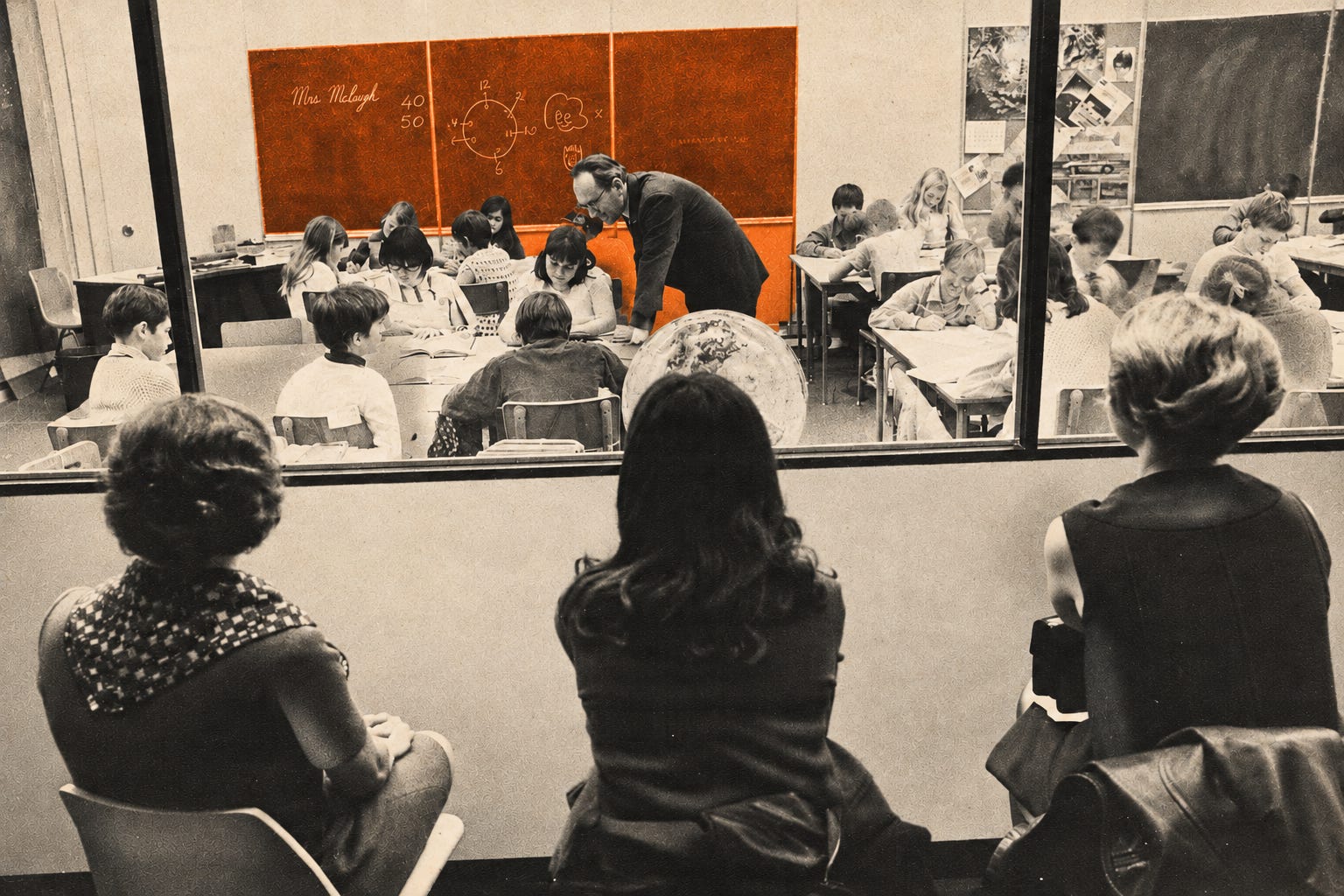
This is what’s called an inquiry-based approach. And while no one would ever consider teaching CPR that way, its adherents argue that it’s the perfect way to teach math.
Determining the best way to teach children is at the crux of the second season of education reporter Emily Hanford’s Sold a Story podcast, which is airing now. It’s a bigger topic than the one she tackled in her first season (the science of reading instruction).
Inquiry — the “think for yourself about how this might work” approach — is a hit with many education theorists. But research has found that the best-performing method, by far, is one called Direct Instruction: a scripted instructional program in which the teacher breaks down new material and has students repeat it until mastery.
Consider how you actually learn CPR: The instructor explains how to do it, asking quick questions to make sure you internalized what was just said. Then the instructor demonstrates it. Then the students attempt it and the instructor tells them whether they’re doing it right or wrong.
That’s direct instruction. We know that direct instruction works extremely well to get poor children reading and doing math at grade level. But, Sold a Story argues, we’ve repeatedly chosen what feels good over what gets results, including refusing to admit it when our comprehensive studies show direct instruction as the strongest method.
Education schools often instead promote inquiry-based approaches, which mostly don’t work as well.
In the 1960s, the U.S. government commissioned a large-scale study called Project Follow Through to see which educational approach produced sustained gains for students. The results were clear-cut: Direct instruction worked extremely well, much better than any of the other programs studied. In fact, most of the innovative programs had negative effects on student achievement (relative to a baseline of normal classroom instruction).
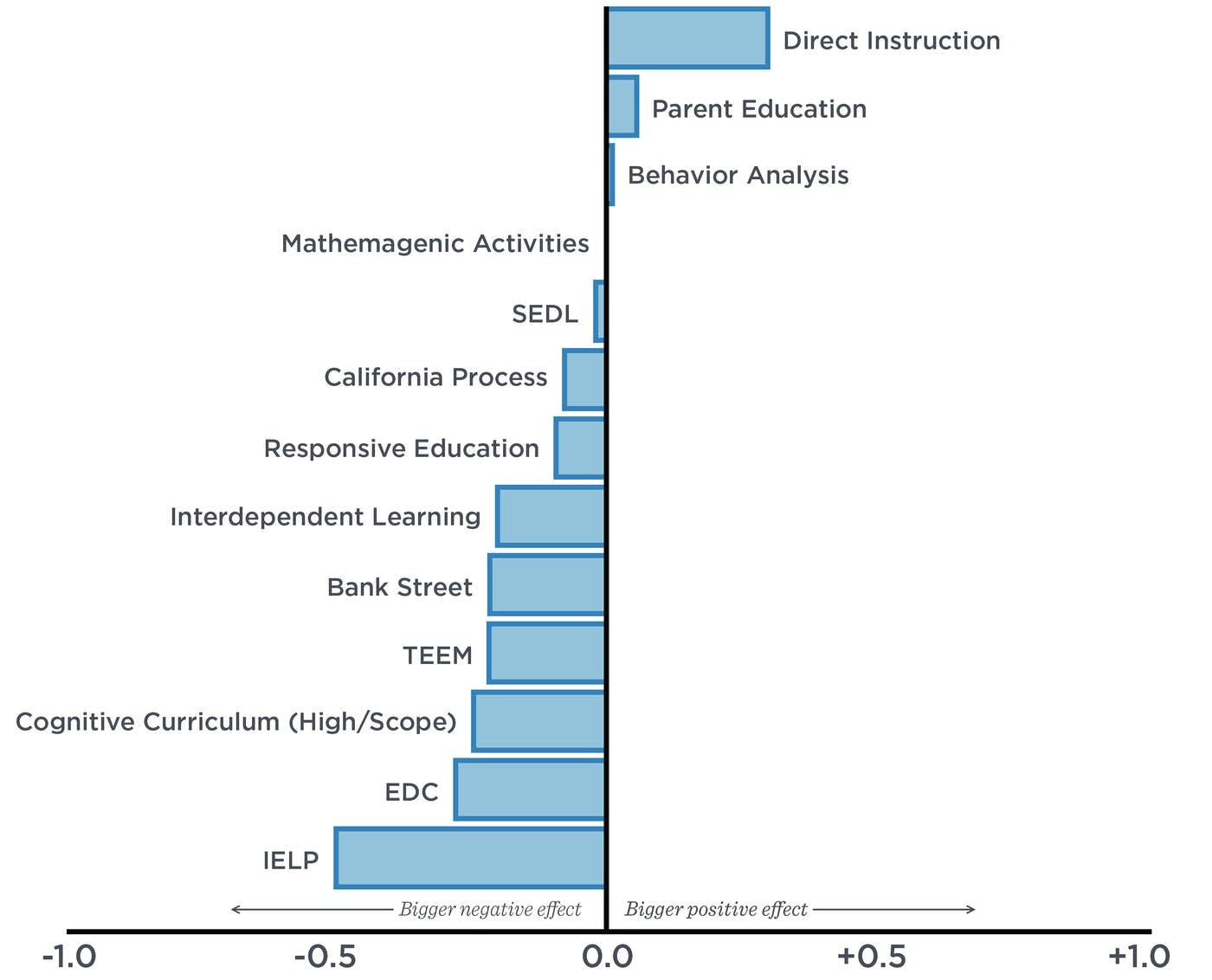
Looking at these results, the government that commissioned the study decided, basically, to pretend it had never seen them. The results buried the facts, and the federal government ultimately decided to highlight individual high-performing schools from each approach rather than be honest that one approach was head and shoulders above the rest.
The podcast meticulously documents how direct instruction’s opponents, who disliked it because it seemed too robotic, persuaded the government to ignore its own evidence. It’s accurate, damning, and compelling.
But, as in season 1, Hanford brings the fire on faddish, non-evidence-based approaches and then is quite fuzzy on the institutional and implementation decisions we would need to make in order to do better. Season 2 is fun and satisfying to listen to — if you agree with her that we’ve neglected the science of pedagogy at great cost to our students.
But even if everyone working in education listened to it and took it seriously, I can’t help but anticipate the result would be of limited utility. Passing a law mandating direct instruction would probably do about as much as passing laws mandating phonics has done — which is to say, not very much. Many states may have changed their phonics laws in response to Sold a Story season 1, but not all have seen actual gains.
And Sold a Story casts inquiry as a villain while ignoring an equally prevalent one: disorganized classrooms with no particular principled pedagogical approach at all. Inquiry makes for a satisfying villain because there are education researchers and education publications fervently evangelizing it1 despite the evidence that it doesn’t work. It has certainly made some inroads in American classrooms.
But Sold a Story somewhat overstates inquiry’s dominance. The National Assessment of Educational Progress asks students whether they do inquiry-style activities in the classroom; almost half never do, and few always do.
Most classrooms, most of the time, are nonideologically muddling along with a mix of lecture and activities — just like most classrooms, most of the time, are nonideologically muddling along with a mix of phonics and guess-and-bluff reading strategies. That means that fixing classrooms takes more than bold truth-telling about what works. It’s going to take changing how we teach teachers, acquire curricular materials, and measure results.
Direct instruction versus inquiry
The first season of Sold a Story has to qualify as the most impactful education reporting of the decade. It told parents around the country that their children were often being taught to read with guess-and-bluff strategies that don’t work instead of the systematic, phonics-based strategies that do. In its wake, 26 states have passed laws mandating science of reading-based instruction.
Season 2 champions an even broader pedagogical method — one that can be effectively applied to reading, math, and really any subject besides. Pioneered by educator Zig Engelmann in the 1960s, Direct Instruction involves teachers explaining concepts in very small doses with carefully designed explanations, then immediately pushing rapid-fire practice questions, with students answering in chorus.
Engelmann’s team reported remarkable results with disadvantaged students — they actually started out working specifically with the younger siblings of students who were failing, according to Sold a Story — and in large-scale studies of which education interventions work, Direct Instruction is consistently at the top in terms of efficacy.
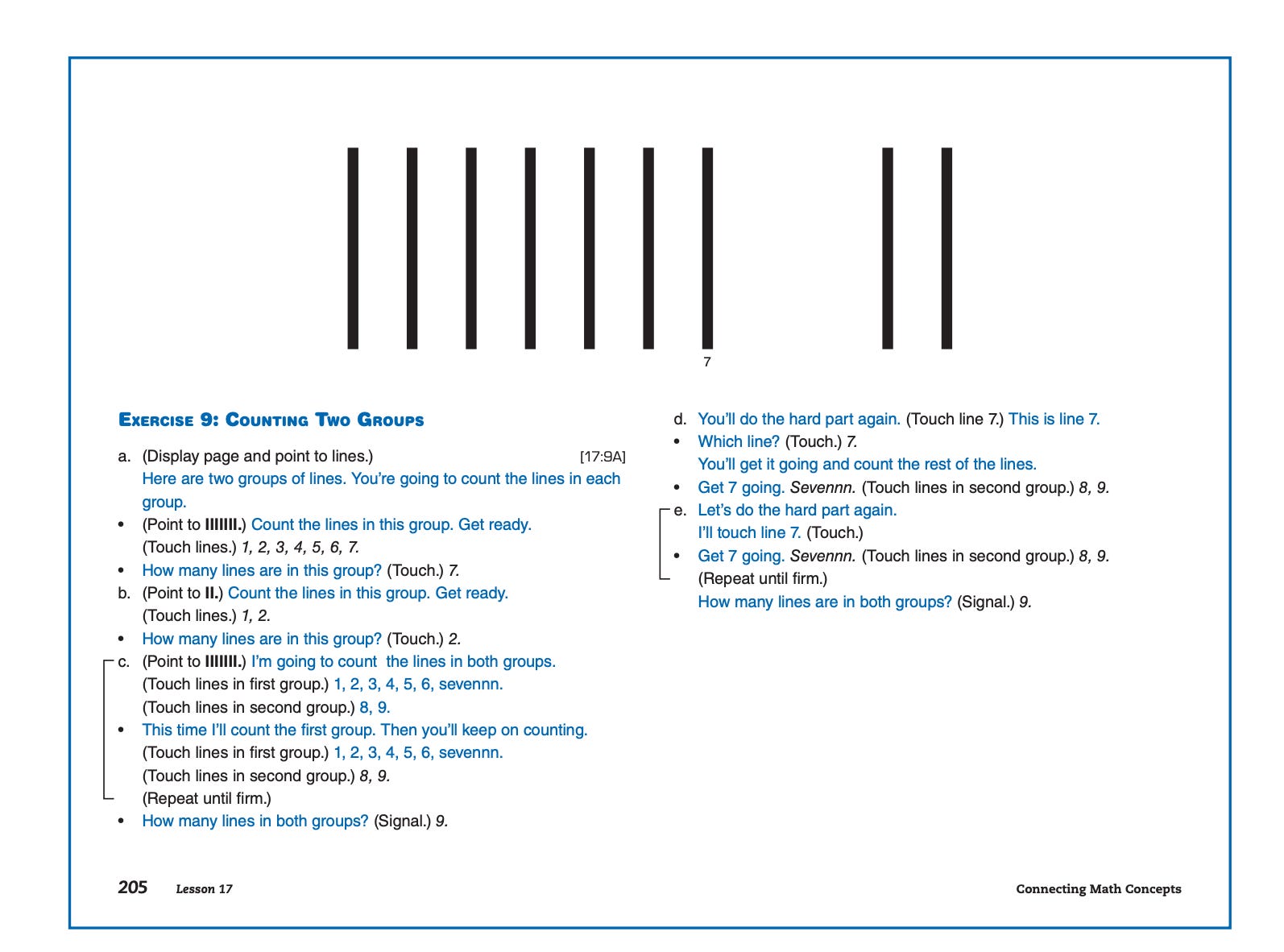
Direct instruction’s foil in Sold a Story is inquiry-based curricula. Perhaps the best way to see the difference between the two methods is to see how they handle teaching simple arithmetic. Here’s a direct-instruction-based lesson plan for teaching the counting skills that are foundational to arithmetic:
Here is a lesson on counting that uses the inquiry style:
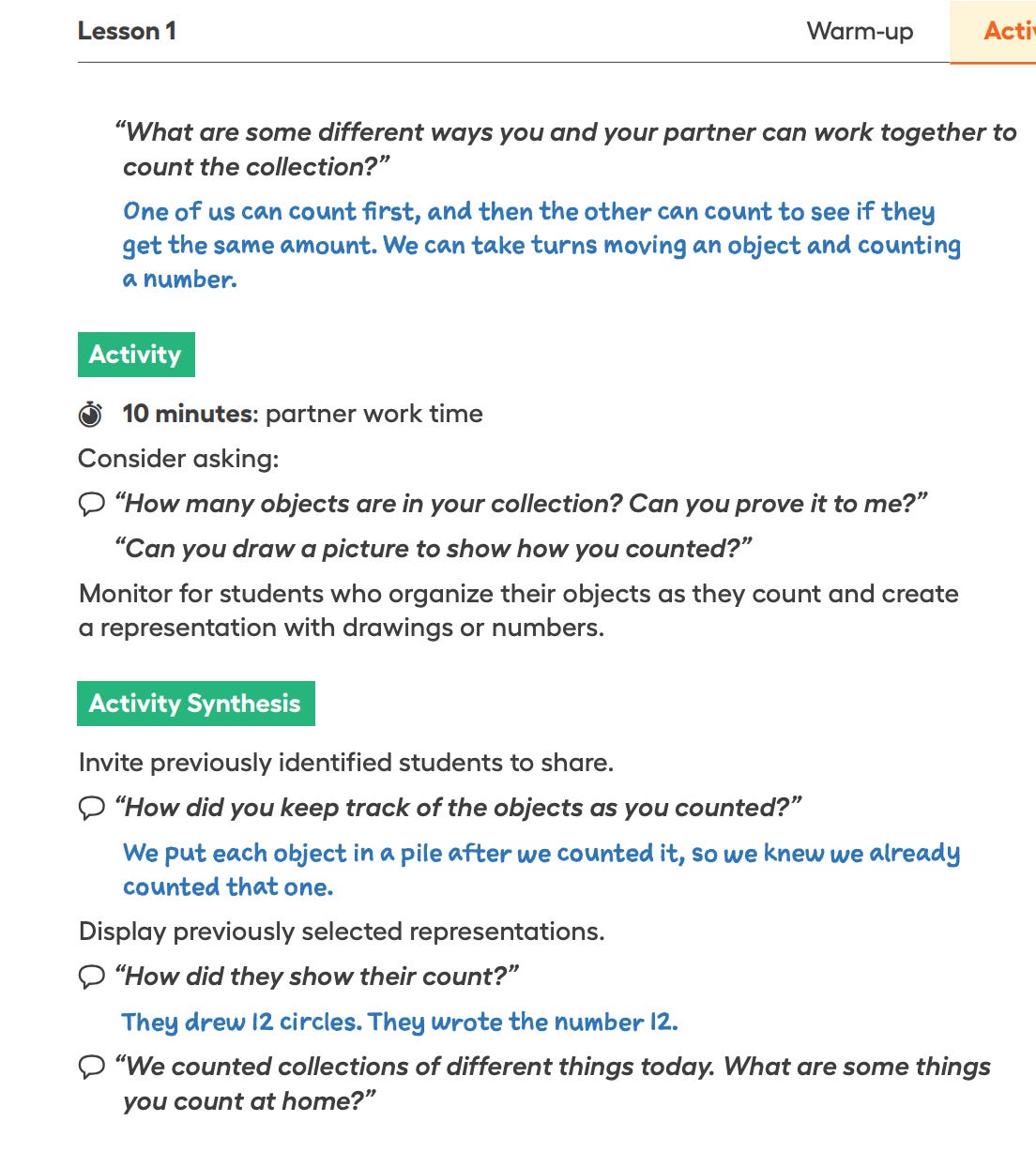
The direct instruction method involves demonstrating the skill to the students, then doing it with the students, then prompting the students to do it themselves. This is repeated until all of the students can do it.
The inquiry-based method avoids demonstrating the skill, instead asking students to start by developing the skill independently. The teacher is specifically discouraged from “giving away the answer” by demonstrating the skill. An hour goes by without the teacher actually confirming that the sum of 3 and 4 is 7.
People tend to like the second method because it feels more open-minded and playful. It appears to take advantage of kids’ natural curiosity. The problem is that it doesn’t work. Some of the kids in the room will already have the target skill, and it will “work” for them. But if a kid doesn’t have the skill, they will be confused until the end of the lesson — when there may actually be a demonstration.
Most people find it intuitive that the inquiry approach wouldn’t work for something like CPR. But it also feels intuitively like it might work for arithmetic. I suspect this is because we already know arithmetic, so we forget what it’s like to not know arithmetic — to be as ignorant of how to approach 3+4 as someone without any emergency training might be of how to approach CPR.
Note also that the direct instruction exercise takes about 5 to 10 minutes to read through, while the inquiry-based one allots a full 10 minutes just for “partner work time” where no instruction is taking place. This suggests that, because teachers using direct instruction don’t need to allow so much time for student-led exploration, they can cover significantly more material in the same amount of time. So even if the two methods were equally effective, direct instruction would be a lot more efficient. Especially for students who are starting out behind, that makes a big difference. So schools really should do a lot more direct instruction and a lot less inquiry.
…but most classrooms are doing neither
In the typical classroom environment, though, it’s simply not the case that students are losing out on a direct-instruction-based education because their educators are executing on a strictly inquiry-based curriculum. On the ground, research consistently finds most educators are adopting a mix of strategies and pulling materials together from multiple curricula based on what seems to them to work and what they have the resources to do.
As Michael Pershan put it in his review of Sold a Story season 2, most classrooms are still the teacher stands at the board and explains the material — not Direct Instruction, Engelmann’s specific program, but certainly some kind of direct instruction, the idea that to teach children, you explain things to them and demonstrate with examples.
In fact, supporters of inquiry have noticed this same thing, and they frequently complain about it. “Teacher-directed instruction dominates classroom lessons,” Larry Cuban’s The Enduring Classroom, a book on the history of instruction in America, complains.
There are popular inquiry-based curricula, but as they’re used on the ground, teachers are almost always offering explanations to their classes — or, as Pershan argues: “teachers are often assimilating the curriculum to the default pedagogy. They are transforming [an inquiry-based math curriculum] into mediocre direct instruction.”
Inquiry is popular in schools of education. It is popular with parents, and most programs, however they actually teach, will claim to have an inquiry element. Even direct instruction programs will often emphasize fostering student collaboration and creativity; the language used to describe a program isn’t always that clarifying about what (if any) approach it employs.
But there aren’t many schools that are really trying to do pure inquiry-based instruction. Instead, most schools do have teachers in front of the class explaining the material.
It’s just that pure explanation is, all by itself, not that useful.
Engelmann’s Direct Instruction is not just “explain it, demonstrate it, and then let the students do it” — it involves breaking skills down into tiny subskills and drilling each of those to mastery, with choral responses from the students. The teacher is specifically tasked with noticing if any student’s responses fall off. It is a remarkably effective program, but achieving its results takes a lot more than a philosophy of instruction. It is almost entirely about implementation.
That’s why, if season 2 of Sold a Story breaks through and gets a flurry of new education laws passed, it still won’t do much. Telling teachers to do direct instruction won’t save our schools.
Top-down directives about how to approach education don’t have a huge effect either.
Actually implementing Engelmann-style programs probably would make an enormous difference. But it would be difficult — just like real reading reform is difficult, even though passing laws about phonics instruction is easy. You would need appropriate curricula, intensive teacher training on the curricula so that teachers know how to teach with them, and ways to measure which classrooms are working.
Mississippi’s phonics success isa blueprint here: First, pay to acquire high-quality curricular materials that have a demonstrated, successful track record. Then, pay teachers to attend training on how to effectively use those materials. Then, track results classroom by classroom and send intervention specialists to classrooms that are underperforming.
This gets glossed as “Mississippi did phonics.” But everyone did phonics. Mississippi did it with good implementation.
In order to really achieve a direct instruction system, we will most of all need Engelmann’s obsession with whether students are actually learning. No high-level directive can substitute for that, and no plan for the science of learning will work without it.
Recommended reading:
A recent article about how the science of reading offers a blueprint for math reform in Washington, D.C., actually describes a classroom using an inquiry-based approach. If the lesson is as the article described it, it runs contrary to the science of education: “While students tested their ideas and debated, the teacher moved from board to board — not giving out answers, but pushing students to explain what they saw and why.” This works only for students who already basically know the skill — just like telling people to practice CPR themselves without giving away the answer. There’s some evidence for guided inquiry in science, but not nearly as much in math — and a crucial element is still the part where the teacher explains what the students were supposed to have learned.