“What would it take to create a world in which every baby is welcome, without this coming at the cost of his or her mother’s personhood?”
This was the question that Mary Harrington, contributing editor at UnHerd and self-described “reactionary feminist,” asked at the outset of the 2026 Women’s Convention, a three-day conference I attended last month in Rochester, New York. Harrington and I disagree on just about everything, but her question struck me as a good one. What could be more true to my own liberal politics than ensuring the dignity and well-being of women who choose to have children?
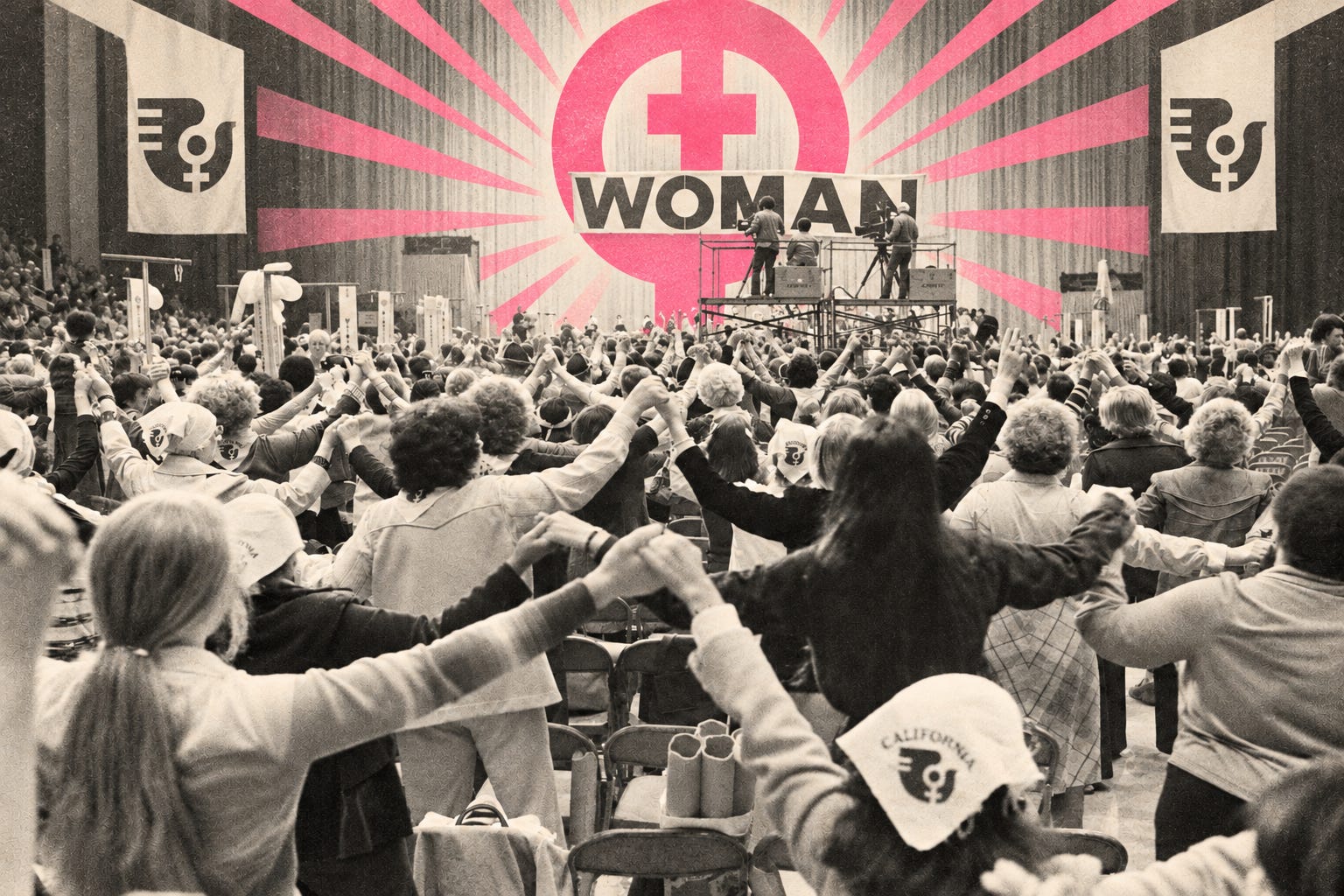
The conference was co-hosted by the “sex-realist” publication Fairer Disputations and the anti-abortion advocacy group Feminists Choosing Life of New York. Like Harrington, most of the 200 women in attendance were white, married, and Christian. I met a publicist from Colorado, a chaplain living in Texas, and a homeschooling mother of four from New Jersey. All of them gave me the impression that they could breastfeed and debate Aristotle at the same time.
No one I spoke to was enthusiastic about Donald Trump (or the Democratic Party). Several expressed concern about the growing threat of misogyny on the right. A gaggle of conservative college women from Michigan told me they worried about their male classmates who joked about repealing the 19th Amendment. When guest speaker Helen Roy, a popular Catholic Substacker, mentioned Defense Secretary Pete Hegseth onstage, the auditorium collectively groaned.
One morning, I carpooled to the conference venue, a Tudor Revival mansion in a leafy part of town, with a group of chatty ladies in a minivan. If they were put off by my press badge and libbed-out vibe, it didn’t show.
And yet, however friendly I found this congregation, however well-read and well-dressed, improving the material lives of mothers was not what they wanted to talk about.
The presentations and panels I attended, as well as the many conversations I had over lunch and tea and cake, seemed gravitationally pulled away from childcare policies and toward the countless evils of liberal feminism: hookup culture, pornography, abortion, birth control, in vitro fertilization, surrogacy — to name just a few.
I am not against debating any of these issues, but the women I met in Rochester did not convince me that they ought to be the focus of a bipartisan, pro-family agenda. Much more could be accomplished with old-fashioned welfare policies, such as generous parental leave standards and child allowances, because such policies recognize both the unique challenges faced by mothers and the increasingly gender-neutral realities of caring for children in America.
These are realities that the assembled women seemed to be living out in their own egalitarian marriages, despite their obsession with sex differences. (Even among conservatives, time spent caring for children has risen fastest among fathers, not mothers.)
Ultimately, I left the Women’s Convention more certain than ever that cracking down on overachieving girlbosses who have premarital sex, freeze their eggs, and watch porn is not how you help American parents.
No one hates children. Please be serious.
Despite the country’s wealth, having kids in America is a daunting proposition. There is no federal law guaranteeing paid family leave, childcare is absurdly expensive, and employees are expected to log more annual hours than in most other wealthy nations. There really are big professional and personal trade-offs associated with raising children, especially for women.
The left and right agree that having a family should be easier. But despite the conferencegoers’ disdain for MAGA, their answer to the question of what has gone wrong in American family life is very similar to one offered by the second Trump administration: Some version of liberal or second-wave feminism is to blame.
Vice President JD Vance has long attributed the falling birth rate to an “anti-child” ideology propagated by a managerial class of liberal elites. In 2022, shortly after the Supreme Court overturned Roe v. Wade, he tweeted: “If your worldview tells you that it’s bad for women to become mothers but liberating for them to work 90 hours a week in a cubicle at the New York Times or Goldman Sachs, you’ve been had.”
This past January, Vance gave a speech at the 2026 March for Life, saying, “Today, the far left in this country tells our young people that marriage and children are obstacles ... that life itself is a burden.”
It’s a convenient political position: As long as the problem is primarily cultural rather than economic, it doesn’t take much to look like you’re solving it. Announcing that you have a fourth kid on the way is enough to make it seem like you are bravely defeating the cat ladies who cowed everyone else into childlessness.
Unlike the vice president, the Rochester women seem genuinely interested in solving the problem. But here is what you have to understand about them: They care a lot about biology. Their central claim is that there are immutable differences between the sexes that social gender identity cannot change — hence the label “sex-realist” feminism.
You cannot just “identify” as a woman, you simply are a woman by virtue of your biology. To be a woman, according to the mission statement of Fairer Disputations, is to be “a person whose body is organized according to the tremendous potential to grow another human being within.”
From this metaphysical perspective, women who do not have biological children — such as lesbians, transgender women, single girlbosses — challenge the very thing that makes women distinct from men, the thing that ought to afford them distinct protections and privileges.
This is the idea that united every headline speaker at the convention, and it’s also the one that puts their intellectual movement at odds with the central claim of liberal feminism: that no one’s lot in life should be determined by their sex. The sex-realist writers who presented at the convention — including Louise Perry, author of The Case Against the Sexual Revolution, and Leah Libresco Sargeant, editorial director at the Institute for Progress (as well as a contributor to The Argument) — share a suspicion of what they consider to be “transhumanist” interventions into the natural female body.
In her welcoming address, legal scholar Erika Bachiochi accused “the regnant form of feminism” (her pejorative for the second wave) of assuming “a series of technological incursions into the body of a young woman such that she can become the equal of a man.” These incursions include “a lifetime on the contraceptive pill, abortion at the ready, the availability of egg-freezing, and other reproductive technologies.”
The upshot is that women who opt into these technologies (not to mention those who commit the unspeakable offense of being trans) have made life worse for all the women who refused them. Like a worker crossing the picket line, the childless corporate lawyer undermined the collective bargaining power of normal women who wanted normal things, such as raising a big family.
When motherhood is understood as a personal choice, rather than an unavoidable fact of life, institutions are under less pressure to accommodate mothers. If women want to make their lives harder by getting pregnant, that’s on them! As a 29-year-old from Seattle described it to me: “Liberal feminism is the new patriarchy. It tells women what to do with their bodies: work all the time and don’t have kids.”
What is clever about this argument is that it draws on pro-choice logic: A liberal society should protect the rights of women who choose to forgo contraception and artificial reproductive technology.
Around 1 in 5 Americans identify as Catholic and are, in theory, bound by church doctrine, which opposes most human intervention in reproduction. Evangelical Protestants, who make up around 23% of the population, tend to hold a similar set of beliefs. That a sizable number of women would feel defensive about their right to defy what has become increasingly normalized by secular society makes sense.
But the case being built at the Women’s Convention went well beyond religious freedom. The main charge against liberal feminism wasn’t that it had served some women and neglected others — it was that it had done an injustice to all women, convincing them that they had to change their bodies and disavow childbearing to be free. In this framing, the freedom to have an abortion or get an IUD isn’t freedom at all; it is a kind of payoff from a society that doesn’t want women to live as women.
Now, there are countless objections to be made against biological essentialism. For one, it sets up trans individuals as the ultimate threat to cisgender women, which, irrespective of your stance on puberty blockers, is simply a cruel and ludicrous war to wage.
It also sidelines the women who would like to get pregnant but can’t, either because they are infertile, as roughly 10% of American women between the ages of 15 and 44 are, or because they know that pregnancy might cost them their lives.
Then, of course, there is the possibility that a woman might not want to be a mother.
In reality, most Americans want to become parents — even, and perhaps especially, the high-powered career woman whose norms are being blamed for the downfall of Western civilization. Among American millennials, 75% of college-educated women born in the early 1980s married and became parents by 40. For non-college women, that number was 68.1%.
Whatever campaign is happening against traditional family values on progressive college campuses, it is not a very effective one.
As Jordan McGillis and Cathy Reisenwitz recently wrote for The Argument, family formation primarily poses a challenge for Americans without college degrees, largely due to the declining standing of working-class men. Today, it is much harder for non-college women to find husbands who have the relative earning power of their fathers or grandfathers, let alone the commitment to intensive fatherhood that is fast becoming the modern norm.
The Women’s Convention’s accusation against liberal feminism was that it pushed women to meet traditionally masculine standards, “in the bedroom and in the marketplace.” Instead of treating women as defective men, these women argue, society should accommodate women’s unaltered bodies.
In the abstract, that’s all fine and well (although I didn’t see much leg hair at the conference).
But among Americans in the lower half of the income distribution, the problem is not that women are being forced to pursue masculine ideals that they can’t meet. It’s that men can’t meet the masculine ideals of 50 years ago because modern economic conditions favor a very different model of marriage (an egalitarian model that Americans say they prefer anyway).
The mismatch in the non-college marriage market is a different beast entirely from elite women opting out of motherhood because Gloria Steinem convinced them children were deadweight. It is also one that the “sex realism” espoused at the Women’s Convention provides no solution for.
Men and women can change
I have never been pregnant or given birth. And if I do, I imagine that I will want everyone to give me a lot of credit for having done those things — more credit than my co-parent who did neither.
The realities of reproduction are, however, not the same as the realities of caregiving. While mothers typically play a distinct parenting role for the duration of pregnancy and, to a lesser extent, breastfeeding, this period of time is then followed by a lifetime of parental obligations that do not require this or that reproductive organ.
Sex-realist feminism isn’t particularly interested in that distinction. The view is basically that, if you have a uterus, your entire life, from the day you are born to the day you die, is defined by this physiological trait.
“But not in a bad way!” the sex realists will tell you. “Your uterus is a gift!”
The only thing is, I would quite like my uterus to not determine who picks up the kids from school or changes their diapers or puts them to bed at night. I also don’t want it to determine who in my marriage makes more money or gets to attend fun conferences.
The good news is, I don’t actually think the Women’s Convention participants want this either. Almost all of them went to college, many of them have law degrees, and an astounding number of them have Substack followings that put many of us liberal feminist writers to shame.
They were also open about the fact that they have husbands looking after their three or four children for the weekend. When I told them that where I come from (Denmark), fathers on average take 11 weeks of parental leave, compared to just one week or less in the U.S., they were approving.
Some social conservatives have started to blame liberal elites for disparaging traditional family life in public while privately living what look like traditional values: marrying, having children, and settling down. But this critique cuts both ways. Highly educated conservatives, including Vance and the women I hung out with in Rochester — who can quote Aquinas off the cuff and write books in their sleep — seem happy to practice gender egalitarianism in their private lives, as long as they don’t have to preach it as a cultural message.
But they should preach it. I understand why some of these women were frustrated to have three kids in their 20s while their childless female peers from law school zoomed up the corporate ladder. But if the traditional male breadwinner-female caregiver household — where men outearn women and women out-parent men — is the only kind of marriage our biology allows for, the future of the American family looks bleak.
On the other hand, if we assume gender roles are malleable, then a whole world of opportunity opens up. This does not necessarily mean promoting a culture of “radical autonomy” or “anti-child ideology.” On the contrary. It means making a “family-first” life possible for more people — not just women in heterosexual marriages with biological children.
The first injustice of several listed in the Declaration of Interdependence, the conference’s de facto manifesto, states that it is “unjust for ... society to champion those who are unencumbered by familial responsibilities as the standard bearers of equality and civic and economic participation.” Hear, hear.
Again, this part of the message clearly has cross-ideological appeal. The leftist theorist Nancy Fraser argued for something very similar in her 2013 book Fortunes of Feminism: institutions should “welcome human beings who can give birth and who often care for relatives and friends, treating them not as exceptions, but as ideal-typical participants.”
Unlike the sex realists, Fraser is explicit that men and women bear equal caregiving responsibilities. For her, biological realities are only as limiting as the political system allows.
Fraser’s position is that men should lead the charge on changing norms around parenting. Precisely because they don’t face discrimination for the biological fact of pregnancy, men are the ones who should be applying pressure on employers by taking paternity leave and clocking out early to attend ballet recitals. That pressure creates space for women to pursue both vocational fulfillment and family life without undue sacrifice.
But biologically fixed gender roles get in the way of this project. By the logic of sex realism, it is always women who are at fault. You can’t very well blame men for not taking on the burdens of childcare if they’re just following their reproductive destinies. You can only blame the girlboss with frozen eggs for shirking hers.