What would it mean to be human in a world where AI has made our labor obsolete? Jerusalem and Matt use Hannah Arendt’s The Human Condition as a jumping off point to tackle this question in their latest book club podcast episode. Paid subscribers can watch or listen to the episode ad free or read the transcript. Free subscribers can watch the episode on YouTube or listen at their podcast provider of choice.
Subscribe: Apple Podcasts | Spotify | YouTube | Overcast | Pocket Casts
The U.S. is facing a daunting fiscal future. The federal government’s publicly held debt roughly equals our annual economic output, $32 trillion, representing a debt-to-GDP ratio nearly the highest in history and about twice the average of the past 50 years. And we’re still digging — in fiscal year 2026, the federal government spent nearly $2 trillion more than it collected. Even as the economy was growing due to an AI boom, the deficit was around 12% larger than the year before.
The current fiscal debate in Washington is trapped in a bleak binary: The only “serious” solutions offered to address our mounting national debt are tax hikes or painful spending cuts. The math, as it has been presented since at least the Obama-era deficit fights of the 2010s, seems to demand nothing less.
However, viewing the deficit solely as an exercise in subtraction is a failure of the liberal imagination.
Democracies crumble when they are locked in a zero-sum battle over a stagnant economy. If our only answers to the deficit are tax increases and spending cuts, liberals will miss out on a whole host of growth-enhancing measures — embracing high-skilled immigrants, building abundant housing and energy resources, investing in the capabilities of children, and aggressively funding innovation — that can make budgetary trade-offs less painful.
Think of the debt-to-GDP ratio as a race between the growth of our debt and the growth of our economy.
Policy changes that raise GDP growth necessarily hold down the debt-to-GDP ratio — they increase the denominator even if the numerator holds steady. Furthermore, higher GDP implies more taxable income, which brings in more revenue and reduces deficits and debt. (Doug Elmendorf, Glenn Hubbard, and I described this in greater detail in a recent paper.)
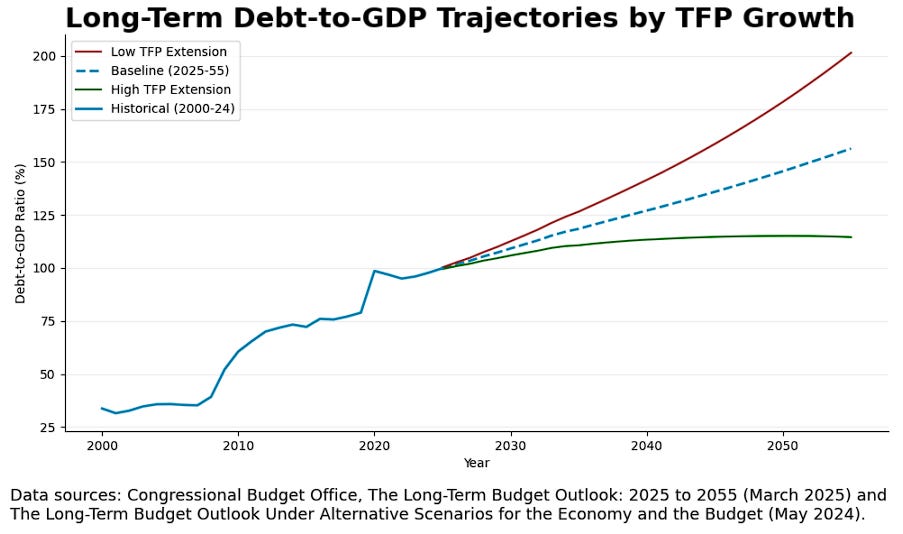
The sensitivity of our national debt to productivity — the rate at which capital and labor are transformed into economic output — is staggering. Total factor productivity growth averaged nearly 2 percent per year for the first few decades after World War II, the peak of the New Deal order that liberals are so often nostalgic for. In fact, this productivity growth was a precondition for postwar prosperity.
But productivity growth plummeted to just a few tenths of 1% from the mid-1970s to the mid-1990s, and recently has sat well below historical averages. If we could increase productivity by an additional 0.5 percentage points each year, relative to Congressional Budget Office expectations, the debt-to-GDP ratio would be stabilized within three decades, according to our findings. The debt-to-GDP ratio would be 42 percentage points smaller at that time.
Some of the measures I’m proposing could be achieved at a low-enough budgetary cost that they would significantly reduce the severity of the austerity required to stabilize our debt. And many of them promote equity and other liberal priorities besides: High-skilled immigration, more housing, cheaper energy, and investments in poor kids are all more likely to benefit those at the bottom of the distribution than the top.
Here are the four areas where it makes perfect sense for equity-minded liberals to become apostles for growth.
The safety net as an investment
Social programs like healthcare and education are often viewed as indirect ways of achieving redistribution. But they can also be profound engines of economic growth for the simple reason that they can greatly increase the earnings of beneficiaries. A wide range of literature confirms that healthier and more-educated people earn more money.
So, when Democrats consider which social safety-net programs to prioritize the next time they have legislative power, it’s worth trying to choose ones that actually reduce the deficit long-term, at least as one consideration. These are typically programs that benefit children: Children are unable to spend for themselves and have many working years ahead of them to benefit from investment.
Indeed, a growing research literature shows that government programs providing benefits to lower-income families help children not only by raising their standard of living in the present, but by significantly increasing their subsequent earnings as adults. Since adults’ earnings reflect their productivity, this implies that safety-net programs for children directly increase future national output.
Economists Nathaniel Hendren and Ben Sprung-Keyser evaluated this through a metric called the “marginal value of public funds,” finding that spending on healthcare and education for children in lower-income families has incredibly powerful, positive budgetary feedback. For example, they estimated that every $1 spent on the four major expansions of Medicaid for children generated increases in subsequent earnings that improved the federal budget balance by an average of $1.78. Early childhood education programs demonstrate similar budgetary returns over time.
New programs may not be as beneficial as existing programs if they are poorly targeted.1 Nevertheless, by investing in the capabilities of the next generation, we foster egalitarian outcomes while simultaneously growing the tax base that will help stabilize our national debt.
High-skilled immigrants are good for productivity
H-1B visas, which allow U.S. employers to hire foreign workers for “specialty occupations” requiring a bachelor’s degree or higher, are capped at 65,000 per year. Another 20,000 are available for advanced-degree holders, mostly in STEM fields.
The economic drag of these arbitrary caps is immense. Research by Marta Prato demonstrates that migrant inventors significantly boost productivity by generating technological innovations. She measures this by first collecting data on the large amount of patenting activity by high-skilled immigrants, then by measuring the resulting increase in innovation from domestic researchers (it’s helpful to have smart collaborators). She finds that expanding this immigrant pool pays big dividends.
If the United States were to admit more foreign workers with advanced STEM degrees, it would greatly boost both the size of the workforce and productivity growth.
Because of the resulting macroeconomic growth, there would be a direct and highly positive effect on the federal budget balance. While some immigrants receive federal benefits, the draw of high-skilled immigrants on the budget is significantly exceeded by the gain in federal tax revenue from their earnings.
In short, these workers pay a lot in taxes because they earn a lot of money. They increase the productivity and thus the tax revenue of domestic innovators, and they make relatively little use of social safety-net programs.
Prato estimates that doubling the size of the H-1B program would raise annual U.S. productivity growth by about 0.05 percentage points after 25 years, which is roughly 10% of what is needed to stabilize the debt-to-GDP ratio. Not bad for a single policy that doesn’t require spending cuts or tax increases.
When deregulation promotes equity
Current land-use regulations hinder the building of both single-family houses and multi-family dwellings across the country, functioning as a massive, regressive tax on mobility and opportunity. These regulations increase the time needed for planning, mandate unnecessary features, reduce the efficiency of construction — and in many cases, completely ban building beyond a low density.
Consequently, house prices and rents are artificially inflated, imposing heavy burdens on families and locking workers out of areas where pay is highest. This inability to live in the most productive places destroys economic output. Relaxing these rules in turn lowers the cost of housing, enhances mobility, improves job matching, and could even lead to higher fertility rates — which taken all together raise average productivity and expand the labor force.
Research indicates that between 1980 and 2010, if we had slackened land-use regulations (such as maximum density requirements) in just the seven metropolitan areas with the largest wedges between housing prices and construction costs, the resulting migration to highly productive areas would have increased the 2010 level of national GDP by nearly 8%. (Expanding housing supply also tends to support equity because more supply drives down rents and housing prices in ways that relieve lower-income families the most.)
Similarly, the administrative state’s permitting apparatus — including things such as the National Environmental Policy Act (NEPA), historic preservation requirements, and fragmented siting authority for electricity transmission — should be reformed to unlock growth in infrastructure and clean energy. NEPA, for example, requires exhaustive environmental reviews for federally funded projects, projects on federal lands, and actions affecting regulated air or water quality.
While intended to force consideration of a project’s impact on ecosystems and public health, NEPA has ended up creating veto points that, in practice, sometimes can block more public benefit than they protect. (See more on that in this earlier work of mine.)
During the Biden administration, Congress acknowledged this bottleneck. After passing the CHIPS and Science Act, it explicitly exempted certain semiconductor projects from NEPA to speed up implementation.
We need to apply this logic more broadly. Easing the restrictions imposed by permitting laws of many sorts would accelerate planned infrastructure and increase the overall number of projects by raising expected returns to investment. Building faster means growing faster.
When it comes to energy, similar ideas have been the subject of bipartisan congressional proposals for a few years now — most prominently the Senate’s recently released Bipartisan American Affordability and Jobs Act, or BAAJA. It would cut the window to sue over federal environmental or historic preservation reviews from six years to 150 days, and it would require courts to set a deadline of no more than 180 days for agencies to fix any permitting issues.
BAAJA would also make it easier for the Federal Energy Regulatory Commission to override state, local, and regional rules to build the interstate and interregional transmission lines needed for faster renewable energy deployment — in other words, more regulation by the federal government to reduce regulation by other actors.
Many climate advocates oppose the bill because it would make life easier for the oil and gas industry. And it’s true that making it easier to build generally does make it easier to build dirty energy in addition to clean.
But the benefits of deregulation will still flow heavily in a climate-friendly direction: Estimates suggest that transmission reforms would reduce grid emissions by roughly 6.5 gigatons of CO2-equivalent through 2050. (That’s because a lot of renewable energy opportunities are far from cities and need transmission to reach customers. Plus, solar, wind, and storage account for roughly 85% of the proposed capacity waiting to connect to the U.S. electricity grid.
Nobody has run a permitting bill through a macroeconomic model and produced a number confirming how much it will enhance GDP. But the Department of Energy estimates that there are $1.60 to $1.80 of benefits per $1 spent on transmission serving renewables, and the growth channel is not mysterious. The same build-out that cuts emissions is what expands electricity supply during a period when demand is sharply rising due to AI, new manufacturing, and electrification.
New supply is what will hold down prices, and it’s also where the equity gains live: Low-income households spend a substantially higher share of their income on energy than rich ones do.
The GDP gains here are also free to the budget: Judicial-review and siting provisions like those found in the 2026 permitting bill cost the Treasury essentially nothing, which is precisely why they belong in a conversation about the deficit. Reforms that raise output without requiring appropriations are rare in fiscal policy.
Of course, there are trade-offs inherent in removing veto points: Some projects will proceed that some people dislike, and some natural landscapes will be altered. But the status quo — of (often) small minorities stopping projects that would lower energy costs or increase mobility for silent majorities of Americans — is not good.
A sustainable liberalism
Finally, even as liberals adjust taxation and spending to create more sustainable budgets, federal policy must prioritize innovation and investment — because innovation is the secret sauce for long-term economic growth.
Federal spending on research and development is one important contributor in this regard. In fact, the economic returns on these investments are so robust that government support for them may even be self-financing, generating subsequent tax revenue that fully, or at least partially, offsets the initial budgetary cost. Yet federal research and development spending has trended downward relative to GDP over the past half-century. Reversing this trend is vital.2
Another important contributor to growth is investment. Alongside direct federal funding, we must leverage the tax code to incentivize private business investment. Research has consistently shown that higher investment incentives — such as the immediate expensing of investment allowed under the Tax Cuts and Jobs Act of 2017 — increase the capital stock, output, productivity, and wages. While these tax cuts generally do not “pay for themselves,” the resulting economic growth offsets part of their cost — modestly in the first decade and more over time.
For instance, the Joint Committee on Taxation estimated that the economic growth spurred by the 2017 tax cuts lowered their projected budgetary cost by 26%. A smart tax reform that, say, increases tax rates while at the same time promoting good investment incentives (including targeted tax breaks) would be a pro-growth, deficit-reducing move.
There will be a strong temptation for Democrats to undo all aspects of Trump’s two tax bills, but that would be a mistake. These laws didn’t just lower tax rates; they also made it cheaper for businesses to invest. Democrats should preserve those investment incentives while raising corporate tax rates above 25%. That would be a win for growth, deficit management, and equity all at once.
Crucially, this is not a return to the magical thinking of “supply-side” economics. We must be honest that growth alone will not solve our debt problems. The scale of the fiscal challenge is simply too large for GDP expansion to serve as a silver bullet; we need more research here, but there is no evidence that plausible growth-enhancing policy changes can stabilize the debt-to-GDP ratio entirely on their own.
But dismissing economic growth because it isn’t a total cure is a dangerous and self-defeating error. Pro-growth policy remains the only positive-sum tool we have to stabilize our debt-to-GDP ratio by growing the denominator, rather than just forcing bitter fights over a shrinking pie.
By prioritizing policies that expand the economy — such as high-skilled immigration, housing deregulation, smart investments in children, and pro-innovation policies — we generate the resources needed to soften the blow of necessary fiscal corrections. The goal isn’t to pretend that growth eliminates the need for austerity or new taxes, but instead to show that growth can reduce the need for ordinary Americans to shoulder the burden of spending cuts and tax increases.
And this is all in addition to what the broad sweep of history shows to be the primary value of economic growth: directly lifting living standards for everyone.
Recommended reading:
Importantly, these estimates do not incorporate the negative growth effects of borrowing to finance such programs.
Some innovation increases the share of income earned by the rich, and some increases the poor’s share. But, over the long haul, innovation has driven up wages for the middle class. Maybe AI will change that, and we should be careful about the equity impacts of AI. But in the case that AI is destructive to workers’ wages, innovation may play a big role in creating new opportunities for workers. So, either way, we should embrace (if sometimes cautiously) the growth that federal support for innovation provides.