When you’ve finished reading today’s post, I hope you’ll check out the latest episode of “The Argument” podcast, where Jerusalem and I explore Hannah Arendt’s “The Human Condition” and what artificial intelligence could mean for everything from the future of work to the purpose of human life. Paid subscribers can watch or listen ad free and read the transcript and show notes here. If you’re a free subscriber, you can catch the episode on YouTube here or listen wherever you get your podcasts.
Subscribe: Apple Podcasts | Spotify | YouTube | Overcast | Pocket Casts
Arguing about electoral politics is annoying at times, so I thought today it might be more fun to go back into “One Billion Americans” mode and uncork some policy takes about how I think everything ought to work.
Before we begin, I want to acknowledge that one way in which I’ve become more politics-brained over the years is in recognizing that at a certain level of detail, it doesn’t make sense to hold too strongly to your policy opinions.
I believe my April take that dogs aren’t people has largely stood the test of time. But in the course of expressing the view that dogs and humans are different in politically and morally relevant ways, I got a little cranky about dog parks. And I don’t think what I said about that in particular really holds up. I don’t own a dog, so I don’t care about dog parks, and if it were totally up to me, I probably wouldn’t build any. But I don’t play pickleball either and yet we have pickleball courts. It’s fine if I’m outnumbered and people want to build recreational facilities I don’t personally use. Tastes differ and that’s okay.
So, some of the ideas below are going to be — deliberately — a little vague because I think a certain amount of vagueness is appropriate. We have a pluralistic democratic society, and there’s never going to be one totally definitive way to do things.
Still, I think we can say a few things about the United States pretty clearly:
The U.S. is a rich country with relatively poor public-health outcomes given our prosperity. The material living standards of the poorest Americans are shockingly bad given the overall high living standards. Health care has a lot of problems, but trying to fix them requires that we pay attention to a lot of fussy technical details. Housing, on the other hand, presents a lot of problems that are quite straightforward and relatively simple. Our long-term budget problems, which everyone’s grown bored of hearing about over the years, are in fact not so “long-term” anymore and need to be dealt with. We need to make policy in the national interest, but that interest is best advanced through openness to the world and especially through collaboration with other open societies.
Now, on to the takes.
Helping those in need
While the U.S. is a lot richer on average than, say, Germany, it’s still the case that poor Americans are worse off by many measures.
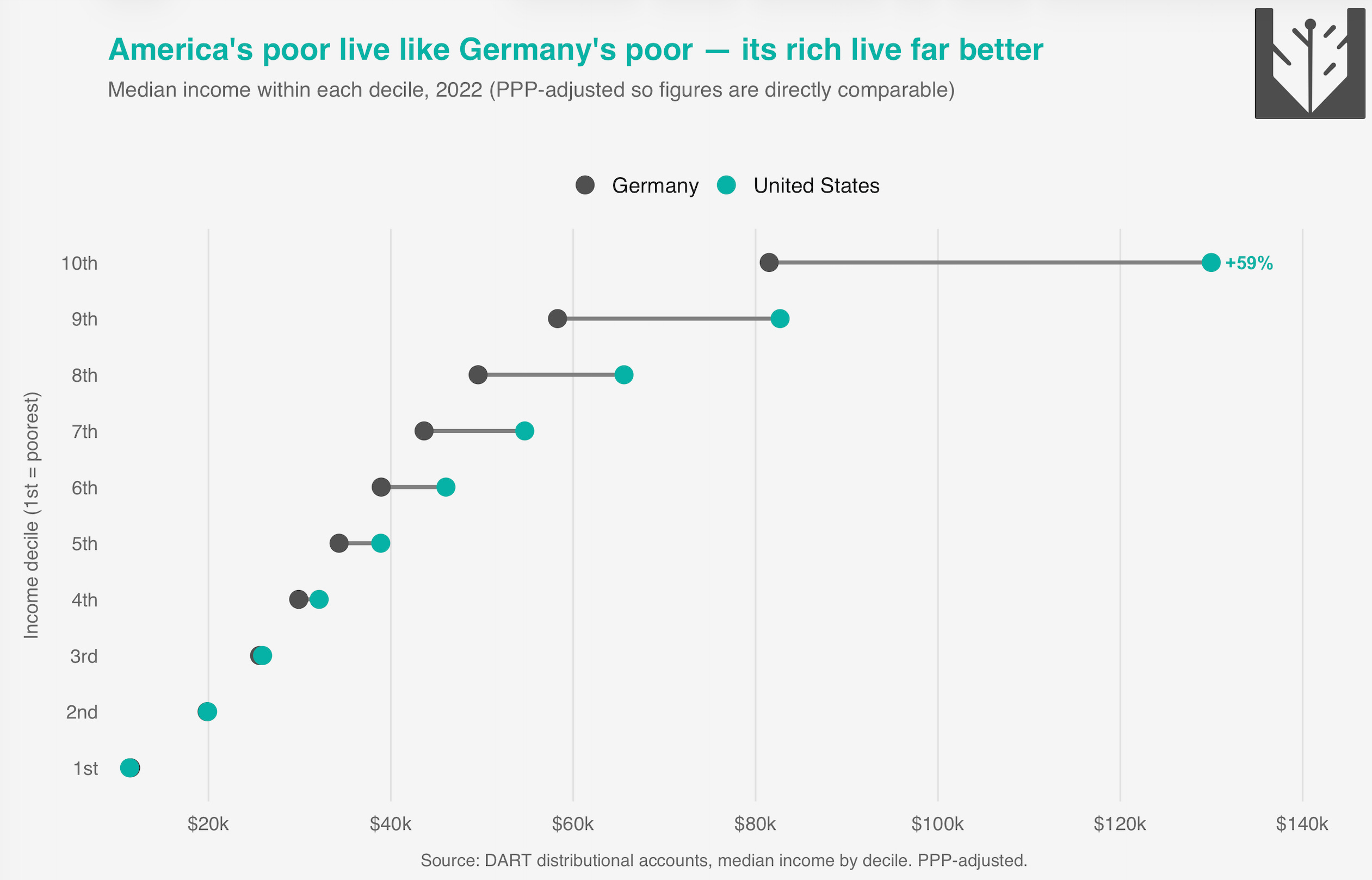
The simplest fix is to give unconditional cash benefits to kids (in effect, to their parents). The most politically expedient way to do this is to make the program relatively cheap by having an income phaseout. But I think the best way to do it is not to characterize this as a targeted anti-poverty program but as a universal transfer from non-parents to parents, just like public schools.
This should probably feature a big one-off payment when a kid is born (a “baby bonus”), followed by generous monthly payments for the first year (“paid leave”), then somewhat less generous payments for the next few years (a “child care subsidy” or a “home care allowance,” depending on what you do), then further reduced payments when the kid reaches school age. Finally, it should phase down for older teenagers on the expectation that they can get part-time jobs (with some provision made for disability and other relevant considerations).
To do this at reasonable payment levels would be incredibly expensive, but I think it makes a lot more sense on the merits than the current smorgasbord of family policy ideas that Democrats are proposing. And it scales up or down smoothly — you could do it just for kids under three and still accomplish a lot and then work for expansion to older kids over time.
The other big thing in this bucket is medical care.
Medicare for All has become this endless factional discourse object that only serves to make people angry at each other, but there ought to be a system whereby everyone can get free or nearly free health care at government expense.
This should be financed with a value-added tax, which would be progressive relative to the existing structure of health insurance premiums but also relatively efficient. The idea is that consumption of “stuff that is not health care services” would pay to subsidize a free tier of health care services. How high should the VAT be? How generous should the free tier be? I don’t think these questions have definitive answers; experts and voters will argue and go back and forth. Since this is a wealthy country, we should expect that most people will supplement with out-of-pocket purchases or private supplemental insurance. And we should also acknowledge that health outcomes are only very partially about health care services. But there is some sense of “necessary and useful medical care” that everyone should be able to get and that is provided by the public, just like roads and parks.
A healthier country
A lot of what makes life in America tough for the poor compared with life in other developed countries is that Americans — and especially low-income Americans — are exposed to a lot of violence. Beyond the lives and money directly lost to murder, robbery, and reckless driving, a tremendous amount of time and resources is wasted on avoiding these problems. Big strides have been made against crime over the past 30 years, but it’s still the case that the most dangerous city in France has a lower murder rate than low-crime rural states like Montana or Nebraska.
Law-abiding people should be allowed to own handguns for personal defense or amusement, but there should be a national registration system and real penalties for people who don’t report the loss or theft of a handgun in a timely manner. There should be a major federal enforcement effort around the networks selling and transporting black- and gray-market weapons to criminals. People convicted of crimes should lose their right to carry a gun for a period of time, and there should be vigorous enforcement not only of the rules against carrying a gun illegally but against helping anyone without a license get a gun.
We should invest in the policing pipeline, perhaps through something like a national service academy for police officers or a program modeled on Teach for America, with the mission of getting idealistic young people to serve as officers in high-crime cities. There should be a consolidated federal policing agency — i.e., we should “abolish ICE” — so federal enforcement resources could be used more flexibly in the most high-impact ways.
We should invest in technology and surveillance (yes, including Flock cameras) and emphasize supervising parolees better, especially because if we could make parole work better (frequent drug and alcohol tests, GPS surveillance), then we could let people out of prison sooner. And we should treat unsafe driving seriously as a form of crime that harms people.
Murder and traffic accidents aren’t the only source of bad public-health outcomes, of course. The inflation-adjusted tax on alcohol should be much higher than it was in 1991, not much lower. Legal marijuana is fine, but the taxes on it should be high, which means we need vigorous enforcement against gray-market pot. We should tax sweeteners and stop subsidizing commodity grain production.
The Robert F. Kennedy Jr. concept that we all need to eat based on regenerative agriculture is unworkable, and we’re not going to get everyone to forget about grocery costs and just eat liver. But we should acknowledge that many more people are overeating nutrient-poor food than are going hungry in this country and do whatever is feasible to discourage mindless consumption of garbage food. SNAP should probably just be cash, but we could also implement programs where poor people get an in-kind allotment of free frozen vegetables if they want them.
Housing first
I’m always a little peeved that while everyone readily acknowledges that housing is a huge share of the economy, it’s also considered a boring, technical issue that doesn’t count as a “big idea.” This doesn’t make sense.
Housing scarcity is the number one economic problem facing young Americans. Everything in life involves tradeoffs, but housing reform is not a zero-sum transfer from old to young or from homeowners to renters — it’ll make the overall pie larger and deliver broad second-order economic benefits in terms of higher G.D.P. and better-paying jobs. Housing abundance will also contribute, in small ways, to things like making it more feasible for people to get married and have kids and thus at least partially address some widespread anxieties about the state of American society.
ROAD to Housing was a nice start, but everyone knows it’s just nipping at the heels of the problem.
The federal government doesn’t write local zoning codes, but the overarching theme of its efforts ought to be something like taking ROAD’s tweak of the relatively minor Community Development Block Grant program, which provides federal funding for local housing and infrastructure projects, and applying it much more broadly.
Large federal investments in things like surface transportation and even schools ought to be allocated with a formula that penalizes jurisdictions where housing supply is not allowed to meet housing demand. We don’t even need to call it a penalty. Federal money is an investment in the future of the country, and if a county has low objective demand for housing, that’s fine — maybe they really need federal help. And if a county has objectively high demand for housing but residents don’t want to allow the built environment to change, that’s also fine in some sense — but they’re not going to get any federal help. And when some places lose their federal dollars, that money should go instead to places that are facilitating growth.
At the same time, the federal government should address things that are clearly within the scope of federal competency.
We don’t need to go all the way back to the 2006 vintage of mortgage regulation, but we’ve made it too hard to get a home loan.
The federal government should be willing to sell off non-park land in the West for housing development.
We should push states to adopt modern building codes that allow for cheaper materials and more efficient floor plans.
This is a pretty radical agenda, and I think it would have large benefits for the country.
An open society
We should answer “The Indian Question” with an enthusiastic yes.
If people of above-average intelligence and drive want to come to the U.S., we ought to give them the opportunity to do so. People with job offers that pay above-average salaries should be allowed to move here. So should students with high SAT scores. Even low-wage workers can be fiscally beneficial, but they should probably come in on temporary work visas, pay taxes (and their employers should pay a special employer-side payroll tax), and then go home with some savings in their pocket.
It seems like a good idea to have some kind of values-based screening to try to weed out people who hate America or are fundamentally hostile to democracy or the Constitution. But instead of endlessly debating the fiscal impact of immigrants (the restrictionists are mostly wrong about this), we ought to be letting in immigrants on terms where the fiscal impact is positive.
In the real world, there are limits to what people will put up with in terms of even an orderly immigration system. I grew up in New York City, surrounded by a very multi-ethnic, multi-lingual community, so I don’t personally have the nostalgia for a whiter 1980s America that some people seem to. My personal preference is for a very high level of local diversity, probably higher than is politically viable in a national context. But all signs are that the voters are enthusiastic about skilled legal immigrants, so we should be able to go pretty far with immigration in the national interest.
We should be mindful of the strategic concerns involved in trade with potentially hostile countries. We do not want our entire economy to rely on Chinese-made batteries or to sell them the finest microchips and lithography machines.
But broadly speaking, the current “affordability crisis” should teach us not to sneer at the very real upside to being able to buy cheap socks from foreign factories. We should be doing everything possible to promote the free flow of goods and services across the U.S., Europe, the big Anglophone countries, Japan, and South Korea and trying for even deeper economic integration with Latin America and the Caribbean.
It was easy during the long period from 1984 to 2019, when inflation was basically always low, to develop a condescending attitude toward cheap consumer goods as a policy goal.
But it turns out that people care a lot about cheap consumer goods.
This column will reach infinite length if I get into artificial intelligence here, but I think a current problem for the A.I. industry is that while large language models do a lot of stuff that is demonstrably impressive, I’m not seeing anything I buy getting cheaper as a result of this powerful new tech. Some of that is a lack of imagination from the companies themselves, and some of it is the policy environment. But we should be rolling out robot taxis, cheap 24/7 medical consultations, and other tangible new products as fast as possible while trying to slow (and ideally halt) the race toward superintelligence that could disempower all of humanity.
A serious fiscal policy
The cost of money — most of all mortgages and auto loans — is part of the cost of living. And these interest rates are in part a function of the broader macroeconomic environment. I spent the Obama years cursing that with interest rates and inflation low, we should run a more stimulative fiscal policy. Now we have the opposite problem and need deficit reduction to address inflation and interest rates.
A lot of this should be on the tax side. But I think it’s been a mistake to spend so much time contemplating exotic, hard-to-implement, and potentially unconstitutional new tax concepts.
The main solutions that we need are enforcing the existing tax code much more vigorously, ending the “stepped-up basis” rule, closing a few well-known strategies to avoid estate taxes, capping the value of all tax deductions, and then just increasing the rates somewhat in a normal way. This has somehow come to feel like a harder political lift than designing an entirely novel tax system from scratch. But in the real world, raising the tax rate on corporate income is clearly the most feasible way of addressing the concern that a handful of business owners are piling up too much wealth.
This ought to be paired with action on the spending side. I do think the evidence supports the view that genuine fraud is not a large share of overall American federal spending, but there’s not zero fraud, and voters are bothered by it, so we ought to address it. DOGE was weirdly uninterested in longstanding Government Accountability Office program-integrity recommendations and decided to target medical care for African kids instead. But it’s worth going back and doing that stuff right and making a big show out of it.
There’s also a lot on the spending side that’s not “fraud” but is either known not to work (many job training programs) or else deliberately inflates costs (lots of procurement rules).
Of course, to really get serious about spending, you need to look at spending for the elderly. This is, famously, a political hot potato. On the merits, though, would it really be so bad if senior citizens in the top third of the income distribution received the same Social Security benefits as seniors in the middle third? Would that actually violate our sense of what we owe our elders? Medicare Advantage is a disaster zone of overspending and cons. We of course “can” just raise taxes and use the proceeds to cover these costs. But it would be good to reduce the deficit, which requires raising taxes, and there are things we should spend more on. So it really makes sense to spend less on things that aren’t needed.
To wrap this up, a point I would make from trade to immigration to housing to technology is that if you want things to be different, something has to change.
A lot of recent American politics feels to me like political entrepreneurs complaining about the status quo but then also promising to stop all change or maybe make things like they were in the past, except you don’t need to give up anything you like about the present. This might just be what happens in aging societies: The electorate gets brain-poisoned by nostalgia, and nobody wants to run on themes of hope and change anymore.
But I hope that’s wrong and we’re just trapped in a bad equilibrium a bit arbitrarily.
Paid subscribers can watch or listen to this week’s episode of “The Argument” ad free and read the full transcript and show notes here.