The Argument will be hosting a live election night watch party, with Nate Silver of Silver Bulletin and Galen Druke of GD Politics! Join us for reactions from some of the sharpest analysts in the business, plus guest appearances from other renowned experts as the night plays out.

Welcome to The Closing Argument, our verdict on the news, plus everything The Argument published and appeared in this week.
The Verdict, by Jerusalem Demsas
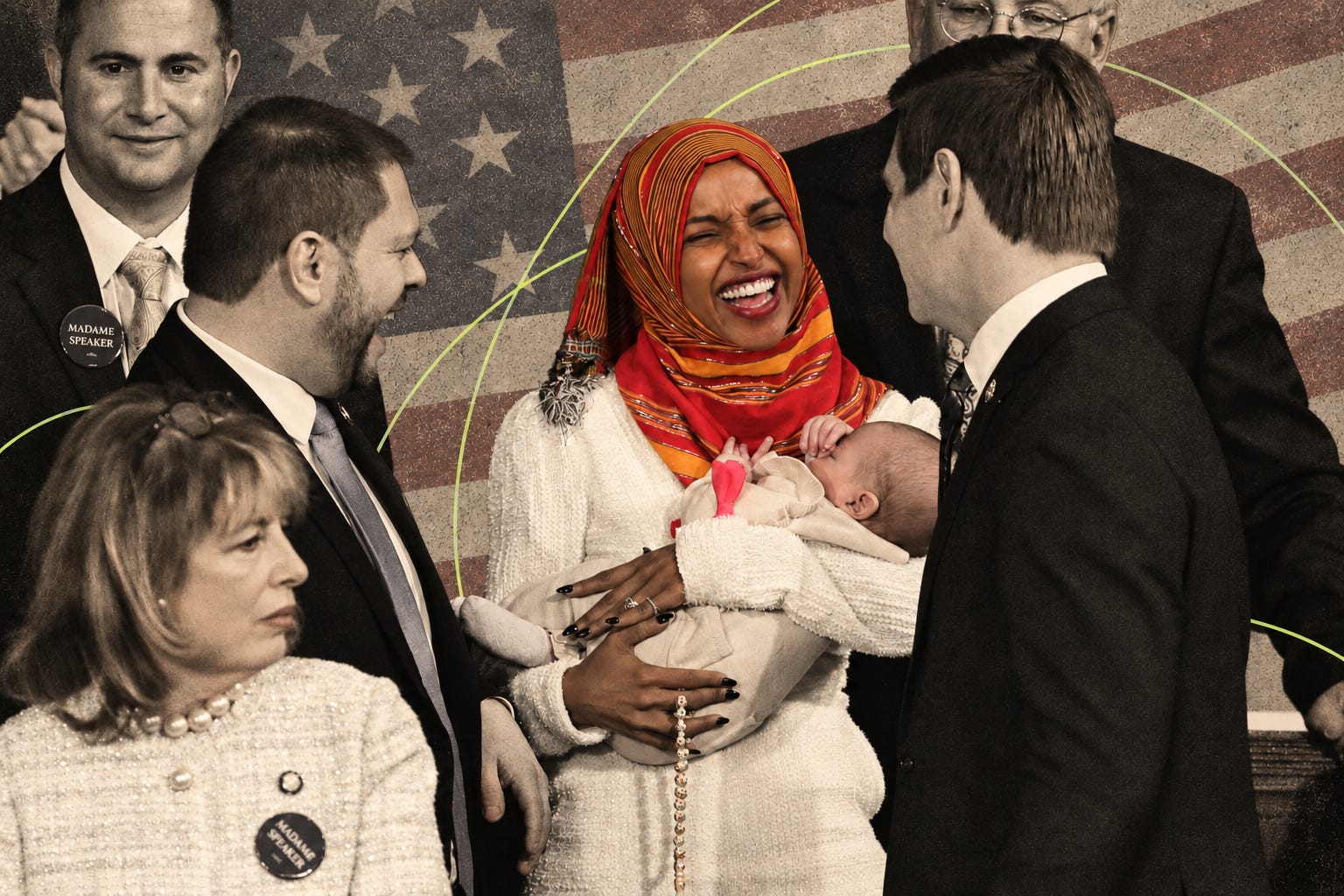
Rep. Ilhan Omar, D-Minn., wasn’t born here, but the Trump administration’s nascent attempt to strip her legal status is the best argument I can imagine for birthright citizenship.
Precisely because Omar is not a birthright citizen, her case shows us what a determined government can do when citizenship is contingent and contested. It can dig through your family history looking for a reason to declare that you were never really an American.
Birthright citizenship forecloses that kind of abuse. It offers a remarkably simple guarantee: You were born in the United States, so you are an American, and no one can take that away from you.
Omar came to the U.S. as a 12-year-old refugee from Somalia in 1995. She became a U.S. citizen at 17 in tandem with her father. And now, the Trump administration is looking to reverse all of that because Omar committed the crime of having bad takes — a charge that not a soul in the Trump administration could beat.
The case revolves around Omar’s birth year: An old Minnesota legislative biography listed her as born in 1981 rather than 1982, her official birth year. Her staff had the date corrected in 2019, saying it was an error, but Trump administration investigators are now examining whether Omar or her father intentionally lied about her age on immigration paperwork. If she was actually born in 1981, she would have been an adult when her father became a citizen in 2000, meaning she wouldn’t have automatically been granted citizenship alongside him.
None of this would be happening if Omar weren’t an outspoken progressive who has spent a decade as a vocal opponent of President Trump, launching inquiries into the administration’s controversial Immigration and Customs Enforcement (ICE) operation in Minnesota and vowing to vote against giving a “single cent“ to ICE.
As the far right has become increasingly unhinged about Somali immigrants — Trump called them “garbage” four times in seven seconds at a Cabinet meeting last December — the administration has fixated on Omar’s citizenship: Trump has said we should “throw her the hell out of our country,“ and that she “could also go to jail.” Vice President JD Vance has said Omar “definitely committed immigration fraud“ and that he was working with White House deputy chief of staff Stephen Miller to figure out “remedies.”
Going after the citizenship status of your political opponents is, and I do not say this lightly, Nazi shit.
Hannah Arendt, who, like millions of Jews, was made stateless by the Nazis, argued in The Origins of Totalitarianism that the stateless person is worse off than a criminal because at least a criminal has rights. A stateless person is akin to Dred Scott, the African-American slave who sued for his freedom but was told by the Supreme Court that Black people could not be U.S. citizens. In the court’s view, they had “no rights which the white man was bound to respect.”
This is why the first part of the 14th Amendment — ratified a decade after the Dred Scott decision and the brutal Civil War that followed it — reads: “All persons born or naturalized in the United States, and subject to the jurisdiction thereof, are citizens...”
Birthright citizenship isn’t some quirk of English common law that we never got around to fixing. It’s the specific remedy we adopted when we watched how the government treated people who didn’t count as rights-bearing individuals. It works by taking the power to decide who belongs out of the government’s hands.
We already know how bad things can get without durable safeguards around citizenship. The first citizenship law that the Nazis passed a few months after Hitler took power in 1933 gave the regime power to revoke naturalizations and strip citizenship from Germans abroad. The first list issued under it named 33 people including regime critics like Kurt Tucholsky and social democratic political opponents. Albert Einstein was on the second such list, the novelist Thomas Mann was on a 1936 list, and Arendt was added in 1938. By 1945, there had been 359 lists including 39,006 names, and a 1941 decree had made every German Jew living abroad stateless.
Eighty years later, watching the U.S. government comb through a sitting congresswoman’s 26-year-old immigration file for a reason to deport her, I have no patience for engaging with the persecution of Ilhan Omar as if it’s an abstract debate about whether someone could ever be prosecuted for citizenship fraud. Trump officials have a history of arguing for their right to revoke citizenship — including birthright citizenship — on a wide variety of grounds.
Birthright citizenship may not protect Omar — or, for that matter, me (I was naturalized in high school when my dad became a citizen) — but it guarantees the rights of 284 million native-born Americans. The Supreme Court has held since 1967 that the government can never strip the status of birthright citizens. In June, the Court explicitly reaffirmed the citizenship of children born here to undocumented immigrants or people on temporary visas, rejecting Trump’s attempt to exclude them in an executive order he signed on his first day back in office.
Five weeks after the Court’s decision, the administration was back at it with orders attempting to make citizenship at birth turn on whether your parents have been designated terrorists or foreign-government employees.
Questions about birthright citizenship aren’t only coming from the far right. John Arnold, a big funder of serious evidence-based policy work (and whose organization, Arnold Ventures, is an investor in The Argument) posted a Venn diagram to Twitter last year: one circle for people who oppose birthright citizenship as policy, one for people who think the Constitution plainly requires it. He placed himself squarely in the intersection. Clive Crook, Bloomberg opinion columnist and former Economist deputy editor, argued that the Supreme Court was technically correct on the legal question while calling birthright citizenship “questionable at best.” Bill Maher derided birthright citizenship as “kind of crazy.”
Many other voices across the political spectrum have raised the prospect of eliminating birthright citizenship, usually by pointing out how unusual it is: Most rich countries don’t do it. They’re right that America is exceptional in this regard — but when have we been anything but?
The point of birthright citizenship is that it doesn’t care whether your parents are criminals or liars or whether they ever intended to stay in the country to begin with. It doesn’t even care about whether you’ll turn out to be the kind of person a sensible country would choose! It asks just one thing: Were you born here?
From a technocrat’s perspective, this is hardly optimal. Surely there is some set of criteria by which we could select for better and worse citizens. Maybe there is! But the question is whether we want the government to have that kind of power. The current one has told you what it thinks of Somalis and Muslims.
The virtue of birthright citizenship is that it is dumb on purpose. It gives the state almost nothing to decide when it comes to the citizenship of most of the polity. The question isn’t what rule a wise government would design; it’s what kind of guarantee prevents an unwise government from revoking fundamental rights.
Being a citizen doesn’t confer goodness or worth. Timothy McVeigh was just as much a citizen as Dolly Parton. The government had plenty of tools to ensure that McVeigh was punished for the 1995 Oklahoma City bombing: It tried and convicted him of murder, and it even executed him in accordance with the laws he was bound by.
What it could not do, at any point, was make him something other than an American.
Midterm update
Lakshya Jain, our director of political data, uses data from The Argument’s polling operation to inform the Split Ticket 2026 House and Senate models. Here’s his update on the state of play this week:
Third-quarter fundraising updates are in, and unsurprisingly, Democrats remain commanding favorites to take back the House. Our model is more bullish for Democrats on several races than many experts are, and in a wave that continues to rise, even redder seats like Kentucky’s 6th Congressional District and Missouri’s 2nd have come onto the board as toss-ups. Meanwhile, in the Senate, the model gives Democrats a 64% chance of winning the majority — not a decisive likelihood, but a notable one.
These models update every day; bookmark this page to see the odds of each party taking the House and the Senate.
Top stories this week, by Milan Singh
In 2020, Joe Biden won Medicaid recipients by 19 points. In 2024, Donald Trump won the same group by 2 points. Then he signed a law subjecting many Medicaid recipients to work requirements. Now, as University of Michigan law professor writes, the Trump administration is trying to break its own law because it’s afraid those rules won’t strip enough people of their healthcare.
Some social conservatives have begun arguing that the sexual revolution of the 1960s and 1970s is responsible for the rape case unfolding at Cornell University — and many other social ills besides. Does that mean we should RETVRN to the good old days before birth control? does not think so! She points out that earlier social arrangements came with much more obvious downsides than their boosters acknowledge. She also notes that conservatives’ new obsession with the pleasures of married sex is itself unthinkable without the new norms they decry.
Anthropic invited The Argument’s and to its San Francisco offices for a two-day briefing with some of its top researchers. The researchers think that their pursuit of self-improving AI models will, at best, lead to the complete vaporization of our current social relations and, at worst, lead to human extinction. Are they crazy? Kelsey’s not entirely sure, but she thinks it’s probably time for the government to stop them regardless.
🌟Abundance Wins of the Week🌟
The Bureau of Land Management sold leases to nearly 200,000 acres of federal land in Nevada for geothermal energy, netting $4.83 million. The Bipartisan American Affordability and Jobs Act, the permitting reform bill recently introduced in the Senate, includes legislation that would exempt some geothermal projects from National Environmental Policy Act review, putting the clean energy source on more even footing with oil and gas.
President Donald Trump signed a new executive order establishing a task force to issue recommendations on streamlining the permitting of manufactured housing. Currently there are several overlapping permitting and review processes for manufactured housing; the aim of this executive order is to eliminate redundant processes and ensure that agencies reciprocally recognize each other’s licenses and approvals.
The Nuclear Company announced a proposal for a new 6.6-gigawatt campus of up to six new nuclear reactors in Lewis County, Kentucky. That’s enough to power more than 5 million homes, according to the EIA. The hope is to begin construction in 2028, pending regulatory approval.
Worth watching…
The Senate recently released the text of major permitting reform legislation, which among other things promises to make it much easier to build the high-voltage transmission necessary to facilitate renewable energy. But some environmental organizations are lukewarm-to-cold on the bill, arguing that it would also benefit fossil fuel companies. On this week’s podcast, and discuss whether elected Democrats should listen to the green groups or not. To the extent that Democrats believe their own campaign promises about affordability, maybe they shouldn’t.
The midterms are shaping up to be something between a blue wave and a blue tsunami. Polls, election models, and betting markets currently have Democrats favored to flip the House and (more narrowly) the Senate. But some Democratic nominees in key races, such as Abdul El-Sayed in Michigan, are on track to underperform, while others, such as Adam Hamilton in Kansas, look like they might pull off upset wins in deep-red states. On Substack Live, The Argument’s and VoteHub’s were joined by Silver Bulletin’s to discuss how candidate quality might shape the battle for the Senate.
Many people who have worked at Anthropic and OpenAI are concerned that AI tools could pose catastrophic (or even existential) risks to humanity. In a Substack Live conversation, spoke with Hamza Chaudhry of the Future of Life Institute about how AI could supercharge existing threats posed by nuclear weapons and genetically engineered viruses.
What’s News with The Argument
The Argument recommends, by Milan Singh
Our editor-in-chief, , read Philip Roth’s The Human Stain and says she is “now a stan-for-life.” The novel is set in the summer of 1998, shortly after the Monica Lewinsky scandal broke, and the main character is also grappling with various scandals in his own personal life. “That’s as specific as I want to get because I’m spoiler-phobic,” she said, “but it’s really about the prudish style of American politics and whether true freedom from the life you’re handed means leaving it all behind.”
This week, “at the behest of a friend,” gender and culture fellow read the millennial British journalist Dolly Alderton’s memoir Everything I Know About Love. Initially dismissive of the book — “how interesting could it possibly be to read about the chaos of being confused, drunk, depressed, and in love in your 20s?” — Maibritt ended up coming around: “The best thing about Alderton’s writing is that she somehow manages to be completely earnest without ever taking herself too seriously.” May we all strive to do the same.
Staff writer recommended the video game Into the Breach, “one of the best roguelike games in recent years.” He’s a big fan of the roguelike genre — a type of video game where you must start from the beginning each time your character dies — with some of his favorites being Into the Breach, FTL, Balatro, Slay the Spire, and Hades. Editor wanted to add on Blue Prince as a standout in the genre.
Eli also had a spookier recommendation: “I was highly skeptical that Carrie needed a fourth screen adaptation when Mike Flanagan announced he was doing it, but the man can’t miss,” he told me.
Senior video producer finished Marcel Proust’s Swann’s Way and loved “how slow and deliberate the language was, and how his similes are so original and insightful.” He offered the following example, from the Lydia Davis translation: “Sometimes in the afternoon sky the moon would pass white as a cloud, furtive, lusterless, like an actress who does not have to perform yet and who, from the audience, in street clothes, watches the other actors for a moment, making herself inconspicuous, not wanting anyone to pay attention to her.”
recommends The New Yorker staff writer Ava Kofman’s new five-part narrative podcast series “The Journey”: “Come for the bizarre true crime saga, stay for the uncomfortable questions about the future of American surrogacy.”
When reached for comment, staff writer said that “weekly is just more often than I experience the culture, I’m sorry.”
We have merch!
We have quarter-zips, keychains, hats, and stickers. Each one is a great conversation starter in its own way. Buy them here.