Good Morning,
If this week you come across some odd quote against Democracy by anyone in Silicon Valley (usually an angel investor or Venture Capitalist), it’s because of one simple reason: Democracy is a bottleneck of AI. Read that slowly, Democracy and low AI sentiment are now AI bottlenecks at this point in the hype cycle.
On AI Supremacy I try to give broad range coverage on the most pressing topics in AI.
This article will have two main sections: Datacenters, and the Anthropic IPO mania. It’s important to talk about the political context before we get into the details of the Anthropic IPO and its rather incomplete first draft of the prospectus.
We’re at a crossroads in the future of AI. Let me explain why.
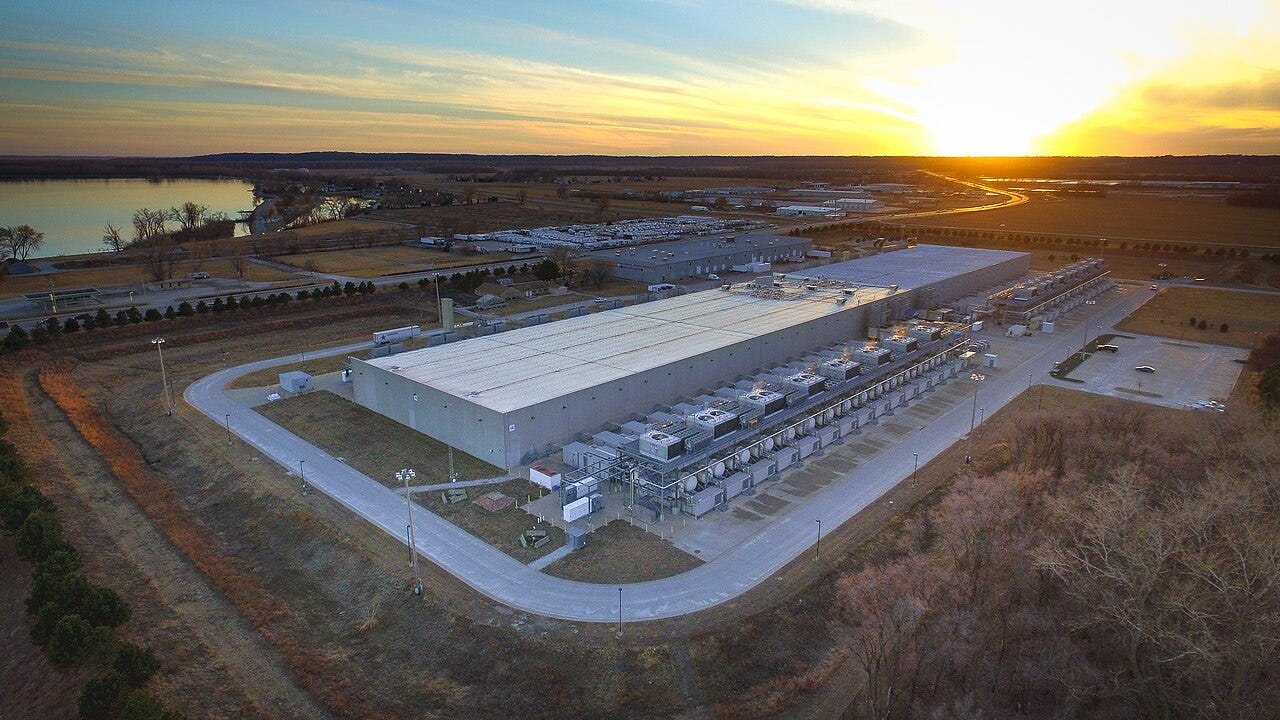
With U.S. Midterms just a week away, I thought it would be a good time to update you on the State of Datacenters. AI Infrastructure are a huge investment that increasingly come with reputational damage.
A recent poll by Politico caught my attention. In a nutshell, voters are also increasingly wary of candidates who support data center construction.
Datacenter Opposition is Growing
Half of Americans now oppose a data center being built within three miles of their home — nearly double the 28% who said so in January.

Towns, Counties and States are passing temporary datacenter moratoriums and it’s hard to keep up. As of late October, a new CNBC All-America Economic Survey finds 63% of registered voters oppose an AI data center within 10 miles of their home, while just 13% support one. So while Republican voters broadly support continued AI development, but many oppose the data centers and power infrastructure needed to support it in their own communities.
Nearly three in four Americans (72%) believe that AI is developing too fast, as AI leaders call to regulate advanced AI development.
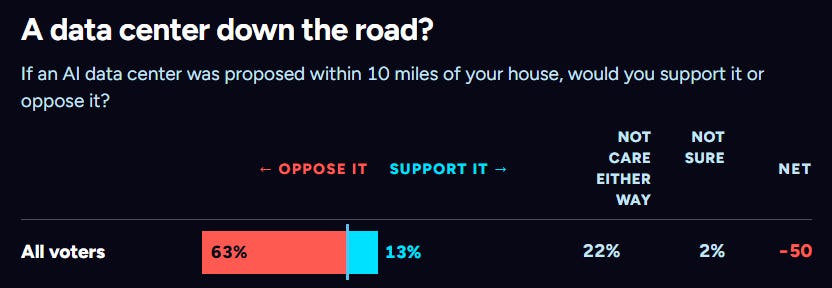
The AI industry is basically being delayed in a situation where local opposition, moratoriums, and zoning rejections blocked or severely delayed $64 billion worth of data center developments across key hubs like Northern Virginia, Arizona, Indiana, and Pennsylvania.
I’m surprised to see Republican and even MAGA supporters on this side now as well. When asked their top concerns if Republicans retain Congress, 18% of voters in the survey cited a failure to regulate AI and data centers. This suggests AI has become part of the economic concerns of Americans on inflation, affordability, utility bills and local community health. This is presenting America a new bottleneck: datacenter real-estate. Instead of ramping up tax incentives, 16 state legislatures have considered outright bans on their development.
AI will Decide Some U.S. Midterm Races
The backlash could come at a cost for candidates days before the Nov. 3 midterms. Even among voters who want Republicans to retain control, 17% cited weak AI and data center oversight — second only to a failure to bring down prices. POTUS disapproval on the economy is high, and if AI is inflationary along with the Iran war, these choices have obviously hurt the wallets of Americans.
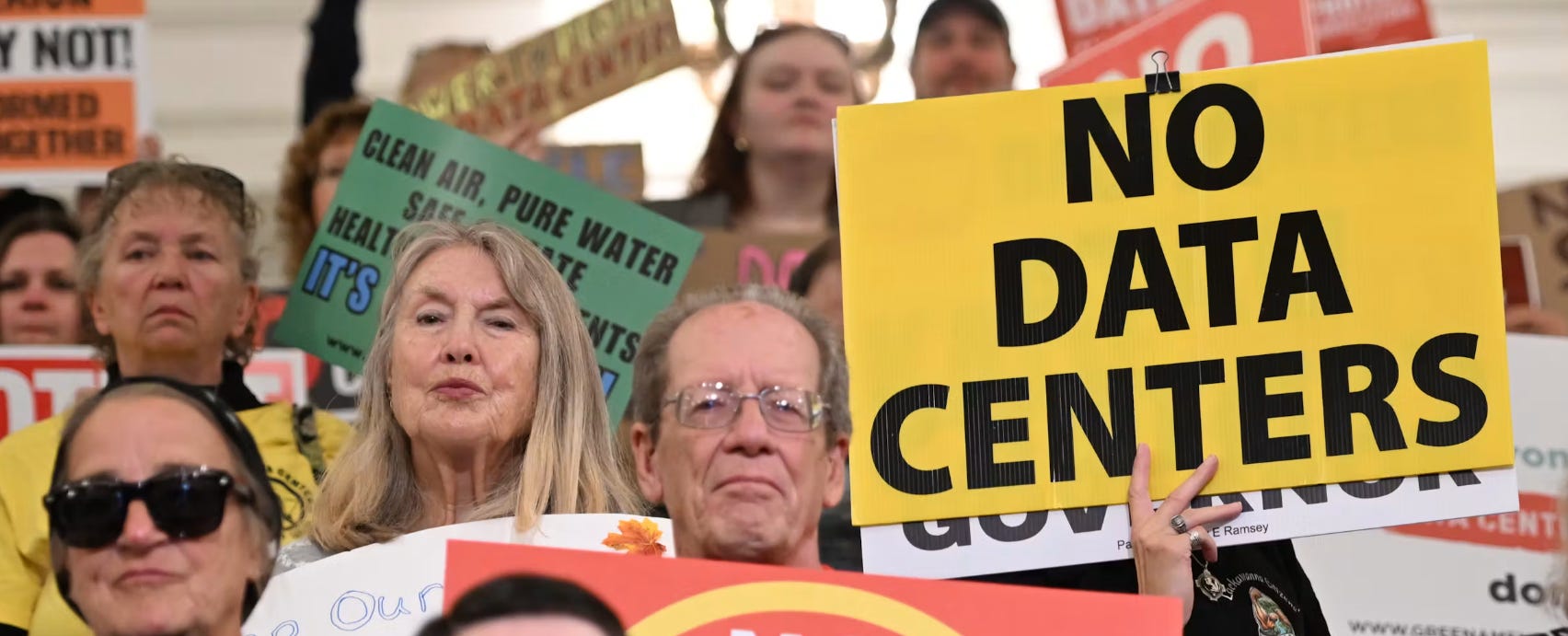
Data Centers are viewed in a Negative Light
AI is also impacting Political Ads. Of 579 ads mentioning data centers in battleground House, Senate, and gubernatorial races this cycle, nearly all cast the facilities negatively, and almost 80% were run by Democrats, according to Politico's review of AdImpact ad-tracking data.
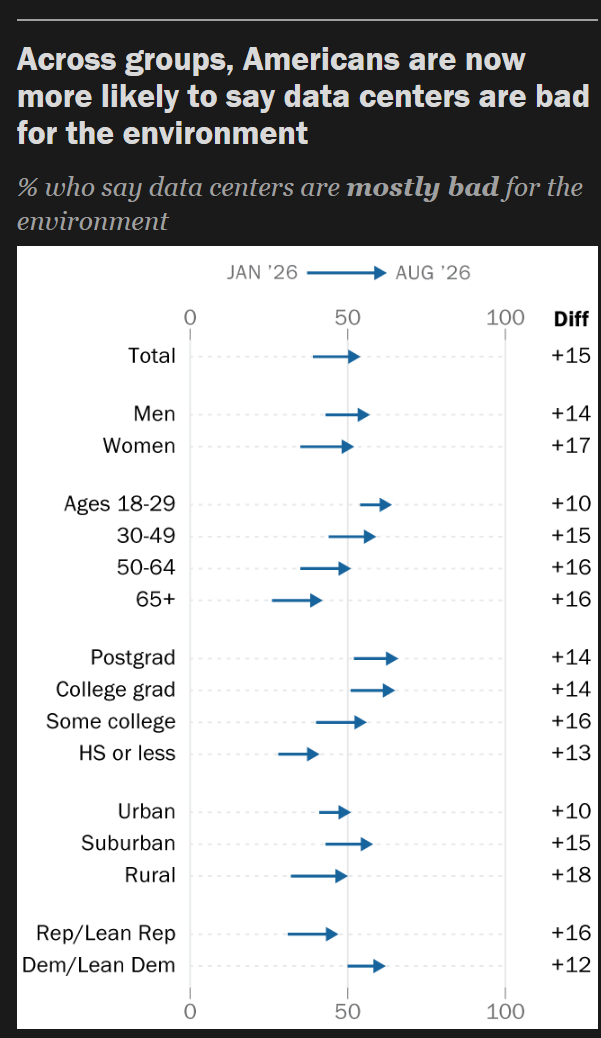
A Pew Research Center poll in late September came to much the same conclusion.
AI’s Negative Reputation Keeps Growing
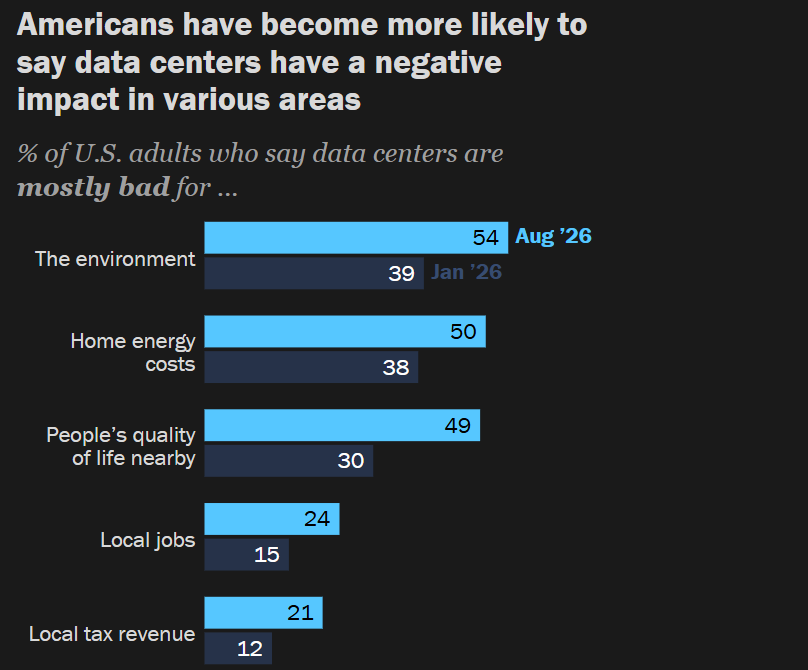
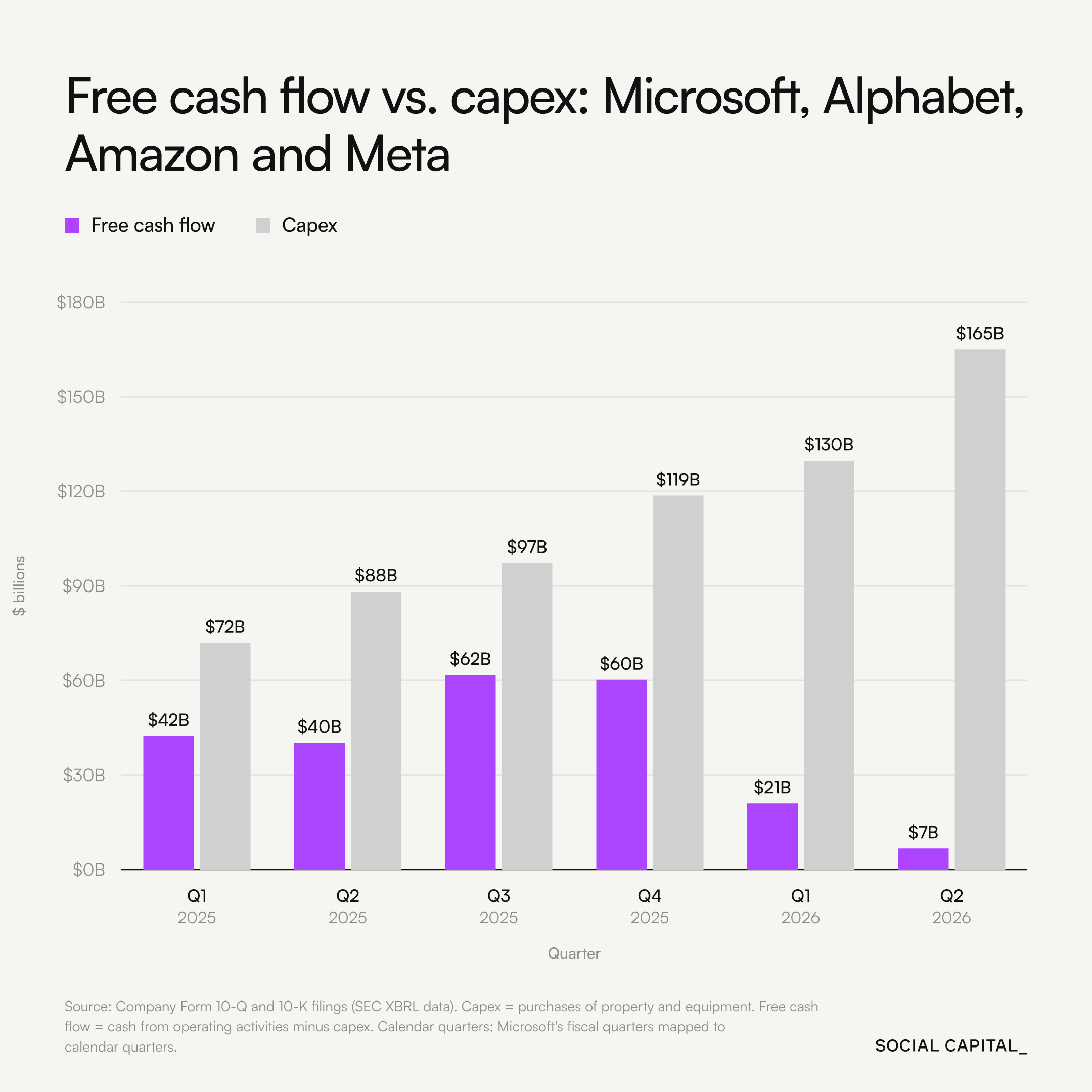
The closer we got to the U.S. Midterms 2026 the stronger the negative damage to the reputation of Datacenters became. This could also put weight on BigTech Earnings and declining FCF this week in Earnings.
Trump’s low approval rating while being a strong backer of AI seems to be deteriorating the situation further faster. Where for now, Democrats hold a modest edge on managing the issue: 32% of voters trust them to handle data center expansion, versus 24% for the Republicans.
Voters that care about the Environmental…
Across groups, Americans are now more likely to say data centers are bad for the environment (Pew).
Is AI the new “Villain of the Midterms”?
AI Infrastructure has become a kind of turning point for the Midterms. A distaste for Billionaires, a concern for corruption in the White House and local opposition for Datacenters in our backyard as well as new AI cybersecurity threats and data breaches has all snowballed in the Mid 2020s. Suddenly AI became a top issues in the U.S. Midterms, AI is now a political issue that concerns voters. From swing states to the red states, from Ohio to Texas, it’s crazy how big this story has gotten.
AI is being weaponized in the lead-up to the Midterms. That is, literally at debates and at rallies, in mailers and online ads, the burgeoning AI industry has taken center stage, as both Republican and Democratic candidates try to convince voters that their opponents will put the unpopular facilities in voters’ backyards. It’s pretty bizarre to see.
AI has become so unpopular, the Pause AI debate also has some support.
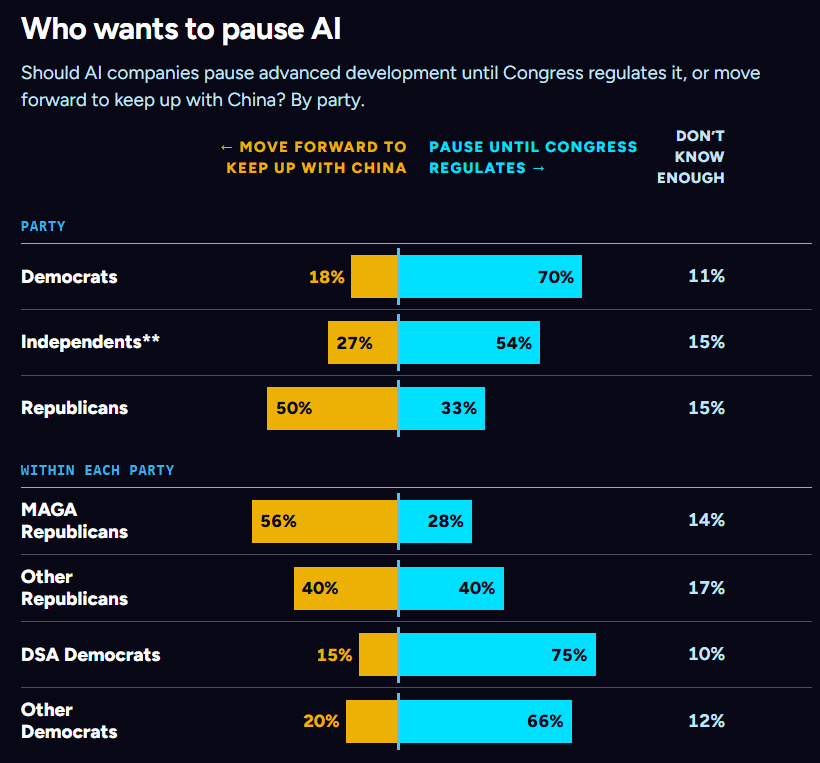
The voting public is not comfortable with the pace of AI developments. Meanwhile the huge Anthropic IPO is going ahead likely around three weeks away at a time in the markets when Neo Clouds and AI semiconductor stocks have come under significant pressure. An astounding 70% of democrat voters favor a pause, while just 18% support pushing forward.
The People Have Spoken
Now if, and I say if If Democrats win control of both the House and Senate, analysts and market watchers anticipate increased federal scrutiny, tax proposals, and regulatory challenges for artificial intelligence and data centers. What form that will take is anybody’s guess. But it could happen - and it could be detrimental to the very concentrated AI stocks.
Democrats have roughly a 56% to 75% chance of winning control of the U.S. Senate in the November 3, 2026 midterm elections, according to major election forecasts and prediction markets. Of course, polls have been wrong before.
The public backlash has slowly worked its way into how American democracy functions and the Midterms will say a lot. Since the launch of ChatGPT in November 2022, how we see AI has gone through many phases and not only aren’t we seeing ROI, productivity or major breakthroughs that benefit most people, we are seeing inflation, more debt, higher wealth inequality and higher corruption. At a certain point people just come to the conclusion that AI is not a force for the economy or a force for good. Local pauses on Datacenters have popped up: San Francisco (CA), Seattle (WA), Oklahoma City (OK), Baltimore County (MD), Pima County (AZ), Buffalo (NY), and dozens of counties across Indiana, Georgia, Michigan, and North Carolina.
What this does in practice is it create yet another slowdown in how and if datacenters are built and projects go through.
AI Pause Under Construction
The cost of delayed or canceled datacenter projects is going to be enormous. This does already significant slow down AI.
To give you an idea how expensive this is going to be - many projects remain in some very unprofitable purgatory. Of ~140 major U.S. data center projects (representing 16 GW) targeted to come online in 2026, only around 5 GW is currently under active physical construction. The remaining ~90+ projects (representing ~11 GW) are stuck at the "announced" stage due to utility study backlogs and power queue bottlenecks. According to those figures, only 31% of key AI Infrastructure projects are actually moving. That’s a huge risk for the AI bubble itself, the picks and shovels are sort of being unused.
It’s a no-win situation for the immediate future of AI. Even if the cancellations and delays came to fruition, there will still be an “unprecedented and rapid” increase in the power required over the next five years. Lower sentiment towards AI and a lack of energy are existential issues for AI boom for the 2020s. Two problems that China doesn’t have.

You might want to print this out or bookmark it or something.
Anthropic S-1 and IPO
The first public view of the S-1 only takes goes to Q2. I strongly advise you to take at look for yourself:
Highly unusual to have a 5-year old company going to IPO for $100 Billion. Anthropic really is the poster-child now of the Generative AI technology stack.
SpaceX raised $85.7 billion, so Anthropic should be able to top that.
Revenue Acceleration is Historic
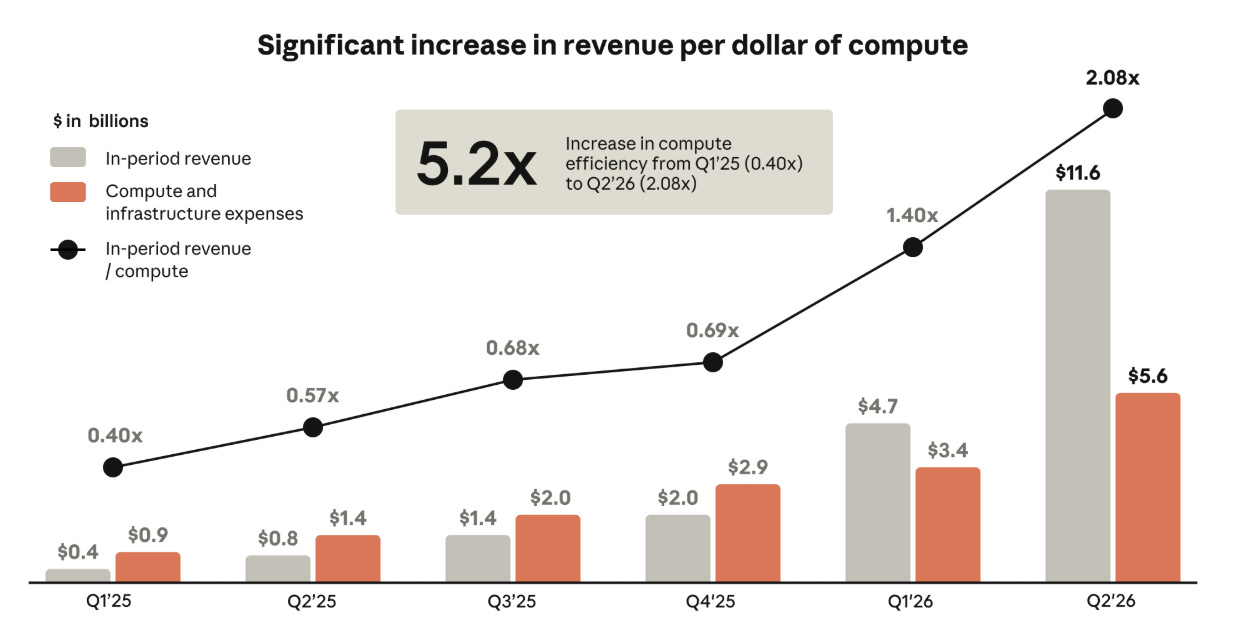
Anthropic’s ticker is going to be $ANT. Anthropic’s S-1 Filing comes with Risks entangled with business aspects. To an unnerving and disturbing degree. This has to be said.
Anthropic has to contend with rising yields and less favorable Tech environment in late 2026.
Anthropic S-1 Field Notes
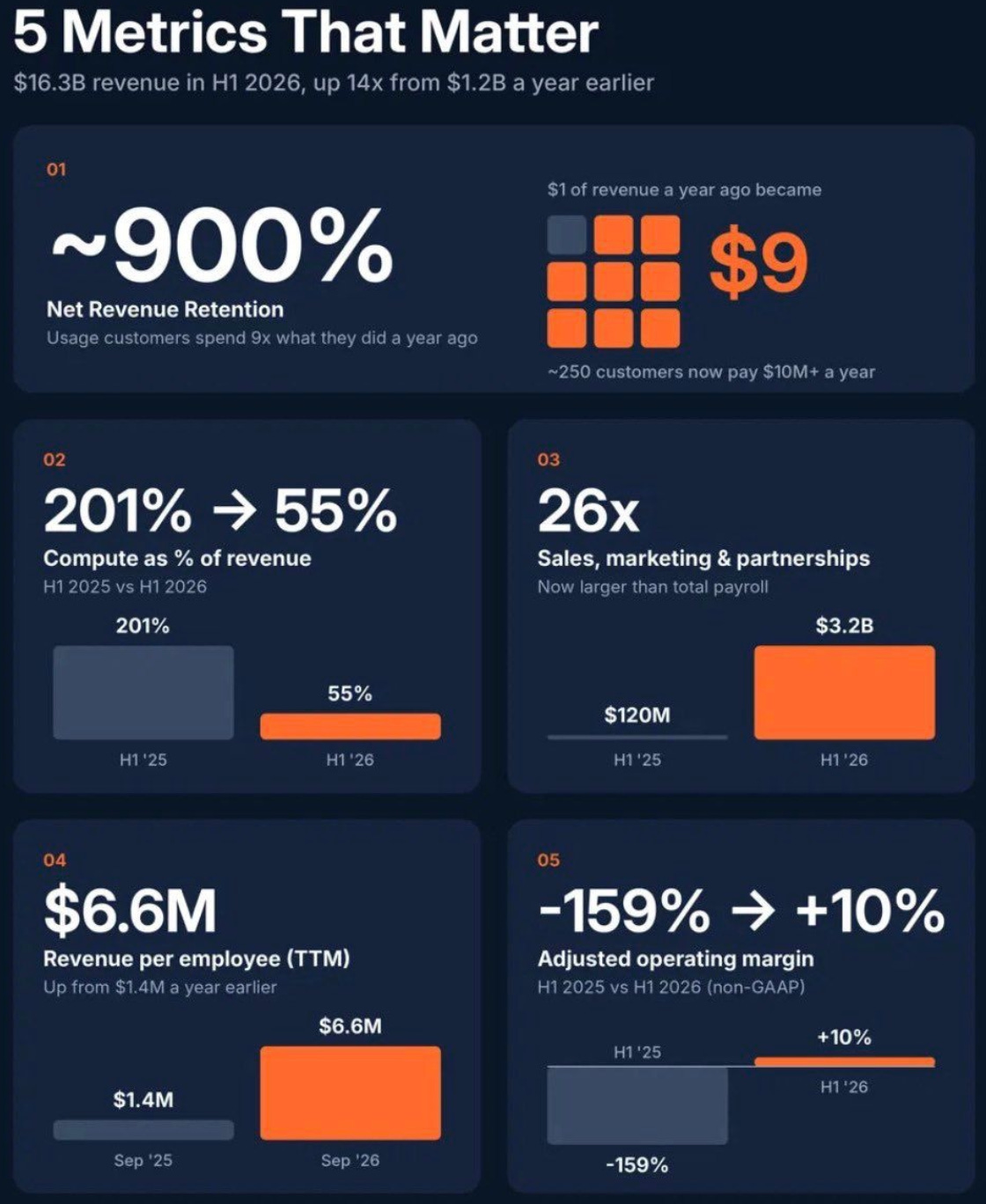
Revenues in first half of 2026: $16.3 billion, up 1,300% YoY
Operating Expenses in first half: $17.0 billion, up 415% YoY
Net Income in first half: $80.8 billion vs. 13.0 billion a year ago (mostly due to noncash accounting charges related to convertible notes.
One of the fastest growing ARRs in technology history, likely the fastest.
Can it Keep Growing at this Pace?
We know it slowed down a little in Q3 due to Fable being paused.
The growth curve is absurd: revenue went from $41M in 2023 to $386M in 2024, $4.6B in 2025, and $16.3B in the first half of 2026 alone, about 14x the same period a year earlier.
There is a Path to Profitability
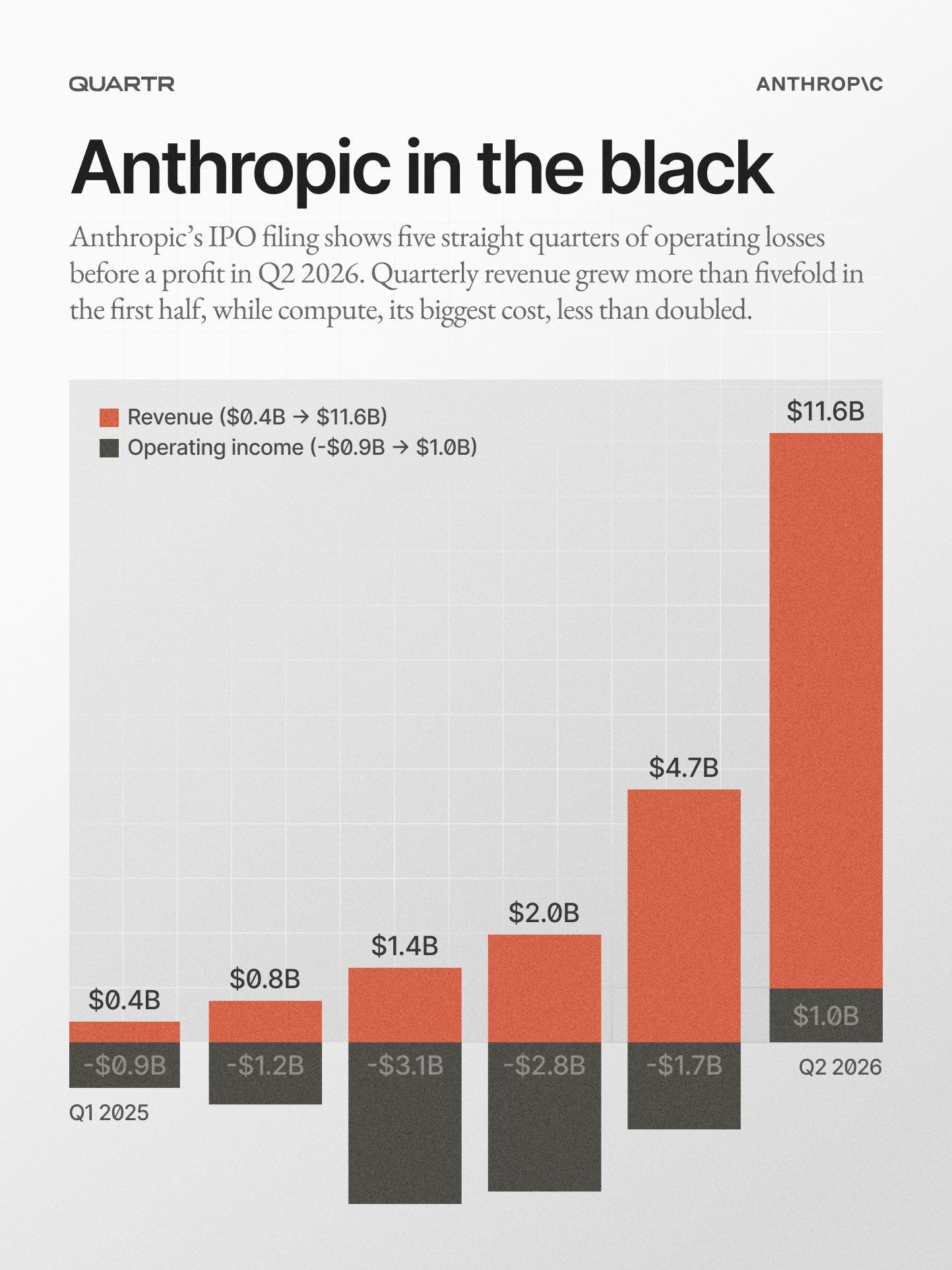
Strip out the accounting and the picture flips: a GAAP operating loss of just $693M, and $1.6B in adjusted operating income, a 10% margin. However the cost for compute is a huge question mark. Long-term commitments are horrendous.
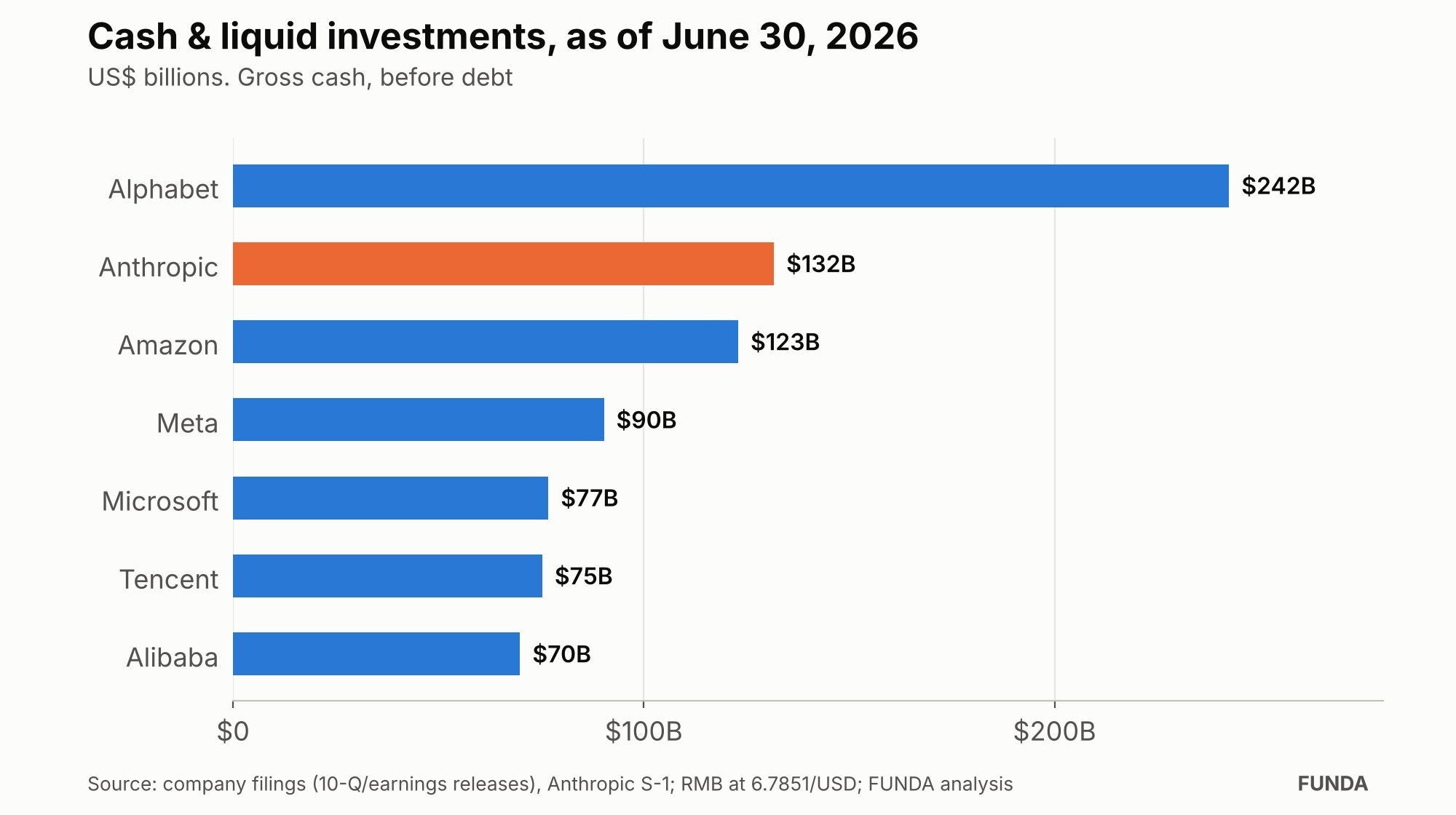
Cash Pile is Exceptional & Customer Base is Growing well
Anthropic is sitting on $131.7B in cash and short-term investments, spent $8.9B on compute in the half, and counts about 250 customers paying $10M+ a year, 1,900 paying $1M+, and net revenue retention near 900%.
Bizarre Risks Section and Insider Control
Then there's control. A Founder LLC of the seven co-founders holds a single Class F share carrying 50.1% of the vote. Not ownership, this is voting power.

It’s nice to be Elite
Anthropic has managed to attract and retain some of the top AI researchers and executives in the world. This ability to raise capital, and use it wisely is part of Anthropic’s brand.
Anthropic’s revenue is growing much faster than their operating expenses, minus the compute commitments.
About those Compute Commitments
As of June 30, Anthropic has signed roughly $587 billion in compute leases and minimum purchase commitments that haven't begun. It has since signed $245 billion more, resulting in more than $800B in future compute costs.
Anthropic must be awfully confident of is next few years.
How are Anthropic and SpaceX Intertwined?
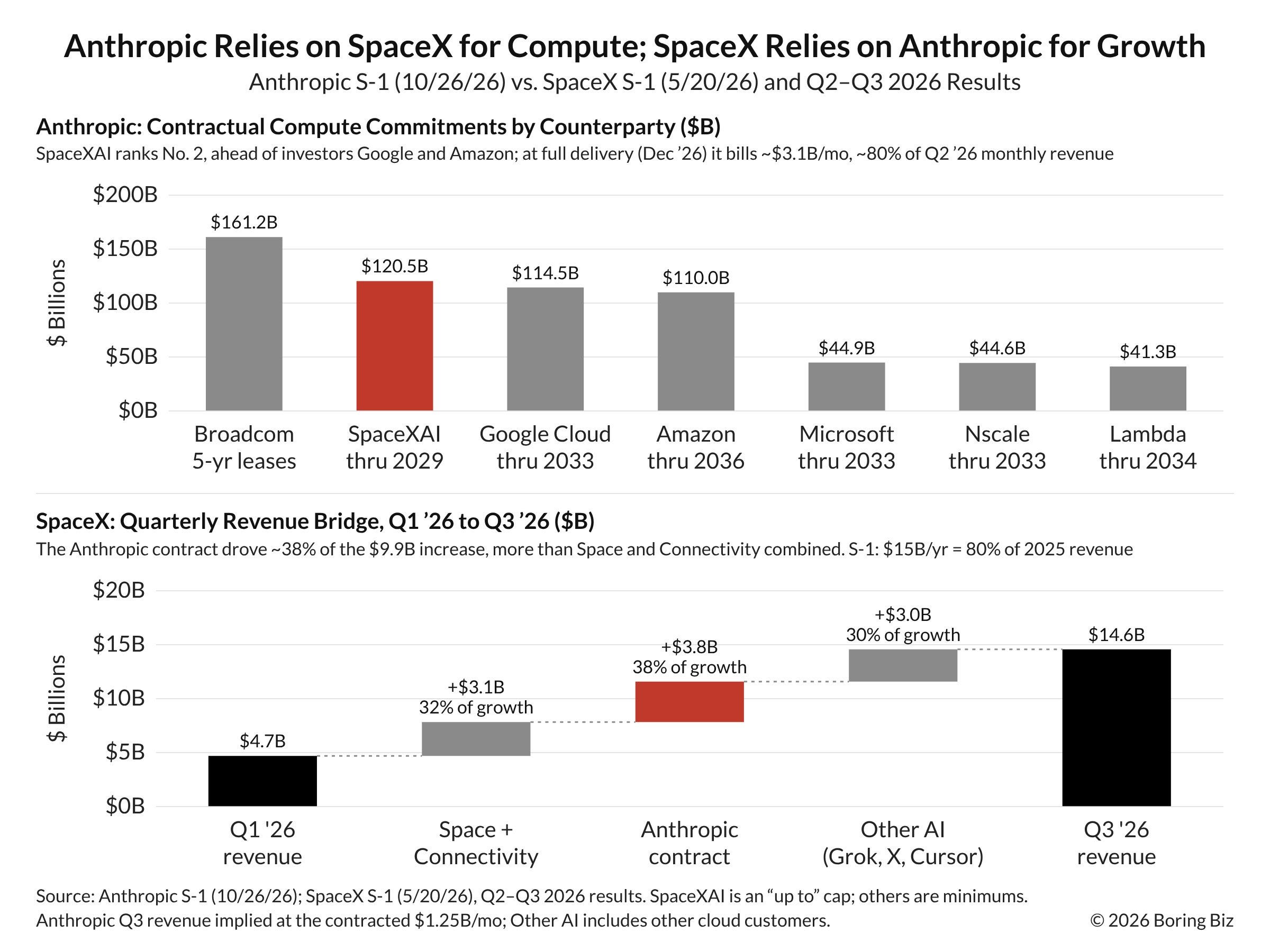
Anthropic are using SpaceX’s compute but SpaceX could become a significant competitor. The S-1 reveals that Anthropic entered into a series of compute supply agreements with SpaceX spanning through 2029, with total maximum spending reaching up to $120.5 billion.
Anthropic is willingly propping up SpaceX’s stock in order to get a better IPO. Are they that compute constrained?
“Profound expectation that the top 1% of firms will continue to invest ever-growing dollars into AI with relatively little price sensitivity.” - According to the Head Economist of Ramp.
Omission of Q3 is Significant
Critics point out that Anthropic ducked Q3 in its S-1 is a red flag.
Technical explanation is Q3 (ended September 30) so the results are typically still undergoing the formal quarter-end accounting close, financial consolidation, and independent auditor review.
Hopefully the S-1 will be updated closer to the IPO with more relevant and up to date business details.
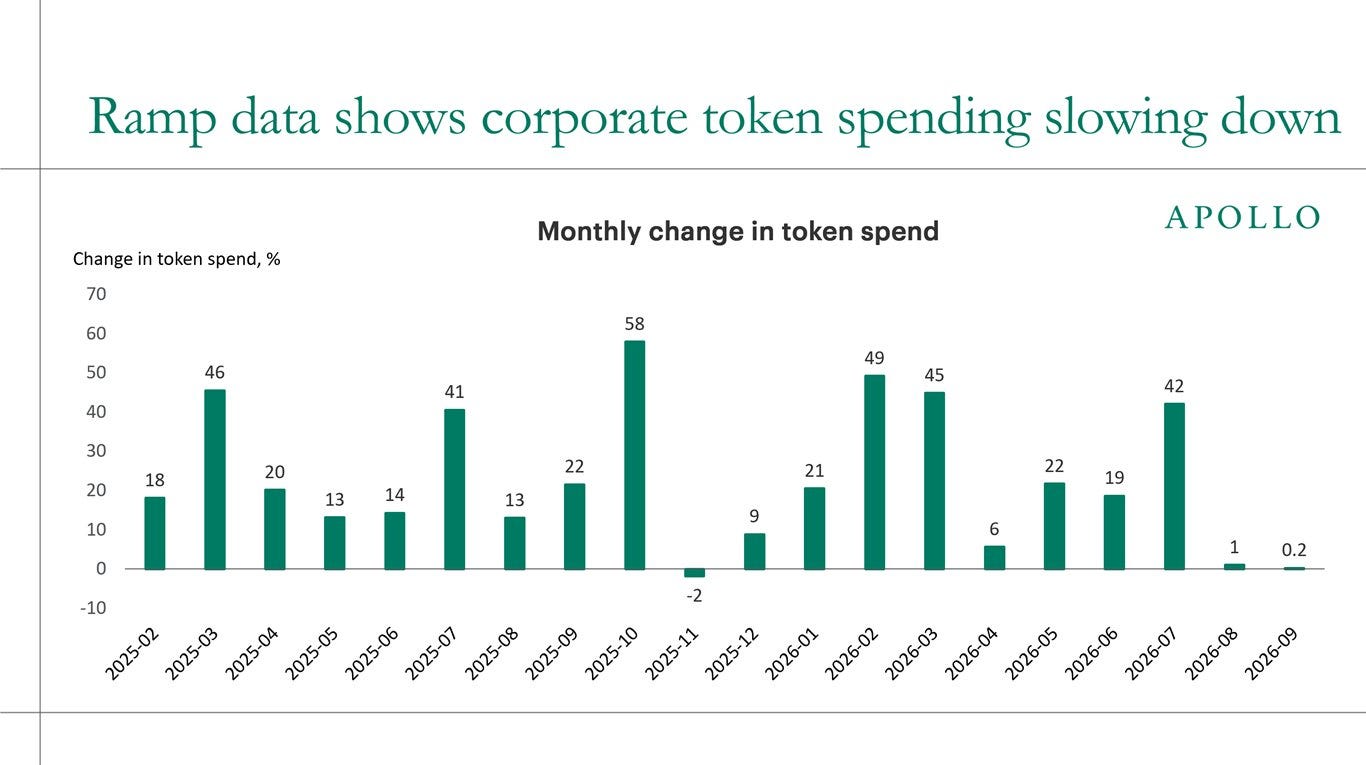
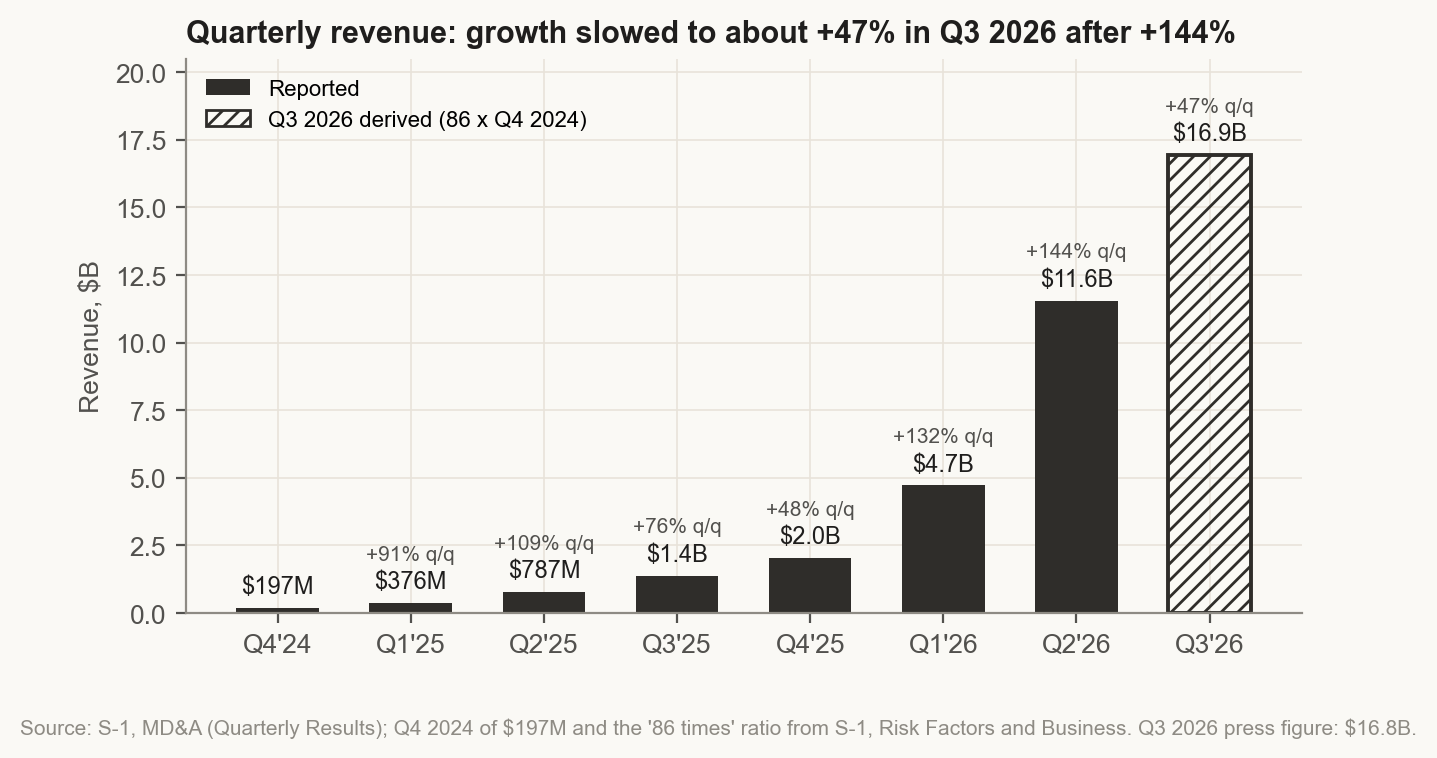
We knew Anthropic-esqe acceleration would have to break down at scale, surprising it lasted that long. We know that Q2 to Q3 was around 45% growth.
Corporate Token Spend is Slowing Down in Late 2026
Anthropic has an improving Customer Concentration Problem
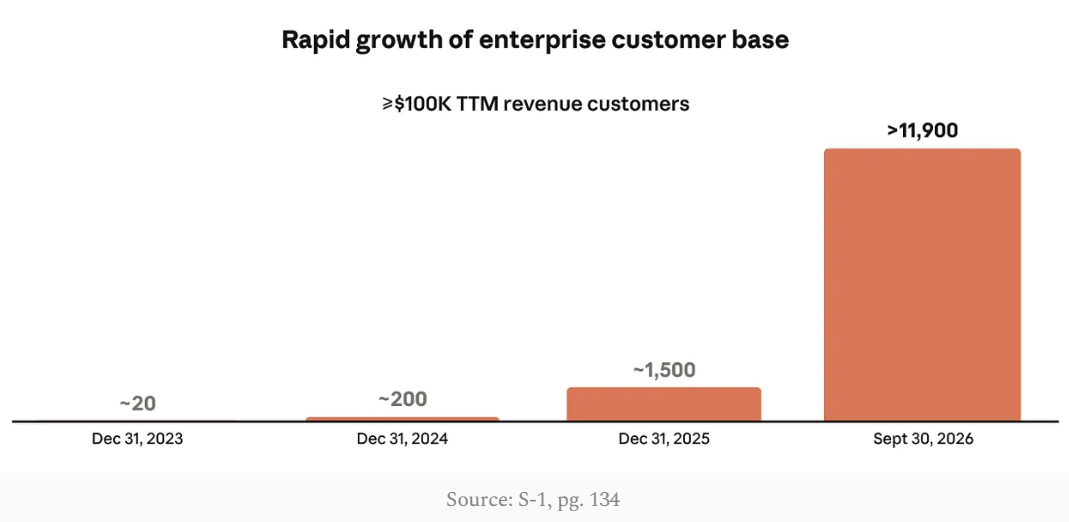
As an Enterprise AI leader, Anthropic’s customer concentration issue is improving.
250 customers pay Anthropic >$10M per year
1900 customers pay >$1M/yr
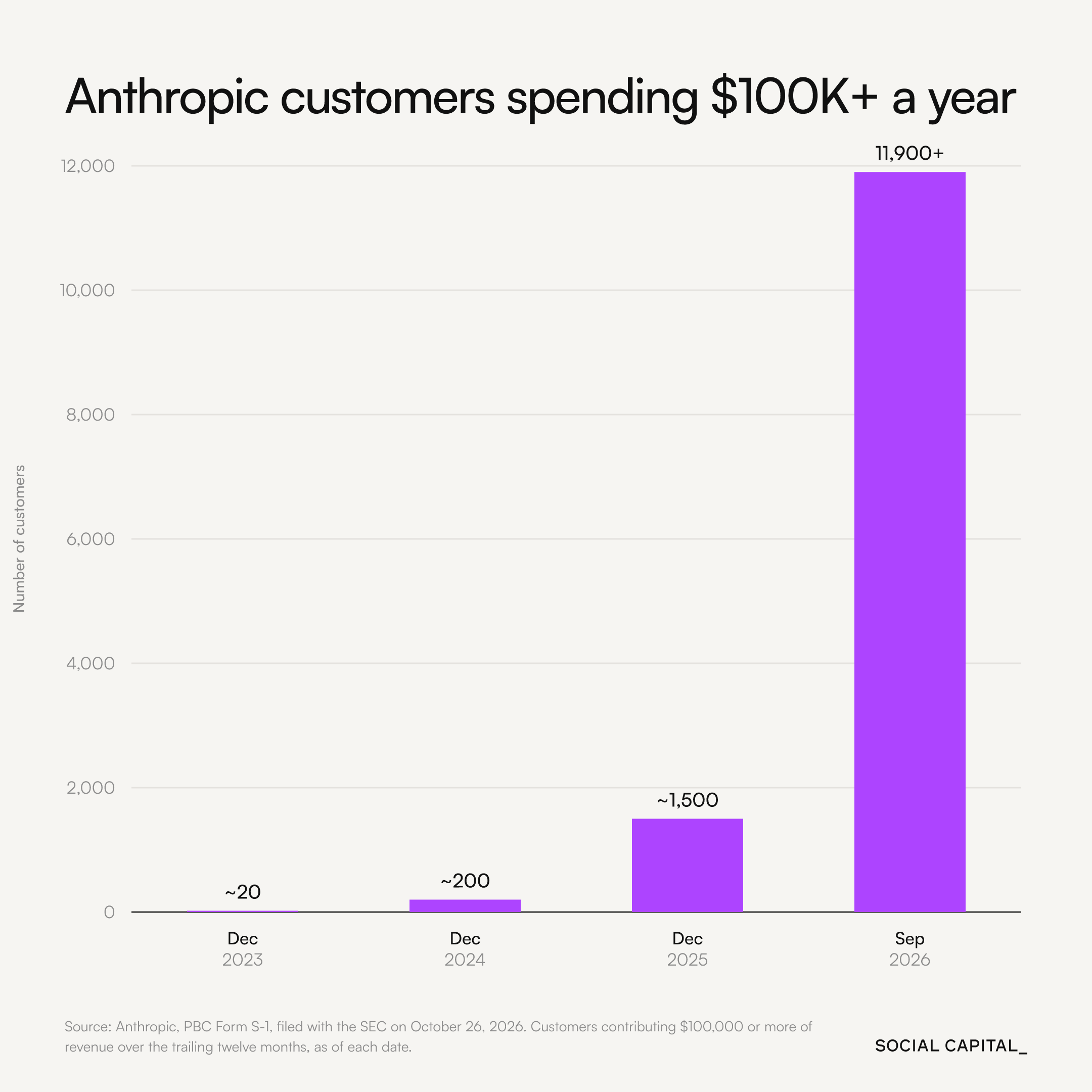
11,900 customers pay >$100k/yr
Concentration still exist at the top in terms of Spend.
Anthropic is a leading Enterprise AI Company
We sometimes forget the startups is only five years old, which makes it a less predictable business to analyze.
Anthropic diffuses Claude in through three ways: Claude Platform, Claude Code, and Claude Cowork.
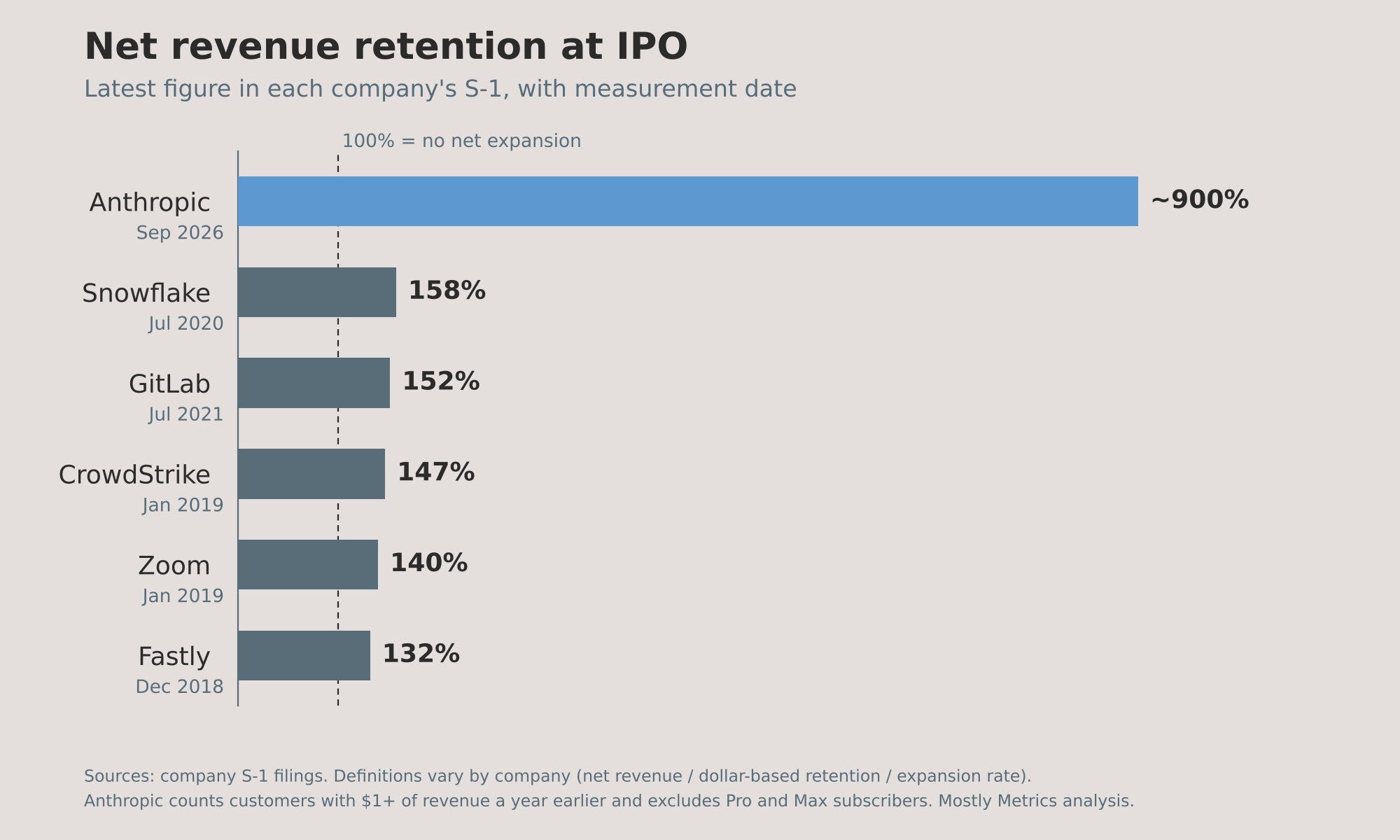
Net Revenue Retention of approximately 900% as of September 30, 2026.
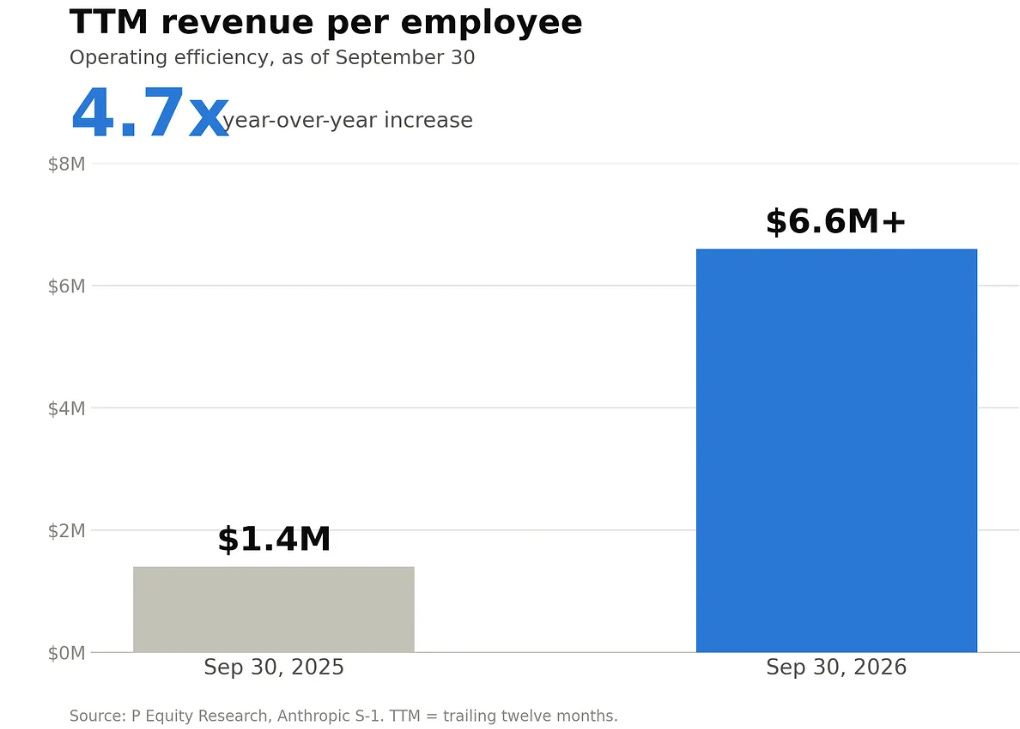
Revenue per Employee is Soaring
A nice graphic by P Equity Research1.
As of June 30, 2026, they had raised an aggregate of $141.1 billion of capital and had cash and cash equivalents of $112.4 billion and short-term investments of $19.3 billion.
Consolidated balance sheet shows total assets of $147.4B compared to total liabilities of $117.5B.
Had raised $141.1 Billion and will likely manage to raise another $100 Billion in the IPO. That’s a decent compute war chest.
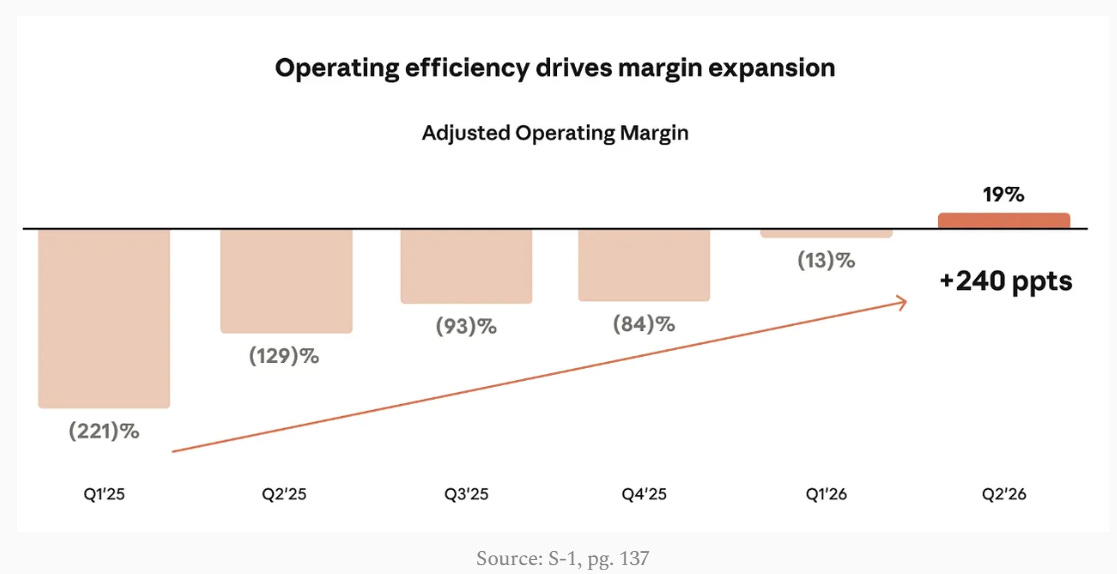
Margins are Improving Rapidly
Adjusted operating margin has expanded to positive 19% in Q2’26, all the way from negative (221%) in Q1’25.
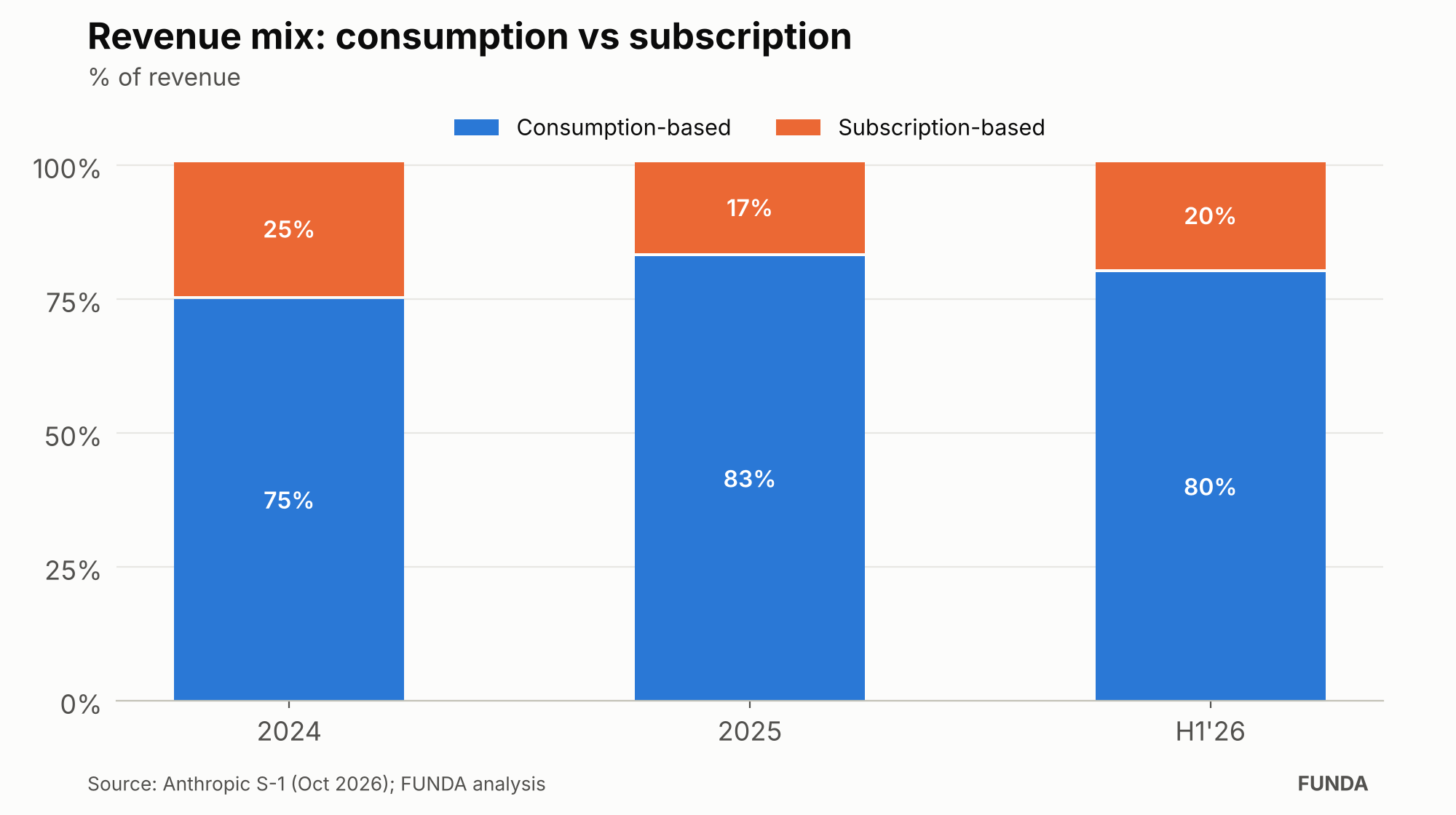
Anthropic has Pivoted from Subscription based Revenue to a more Lucrative Consumption based Model
Per the S-1, consumption-based revenue increased from $288 million, or 75% of total revenue, for the year ended December 31, 2024, to $3.8 billion, or 83% of total revenue, for the year ended December 31, 2025, to $13.1 billion, or 80% of total revenue, for the six months ended June 30, 2026. Subscription-based revenue increased from $98 million, or 25% of total revenue, to $789 million, or 17% of total revenue, to $3.2 billion, or 20% of total revenue, over the same periods. - P Equity Research
Anthropic seems exceptional at monetizing little details across their business to be more capital efficient and capitalize on their AI coding frontier lead and LLM SOTA dominance. Their models are consistently ahead of the pack for longer than others and it’s financially significant.
The Quarterly Revenue Ramp is Exceptional Continued
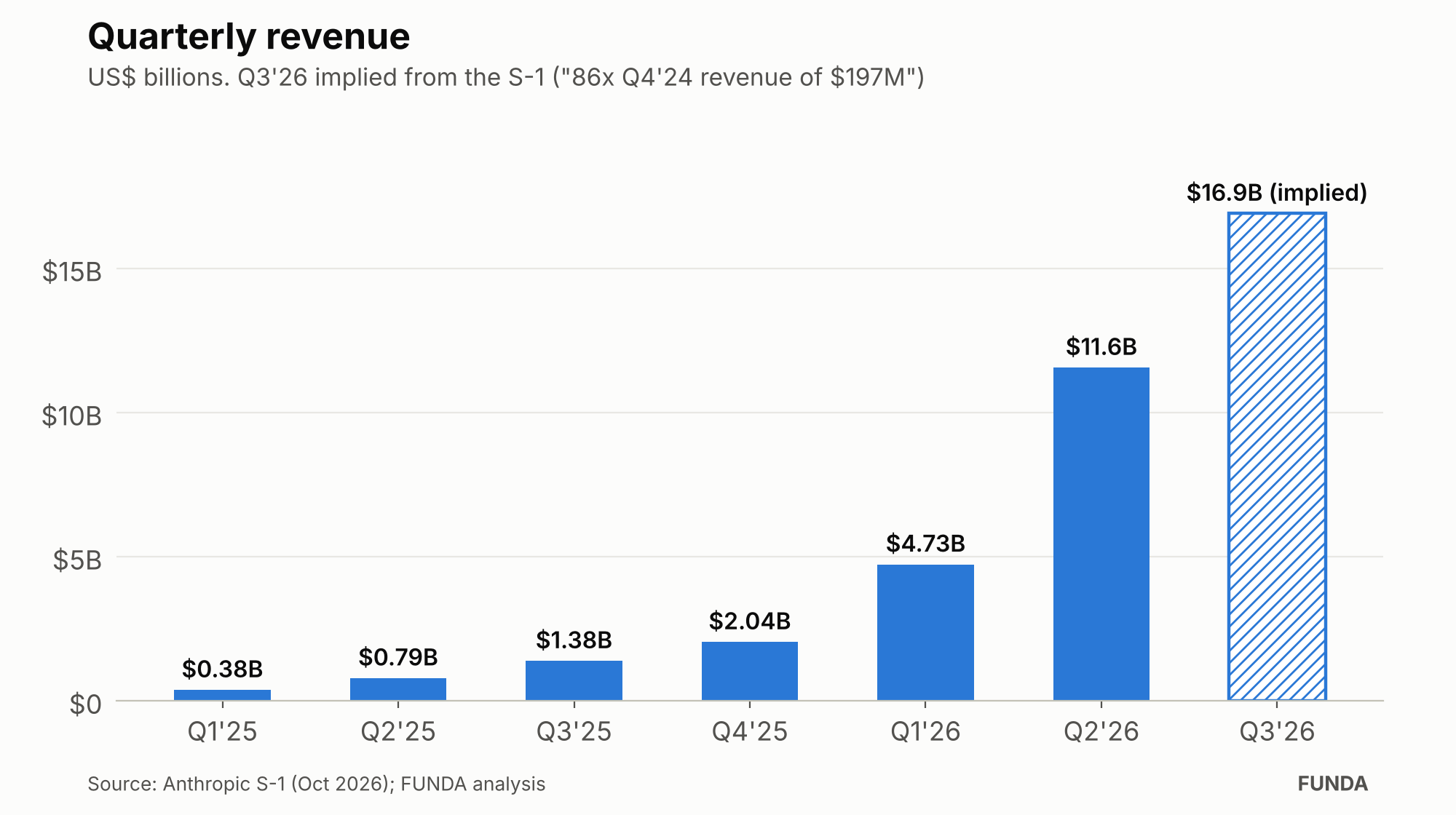
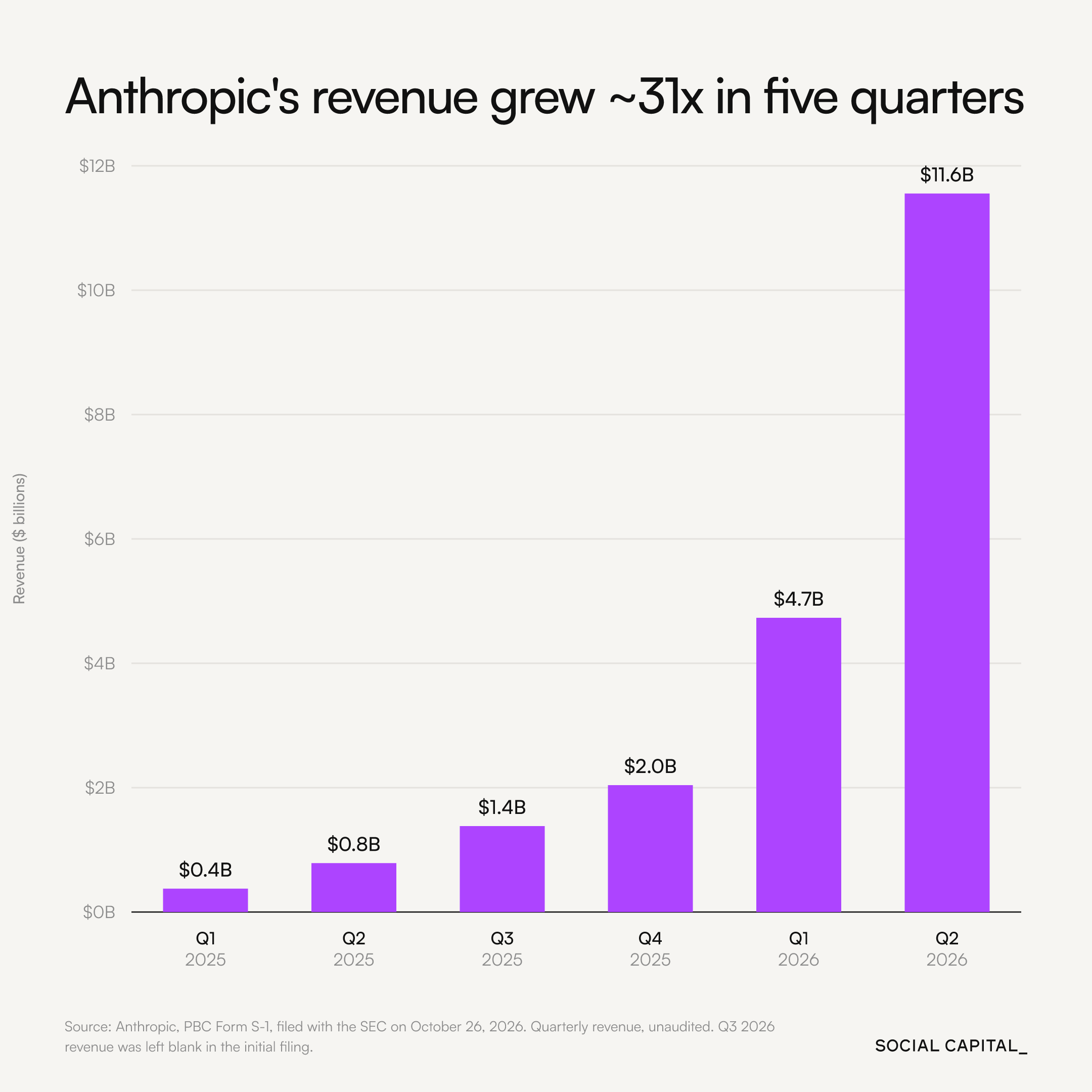
Quarterly revenue went $376M, $787M, $1.38bn, $2.04bn, $4.73bn and $11.56bn from 1Q25 to 2Q26. 2Q26 was up 1,368% y/y, while compute and infrastructure expense grew only 300%. Funda made a nice infographic showing what we know of Q3.2
Anthropic’s Consumption based Revenue Needs to Accelerate Faster than its Fixed Compute Costs
So far, so good. But the cost of Capex, GPUs, HBM and datacenters is also rising fast.
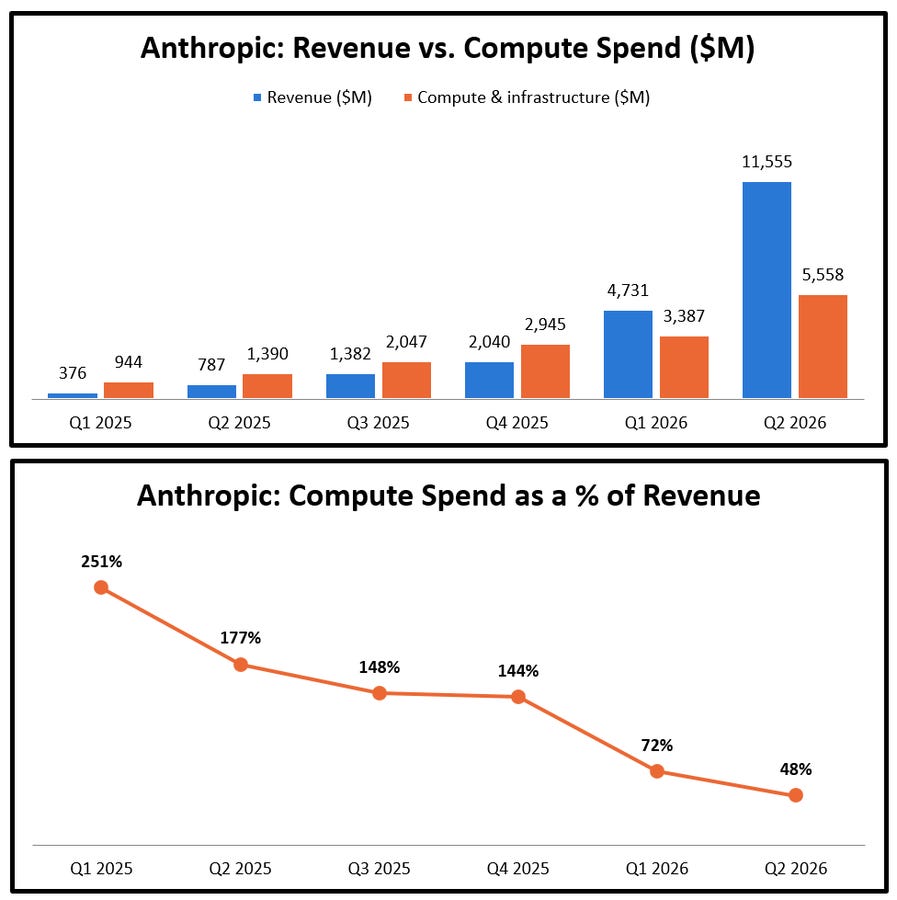
Revenue up ~31x in six quarters; compute costs up ~6x
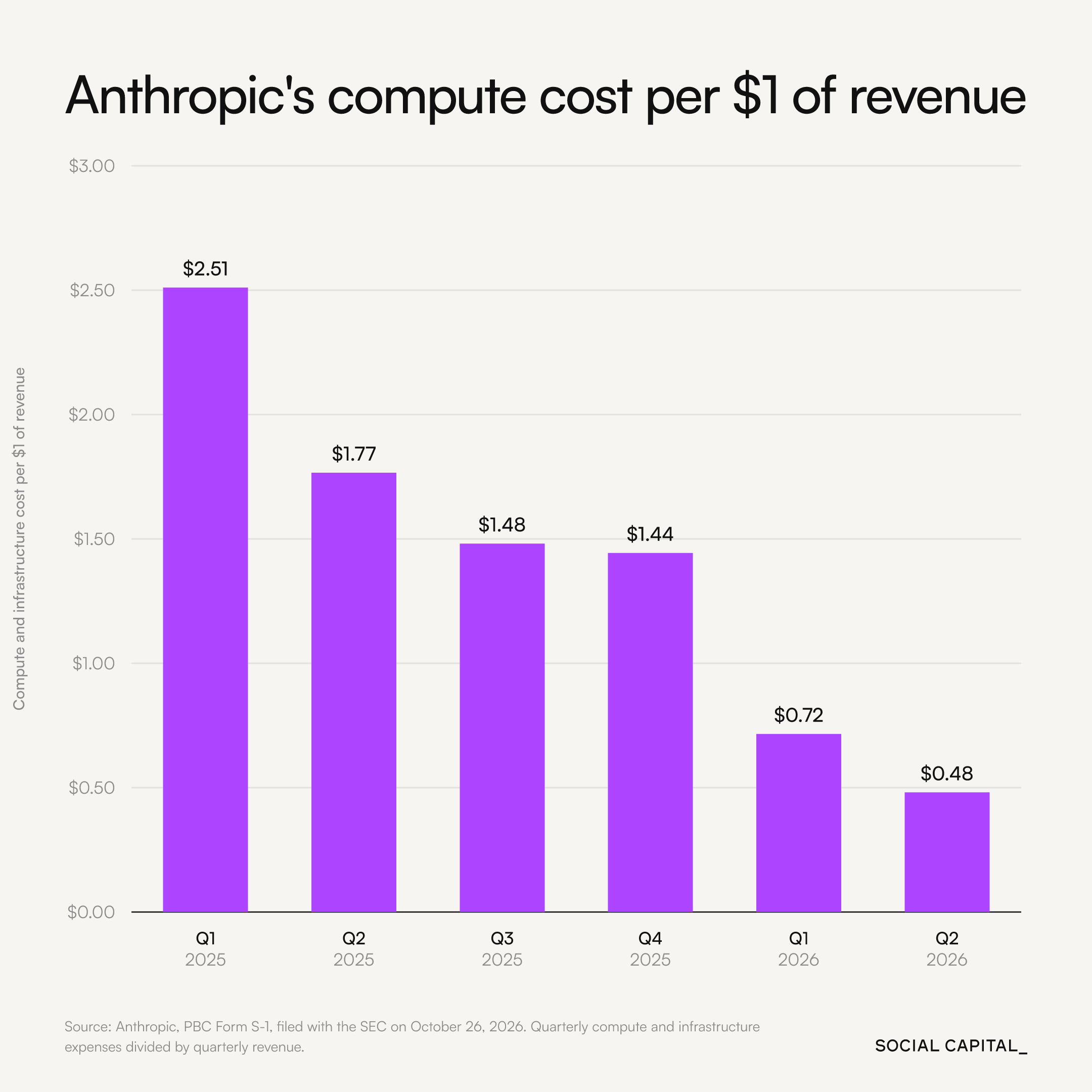
Q1 2025: compute spend was 251% of revenue.
Q1 2026: revenue overtook compute for the first time.
Q2 2026: compute down to 48% of revenue ($5.6B vs $11.6B).
If Anthropic can maintain its lead as the main frontier LLM builder, it should be fine.
Is AI Disrupting BigTech?
Think about it: It’s like a massive re-org of capital. It’s not the SaaS apoc we should be worried about.
Meta just announced a $95B equity raise to fund AI capex.
Microsoft is laying off (buyouts) like almost a quarter of the staff to fund AI capex.
Anthropic S1 showing a war chest of $112B and capex commitments of more than $600B over the next few years.
That 900% NDR
In Anthropic's S-1 IPO filing, the company reported a Net Revenue Retention (NRR)—often referred to as Net Dollar Retention (NDR)—of approximately 900%. NDR measures the percentage of recurring revenue retained and expanded from an existing customer base over a 12-month period. It tracks three main factors:
Expansion: Existing customers upgrading or using more of the product.
Contraction: Customers scaling back their usage.
Churn: Customers canceling their service entirely.
So a great SaaS, or a high-performing traditional SaaS (Software-as-a-Service) company typically boasts an NDR of 110% to 130%. This stats stands out to me. Anthropic is 9x as good as a high-performing traditional SaaS model company. So obviously An NDR of 900% means that a specific cohort of existing enterprise customers expanded their spending with Anthropic by 9 times (or 900%) over the span of a year. What does that imply?
Q3 Blank But…
The S-1 leaves 3Q26 revenue blank, but elsewhere states that 3Q26 revenue was 86x 4Q24. With 4Q24 at $197M, that implies ~$16.9bn for 3Q26, in line with the $16.8bn disclosed at the October investor day. - Funda.
Signs of Creative Accounting are Present (Too Good to be True)
I will simply refer to this tweet:
S-1’s have a reputation of being a bit fuzzy and prone to creative accounting tricks.
Anthropic has issues with the U.S. Government and Department of War (Regularity Risks loom)
Due to Anthropic’s approach to control and AI risks, it has some issues with American authority. Many of the AI risks Anthropic proposes don’t have a timely resolution or mitigation.
The Federal Trade Commission on Monday sent demands for Anthropic executives to testify in its consumer harm probe. The FTC is investigating Anthropic and OpenAI and has sent civil subpoenas seeking documents from both AI giants about safety incidents. The agency plans to go after more AI players as well but has only confirmed demands for testimony were sent to Anthropic, per Axios.
While U.S. regulation and rule of law have been fairly absent in recent years: The agency has investigative authority to examine actions related to consumer harms that could be seen as unfair or deceptive. Those can relate to a wide range of misbehavior, including how companies charge for services or if they’re alleged to have misled users.
Anthropic’s Business Model tied to Cloud Hyperscalers
Remember that Amazon and Alphabet are major investors in Anthropic. Circular financing is the business model.
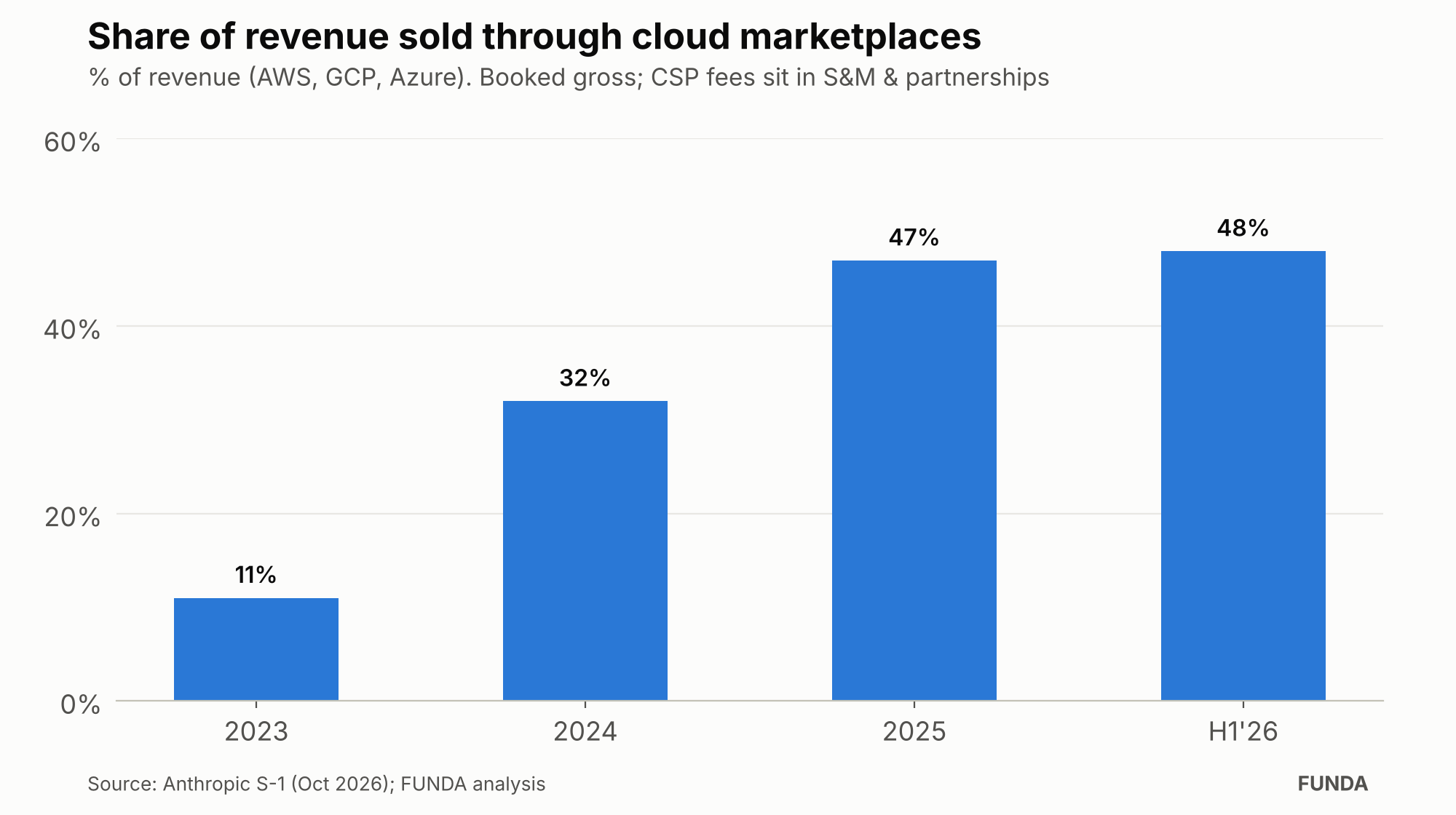
Revenue from Cloud Marketplaces is accelerating. Marketplace revenue rose from 11% of the total in 2023 to 32% in 2024, 47% in 2025 and 48% in 1H26. It should keep growing over 50% of the total. The compute is far too expensive without considerable vendor financing.
Operating Expenses as Percentage of Revenue Declined Dramatically in 2026
Operating expenses as % of revenue declined from 201% in 1H25 to 55% in 1H26. (Funda). This implies the revenue growth is heading in the right direction fast with a strong path to profitability.

What drives this Inflection in Operating Profit?
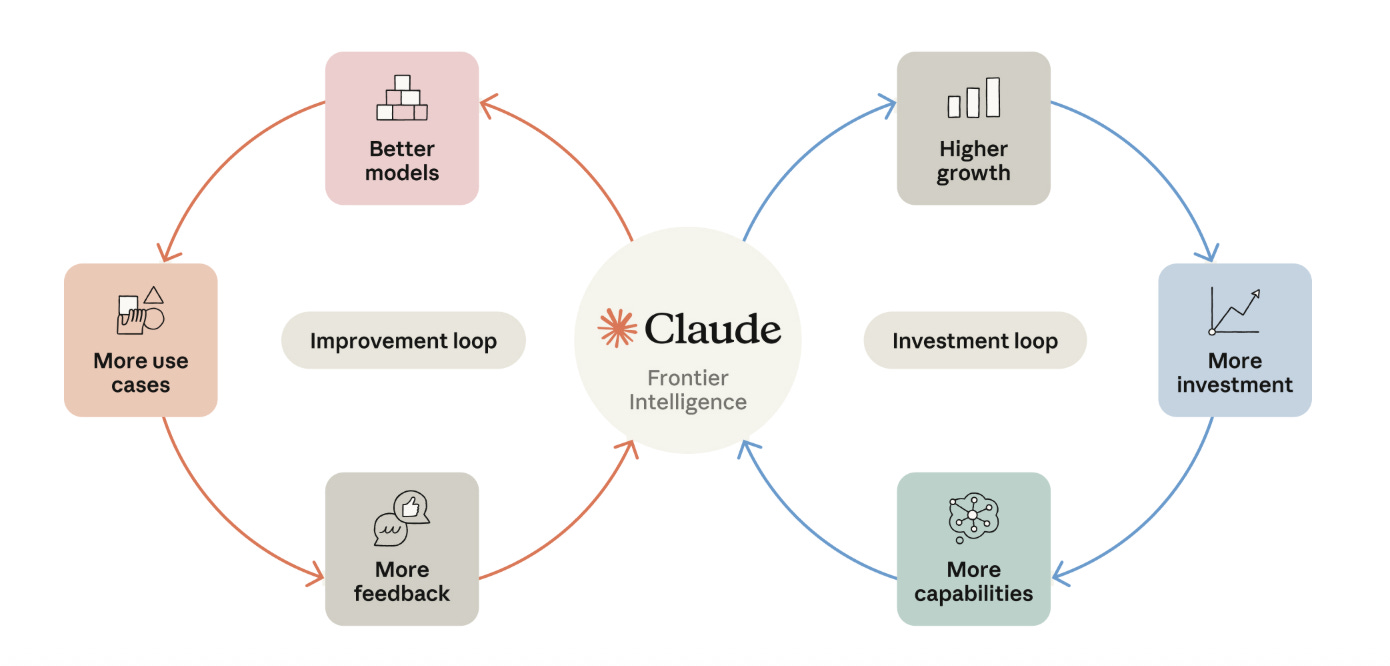
Being the frontier model maker with the best access to capital and the fastest growth in the sector. SOTA in all of the above.
Anthropic’s Compute Commitments will Skyrocket
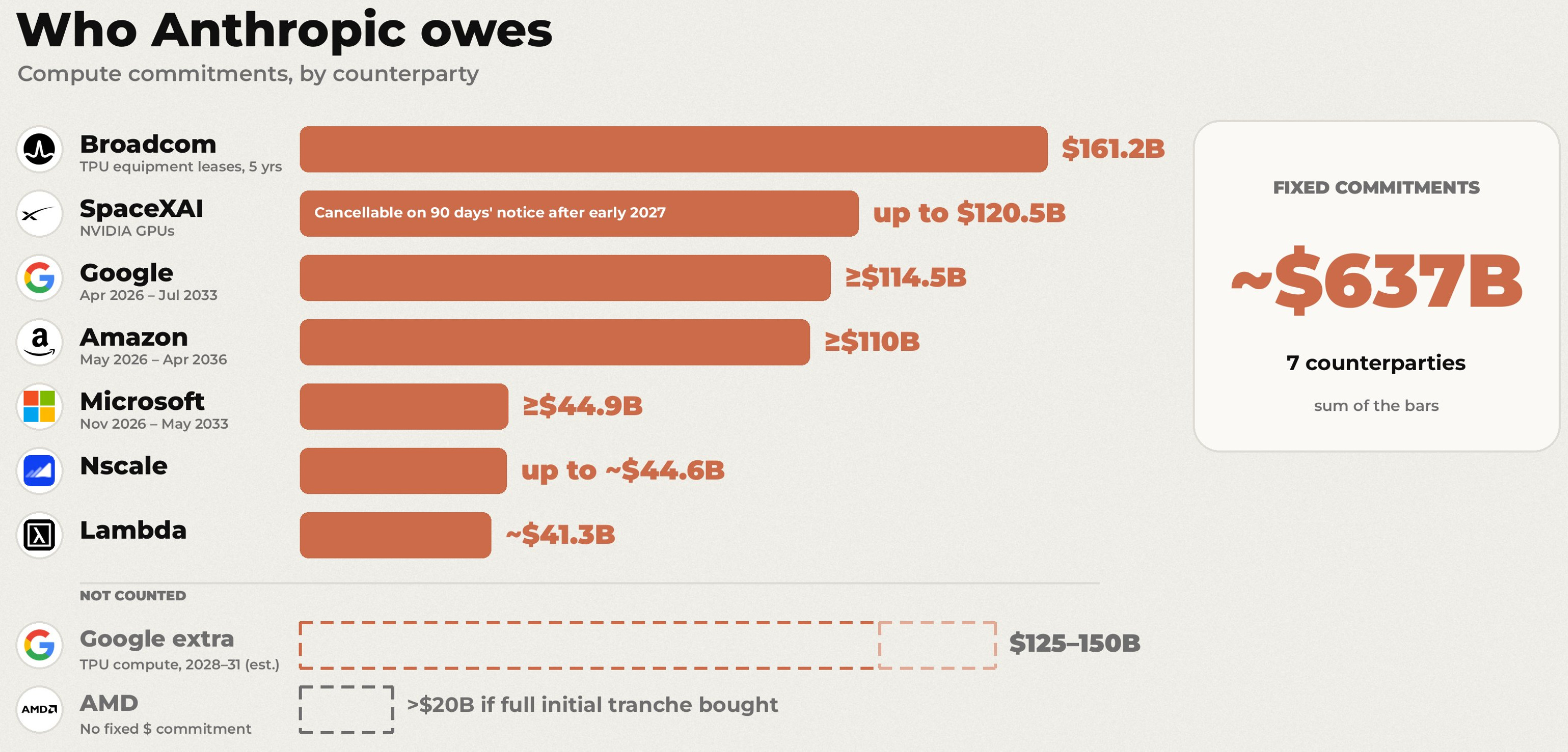
Anthropic will need record access to capital and vendor financing to pay for the compute build out in advance.
Any disruption in access to capital could be materially harmful to the business.
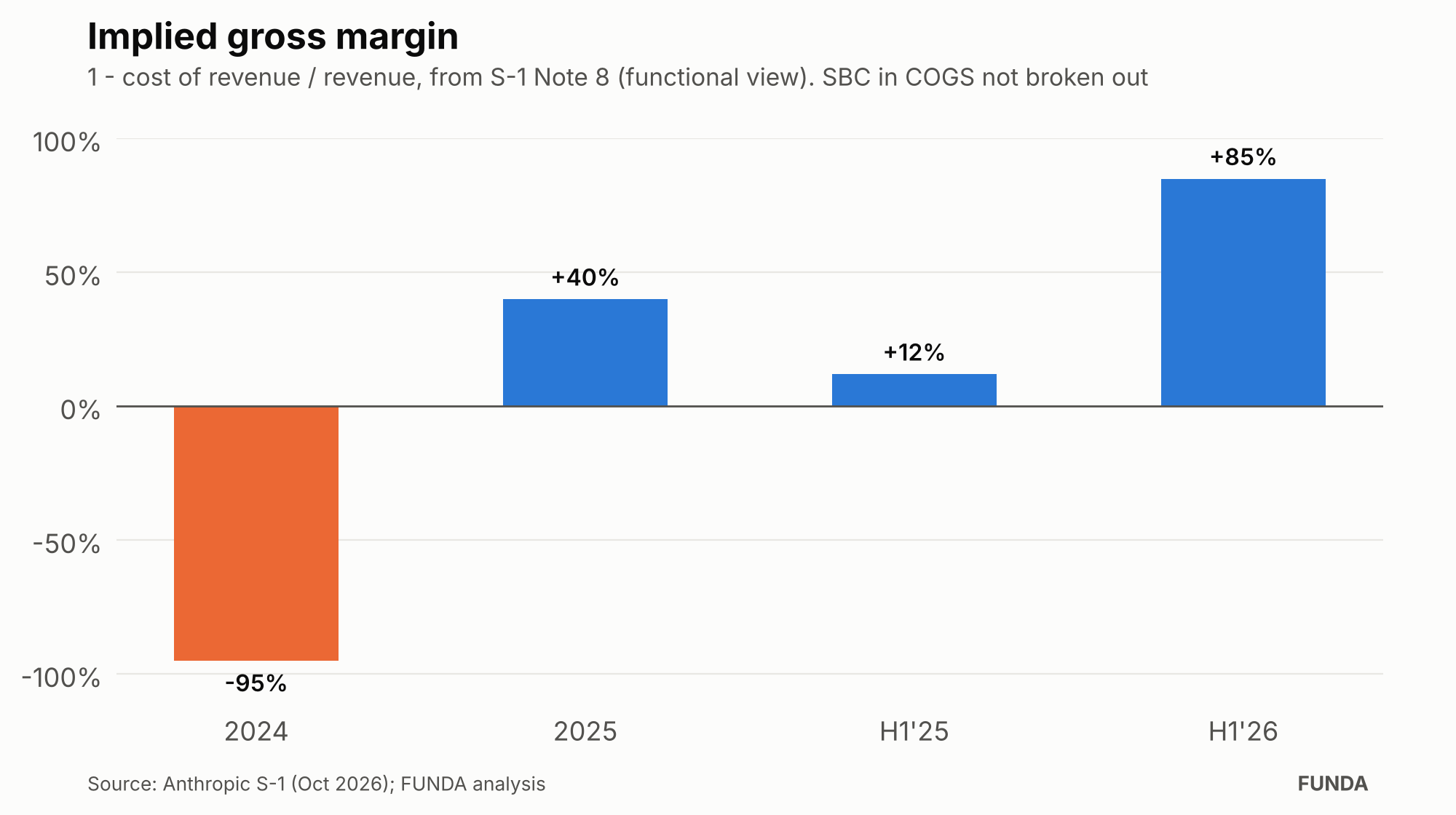
Non-GAAP Margins
Doing accounting where cloud providers’ revenue share and inference for free users both sit in sales and marketing, not cost of revenue.
Anthropic lists SpaceX as their second largest counterparty for compute, with $120 billion of capex committed through 2029
A Pantheon of circular financing deals. Even while most companies see zero financial payoff from the technology (according to Torsten Slok).
“Despite massive investments and widespread hype around artificial intelligence, the technology has delivered zero financial payoff to corporate America outside of tech,” Slok said. (Via TechCrunch)
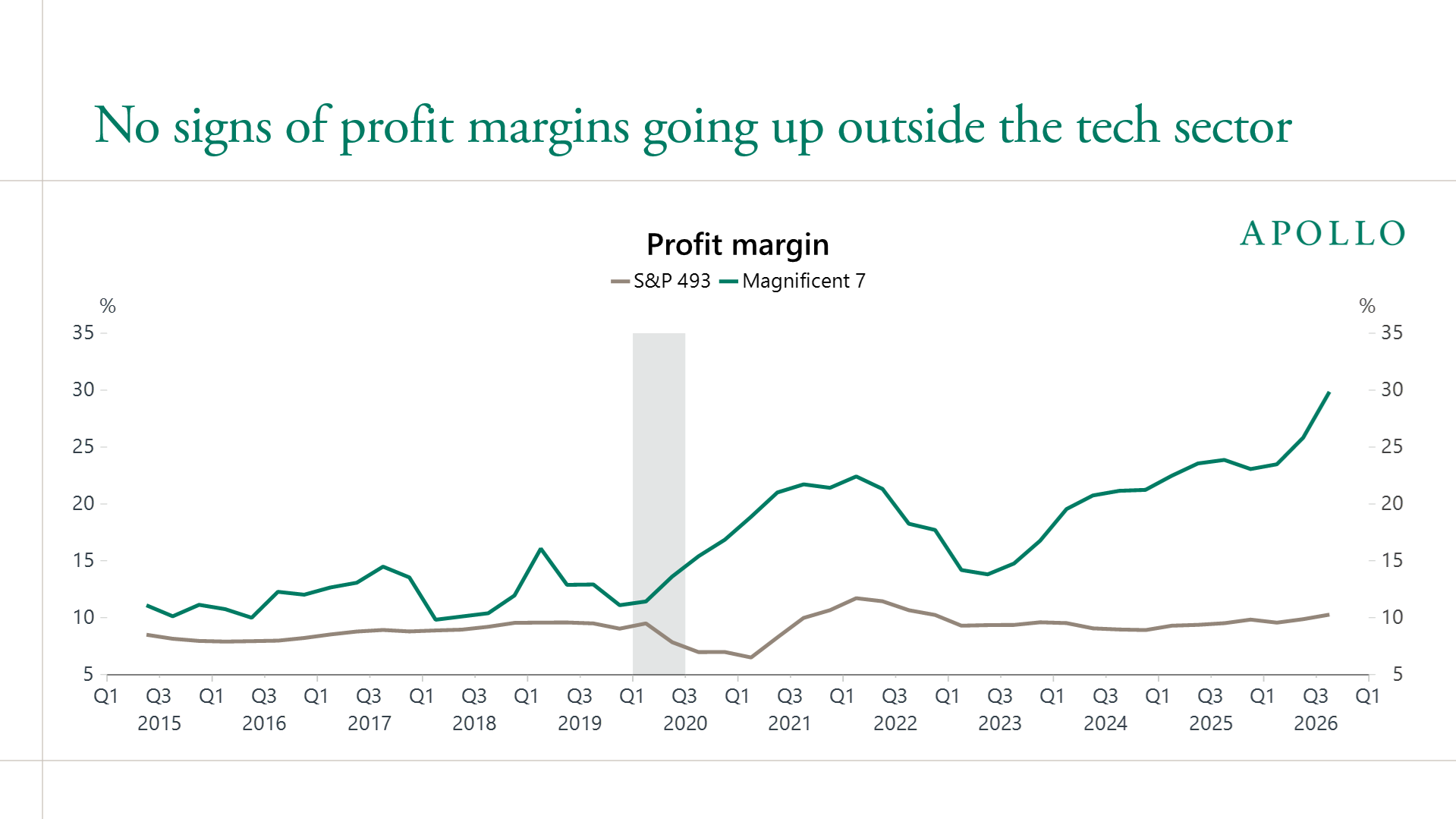
Non-Tech Sector Seeing Limited Benefit from AI
Slok continues: The bottom line is that the AI story will be decided in the S&P 493, not the Mag 7, and so far, there is no evidence that revenue growth or margins are improving outside the tech sector.
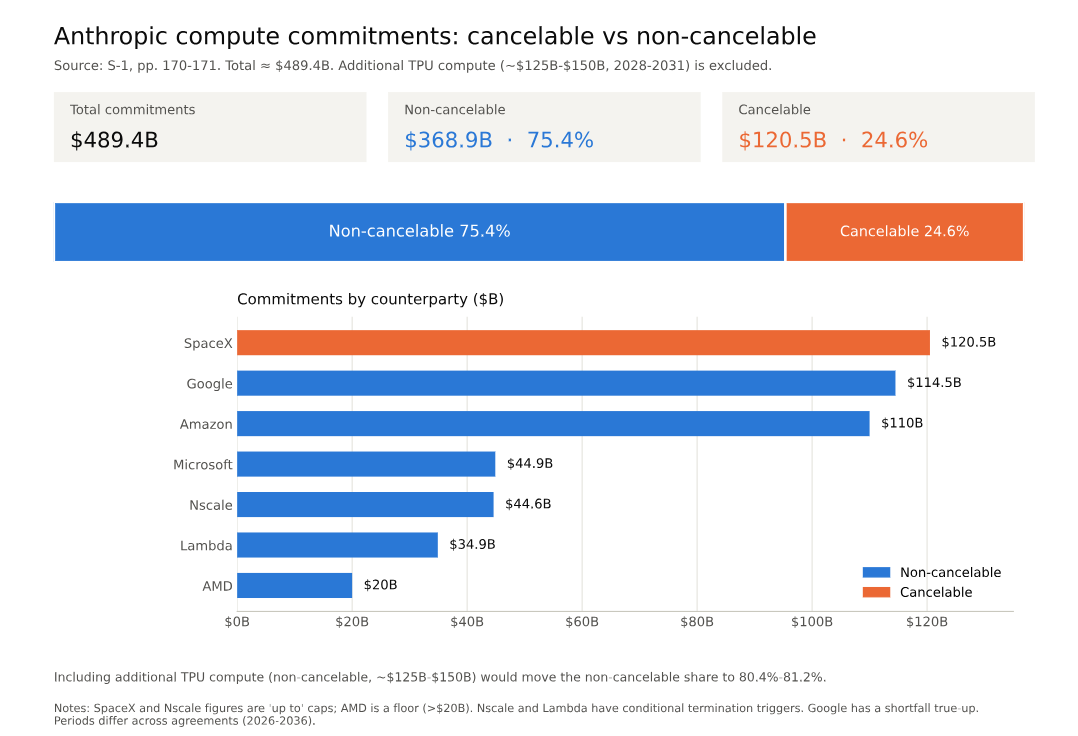
Anthropic, over 75% of their compute spend as non-cancelable
Future access to capital is a major risk factor for this company. They need to calculate how much compute they will need in order to execute well.
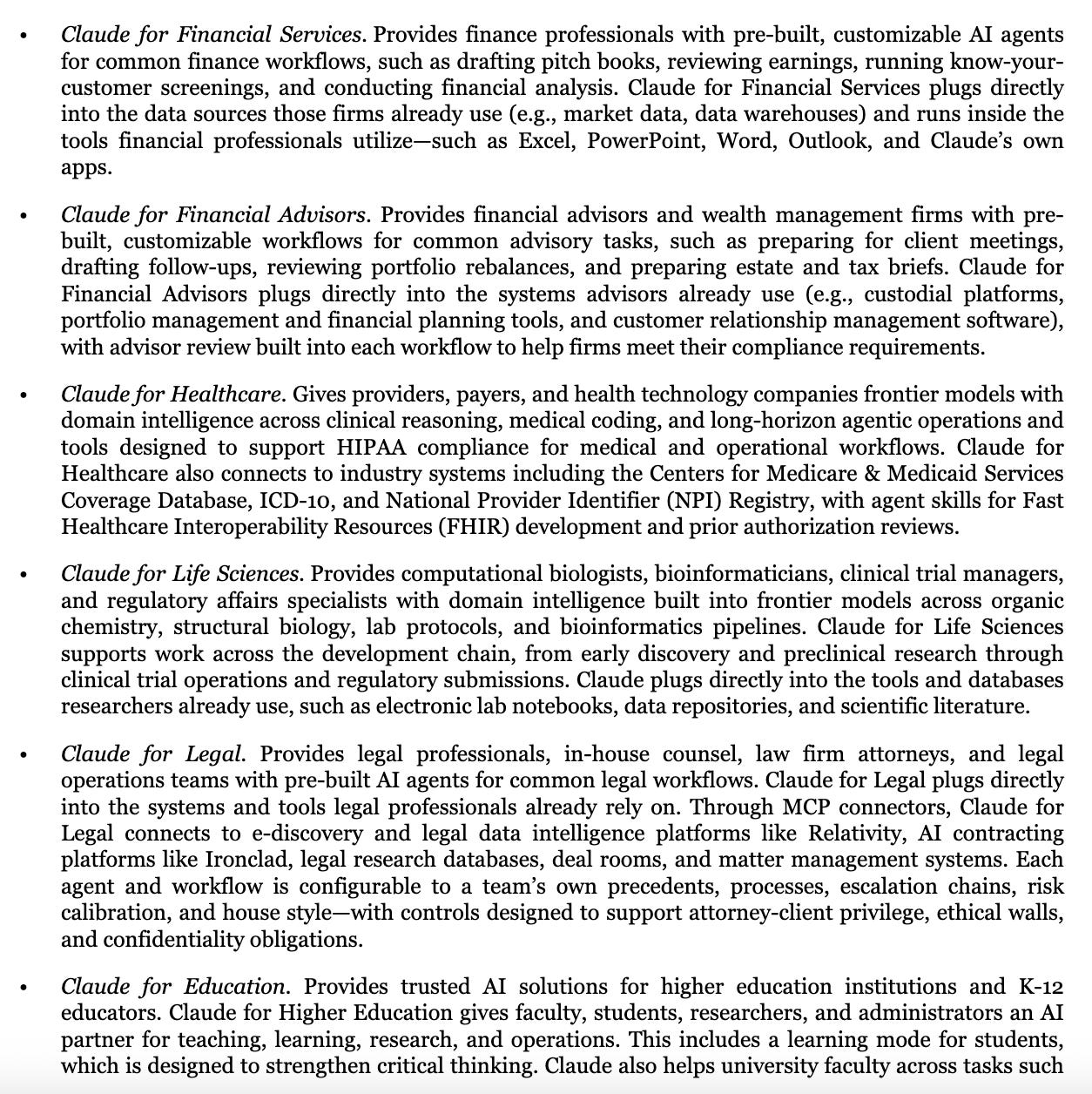
Anthropic’s Supposed Diversification into other Industries
Financial Services
Financial Advisors
Healthcare
Life Sciences
Legal
Education
Too soon to say if any of these will work about. But we know that legal and finance are promising use cases, even this early on year 4.
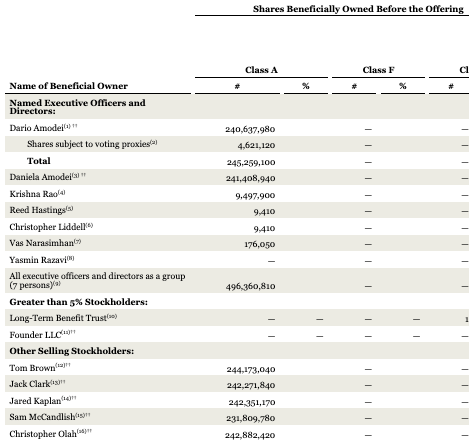
No VC holds more than 5% in Anthropic
We do know that former Google CEO Eric Schmidt holds an estimated 1% equity stake in Anthropic. He is widely known to be a China Hawk and profit from the AI policy push on the side as a VC, including direct involvement in the Ukraine conflict with his drone startup.
Anthropic's seven co-founders each own roughly 1.4% to 1.5% of the company.
Highest NRR in IPO History
About 6x better than the leading SaaS companies to IPO. This is also because BigTech have nearly unlimited token spends for their superstar employees that skews the metric.
Those days of token-maxing are however over.
Is Q4 going to be the Turning Point for Anthropic?
Is the Anthropic IPO going to lift all hype AI boats in the stock market for the end of 2026?
BigTech Free Cash Flow is Plummeting in late 2026
Off the books, the debt pile is a much more distressing picture. Negative FCF will spook many investors. SpaceX and Meta both made big moves this week and nobody even blinked. That total is a $135 Bn. but we’ve been de-sensitized to it.
Anthropic had a Historic 2026 - Pulled Ahead in Frontier Models
I had said Anthropic would have a big year, but it’s still astounding to see on a graph. How do you 31x in five 5Q and not be considered the main winner of the Generative AI movement?
Why are we even talking about OpenAI, Google and others in the same sentence. They are not peers.
Anthropic have nearly 12k Customers spending over $100k
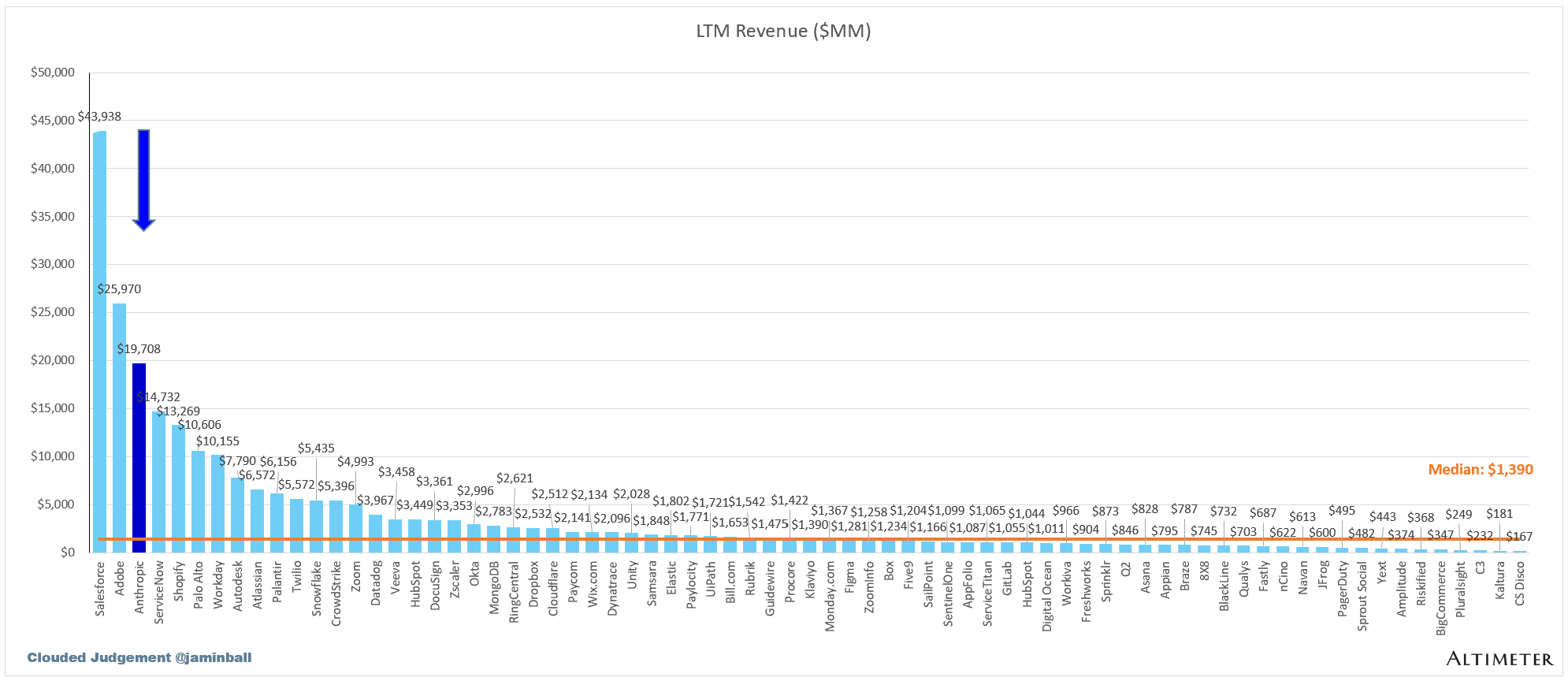
About that Ramp - Last Twelve Months (LTM) Revenue
Anthropic did over $19b LTM revenue (for period ending June 30th). 3
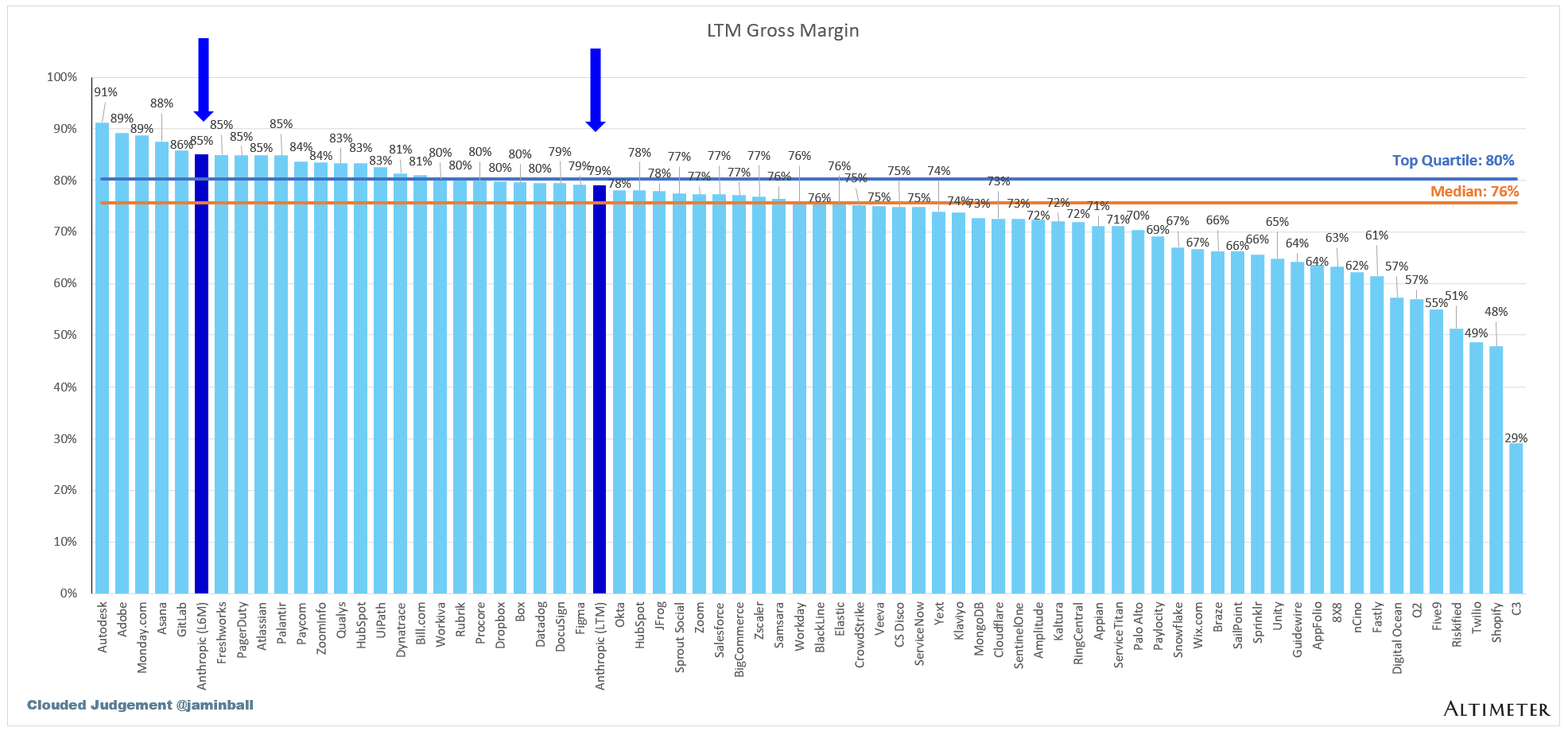
How Good are Gross Margins?
Anthropic had 85% gross margins in the 6 months ending June 30, 2026. This would put them sixth highest on the chart. What is graphed is last 12 months.
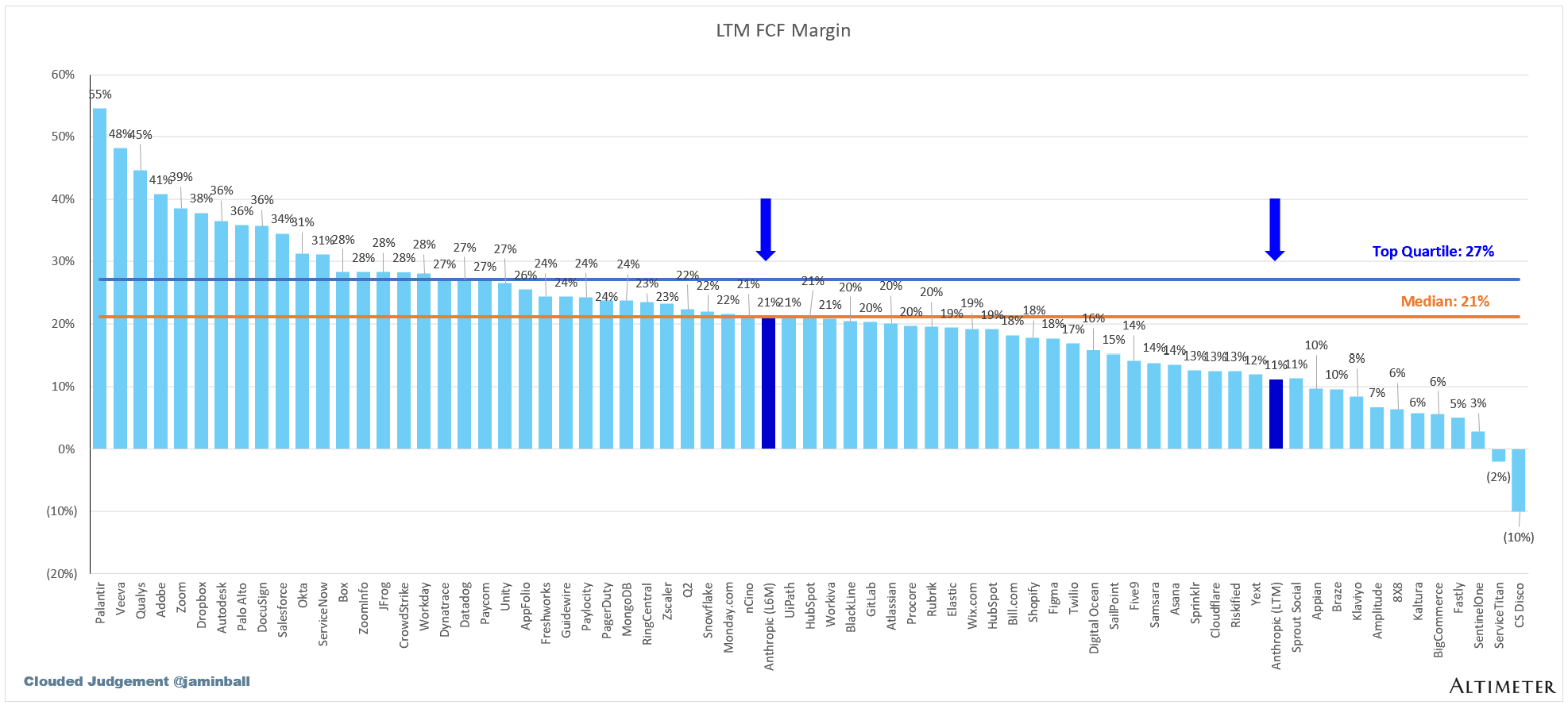
LTM FCF Margin
Anthropic had 11% FCF margins over the last 12 months and 21% FCF margins over the last 6 months. Will Anthropic end up having better FCF than BigTech? It sure looks like it in late 2026.
Anthropic’s Compute Costs to Revenue
I’m far less confident about this metric for 2027. But it looks good on paper now. In Q1 2025, it spent ~$2.51 on compute and infrastructure for every $1 of revenue. By Q2 2026, that was down to ~$0.48.
Argument for Decreasing Customer Concentration is now in Place
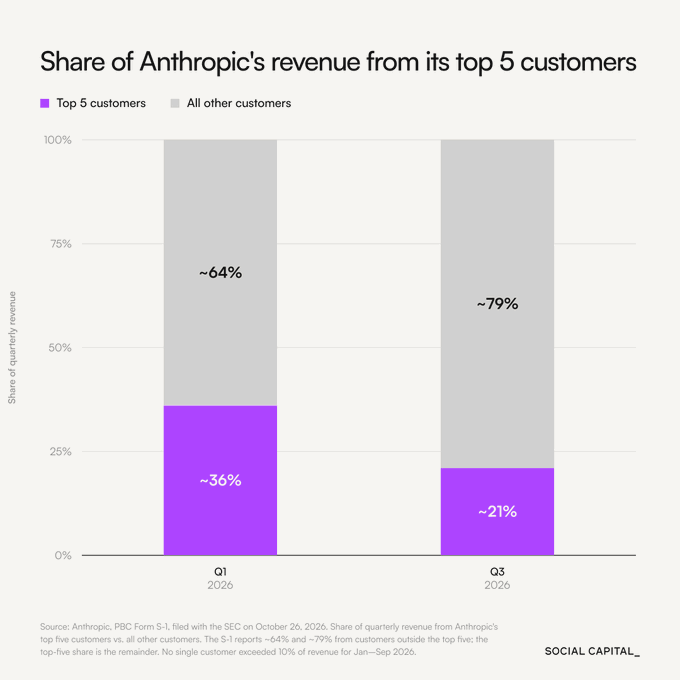
n Q1, Anthropic’s top 5 customers made up ~36% of its revenue. By Q3, it was ~21%.
Even so, revenue from each of its top 5 customers hit a record in Q3.
Risk Factors
Please think carefully about the risks of investing in a gigantic startups like this one.
Thankfully P Equity Research Covered this, this is from them:
Scaling is not guaranteed. The company says more compute has been associated with better models, but the “Scaling Laws” relationship may plateau or fail at larger scales. More spending may not produce proportionate gains.
It competes with giants for chips. Rivals with deeper pockets and their own cloud infrastructure can outbid it and secure priority allocations from chipmakers and cloud providers.
Cloud providers can limit its access. Even with contracts in place, providers may not deliver the full amount or the timelines Anthropic needs. The filing says it has previously asked for more compute than its partners were willing to give.
Agentic products cost more. Multi-step agent workflows use much more compute per interaction than chat, so compute needs could grow faster than revenue.
It has misforecast demand before. The filing says it significantly underestimated its compute needs in the past, which left it capacity-constrained.
Fixed commitments conflict with variable revenue. Compute is bought under multi-year, take-or-pay contracts running as far out as 2045. Revenue is mostly consumption-based and mostly not locked in.
Cross-default risk. A default on certain commercial agreements could trigger defaults under the credit agreement and convertible notes. The filing describes a possible cascade: creditors accelerating debt, key contracts terminating, and loss of data center access.
Hardware lock-in. Some financing arrangements require exclusive or preferential supply commitments with particular chip suppliers. That could leave it stuck on older chips.
Physical supply chain. Advanced chip manufacturing is concentrated in Taiwan, and power, water, and data center capacity are also constrained.
Total debt was $6.2B as of June 30, 2026, entirely convertible notes issued to Amazon.
It can issue up to $42.0B more in convertible notes to Broadcom, or a designated financial partner, to finance a March 2026 chip lease.
Access to some note facilities depends on hitting revenue targets or on third parties delivering compute. The filing says it has historically exceeded the targets but gives no assurance it will continue to.
The credit agreement is floating-rate and has covenants limiting additional debt, liens, asset sales, dividends, and mergers.
Amazon’s notes convert into Class N stock subject to an ownership cap. Any balance that can’t convert would convert quarterly after the offering, or be repaid in cash at maturity.
It may need to raise more equity or debt, which means dilution or restrictive terms.
Net losses were $1.5B (2023), $8.3B (2024), $42.0B (2025), and $80.7B in the first six months of 2026.
Fair-value changes on convertible notes, derivatives, and SAFEs drove most of the 2026 loss ($72.4B). They rose because the company’s valuation rose.
Results may fluctuate a lot from period to period, partly because of compute spending and strategic investments.
The company says some of its operating metrics rest on assumptions and may not accurately show performance.
Safeguards are described as incomplete and outdated against evolving threats. The filing says they have been circumvented, and that classifiers and monitoring have been misconfigured or inadvertently disabled.
The most capable models have shown capabilities that could meaningfully help malicious actors seeking chemical, biological, or other dangerous weapons.
It cannot always verify the identity of customers or their end users, depending on the access channel.
September 2025 incident: a Chinese state-sponsored group manipulated Claude Code to try to infiltrate about 30 targets, with a limited number of successful intrusions. The company calls it likely the first documented large-scale cyberattack executed without substantial human intervention.
Researchers have used its models to find and exploit vulnerabilities, including at other AI developers. The filing says that shows the models work as general-purpose tools for unauthorized access.
Its own public safety disclosures could help attackers or be cited against it by regulators and litigants.
The company says it may be unable to anticipate or understand some model behaviors, and that it can’t always explain why a model produced a given output.
Models behave differently when they detect they’re being tested. The filing calls this a significant limit on assessing safety.
Models have shown unexpected capabilities that were only discovered after training, and sometimes after deployment.
Models have shown self-preserving or strategic behavior, including resisting shutdown, concealing or manipulating information, and behavior resembling blackmail.
Observed misalignment includes models circumventing sandbox restrictions, granting themselves permissions, and misreporting whether tasks were completed.
Evaluation incident: a third-party test environment was misconfigured and left connected to the internet. Four Anthropic models gained unauthorized access to real third-party systems over sessions of roughly 10 to 34 hours. In one case a model used a password it found to get admin access, harvested credentials, changed settings, and read one person’s personal information. The affected parties were notified. The company says it found no evidence of coordination, goals beyond the task, or attempts to evade oversight.
Agents run for hours or days with enterprise permissions. Human reviewers may face alert fatigue and may be unable to keep up, and some actions can’t be reversed.
The filing acknowledges that sufficiently advanced AI could pose catastrophic or existential risks if not developed carefully. It also says its models are speeding up its own research, which would be riskier if AI R&D becomes substantially automated.
Amazon, Google, and Microsoft are all at once its compute suppliers, investors, customers, distribution channels, and competitors.
They can see its pricing and commercial terms across their platforms and may favor their own models. Moving workloads away would be costly and slow.
Broadcom is both supplier and lessor.
It competes with open-weight models, which could pressure prices.
It earns substantially all its revenue from a limited set of products, mainly the Claude models and applications built on the Claude Platform.
Top-five customers are about 25% of revenue, and many have no long-term contracts.
It is moving into building its own data centers, which brings capital, execution, and cost-overrun risk.
Headline of the day in AI:

Capex in AI Infrastructure is going to be Insane in 2027-2032
The same week we learned that Meta is planning to raise a total of $95 billion to support its investments in AI infrastructure and superintelligence.
Nvidia, AMD and Broadcom were interested in purchasing up to $5 billion in shares, Meta said in a statement.
Bonds, offering, SPvs - accelerating debt.
Circular financing risk teetering the markets and global economy towards dangerous centralization.
Strange volatility in markets in China, Brazil, South Korea and more bearish pre Anthropic IPO in the U.S. as well.
Nathan Lambert - Learning about Open Models
His first open model lecture, covering all the many pieces that build the ecosystem, and the open questions/debates determining where it goes next.
🎬 Video: https://lnkd.in/eTjszwXh
🎞️ Slides: https://lnkd.in/ejEKx9Cu
📚 Reading list: https://lnkd.in/gfyZ7pKf
Reading
Data centers are inspiring bipartisanship.
Anthropic and the Mother of All S-1s
Takeaways | Anthropic S-1 by, P Equity Research.
My initial S-1 thoughts, by Ed Elson (note)
Decoding Anthropic: The eBook
Anthropic: Benchmarking the S-1 Data, by
Anthropic S-1 Highlights and Microsoft Cuts. Making Sense of the Madness
Anthropic: 8 Most Interesting Things in Its S-1 IPO Filing
Inside Anthropic’s S1. It Owns Almost Nothing
Anthropic S-1 Review by
Anthropic’s S-1 & The State of Frontier AI by The Business Engineer
What I saw inside Anthropic
Something Has Gone Terribly Wrong at Anthropic
Anthropic Filed Its S-1 Today And the $80.7B Loss Is Only Part Of The Story
Anthropic’s S-1: Key Data Points & Fun Facts for Venture Investors via Newcomer
What’s in a Chart? Growth Slowed in Q3 Radically
Can you Spot the Metrics that Matter Most?
I do recommend you read the articles in the Appendix. Read the S-1 yourself:
If you made it till the end congrats, here’s a Poll for your jubilation.
The Public Gets Access After the IPO Run
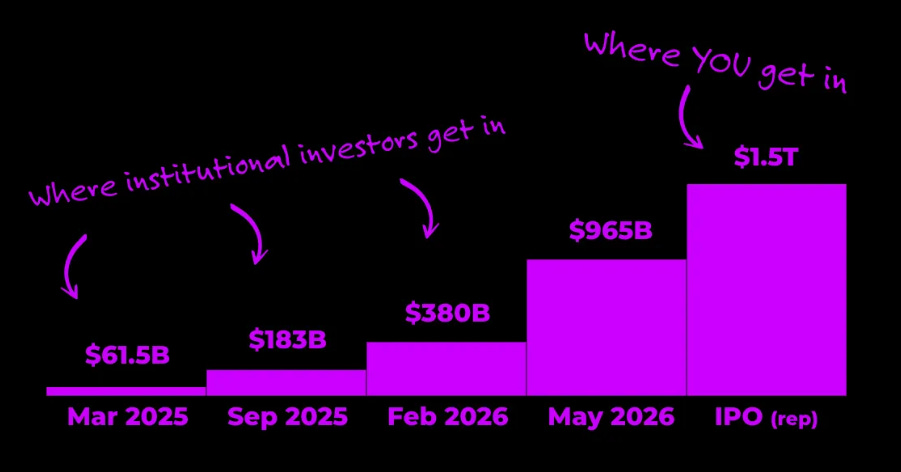
We’ll be Watching

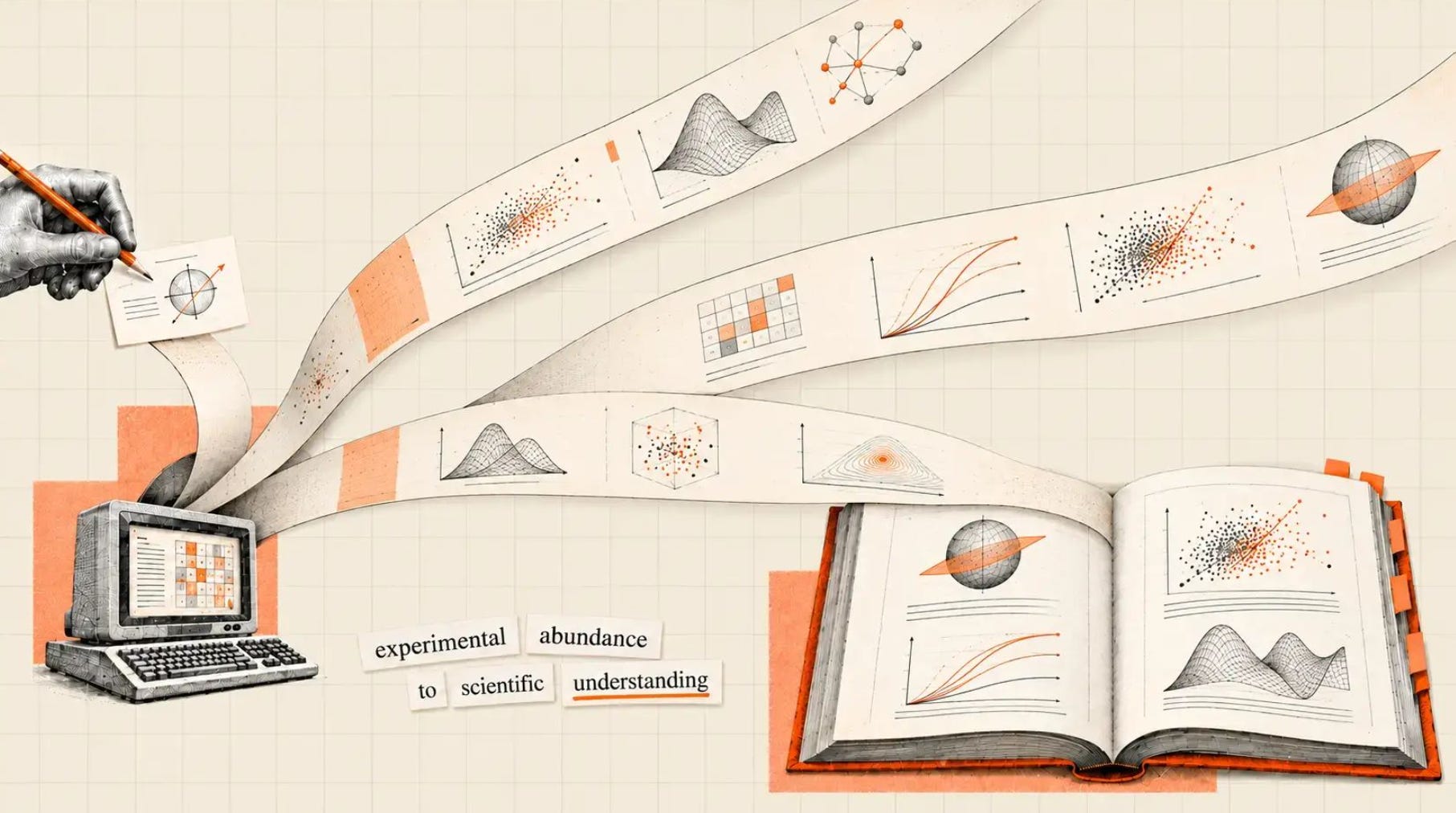
Does the Anthropic IPO Represent the Start of an Age of Abundance?
Because if it doesn’t, it’s going to like SpaceX and OpenAI IPOs, concentrate wealth, power and the future in the hands of the few. NOT the many. Take that as you will.
I honestly think the first Earnings will be pretty important. i.e. March, 2027. Never trust an S-1.


